Author
Success Stories
Publishing success looks different from the inside than it does from the outside. These are stories of authors who built real careers: the decisions they made, the obstacles they navigated, and the lessons that transfer.
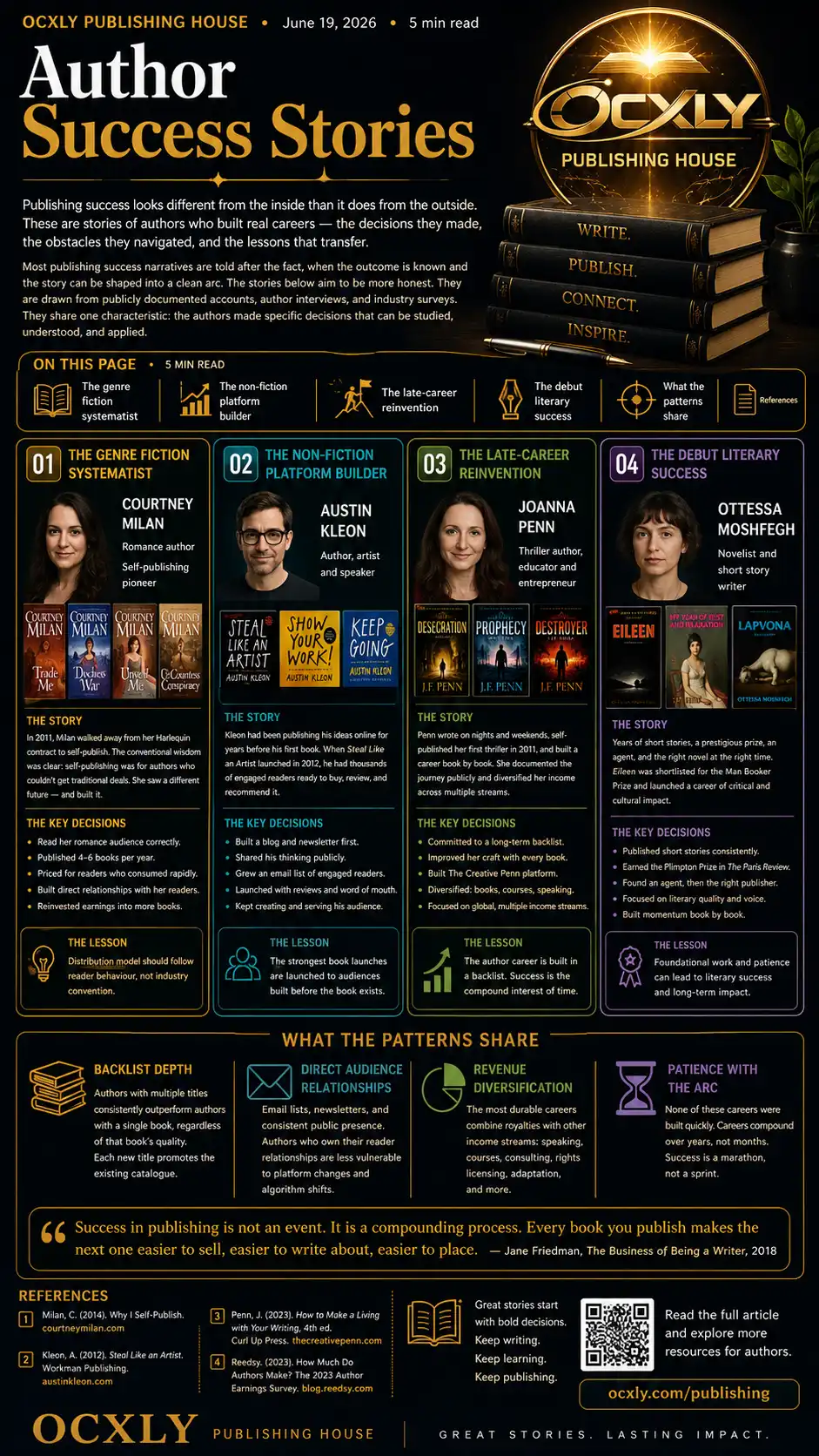
Most publishing success narratives are told after the fact, when the outcome is known and the story can be shaped into a clean arc. The messy reality (years of rejection, mispriced books, wrong category placements, failed launches, and pivots in the middle of a career) is usually edited out. What remains is an inspiring story that is also, in some ways, misleading.
The stories below aim to be more honest. They are drawn from publicly documented accounts, author interviews, and industry surveys. They share one characteristic: the authors made specific decisions that can be studied, understood, and applied.
The genre fiction systematist
When romance author Courtney Milan walked away from her traditional publishing contract in 2011, she did something most authors at the time considered career suicide: she self-published. She had sold her first books to Harlequin, had a readership, and was giving it all up to sell directly through Amazon. The conventional wisdom was clear, self-publishing was for authors who couldn't get traditional deals, not for authors who already had them.
What Milan had identified, before most of the industry did, was a structural shift in reader behaviour. Romance readers consumed books rapidly, sometimes multiple books per week, and the traditional publishing schedule of one or two books per year could not serve them. Self-publishing allowed her to publish four to six titles per year at prices readers in that cadence would find irresistible. By 2013 she was earning more from self-publishing than she had earned from her traditional advance deals, and with considerably more creative control.[1]
The lesson: distribution model should follow reader behaviour, not industry convention. Milan read her genre's audience correctly and restructured around what they actually wanted.
The non-fiction platform builder
Austin Kleon published Steal Like an Artist with Workman Publishing in 2012 after building an audience through his blog and email newsletter. The book sold 100,000 copies in its first year, extraordinary for a debut non-fiction title. It was followed by Show Your Work! (2014) and Keep Going (2019), each of which performed similarly.
The conventional account attributes this success to the books' quality and originality. That is true, but incomplete. Kleon had been publishing his thinking publicly for years before the first book appeared. He had an email list of engaged readers who were primed to buy and review the book the week it launched. The publisher provided distribution and production; Kleon provided a pre-built, warm audience. The combination was unusually powerful.[2]
The lesson: the strongest book launches are launched to audiences built before the book exists. The platform (the blog, the newsletter, the public thinking) is not ancillary to the writing career. It is its foundation.
The late-career reinvention
Joanna Penn spent her thirties in a career she found unfulfilling, writing on nights and weekends. She self-published her first thriller under the pen name J.F. Penn in 2011, before the market had fully absorbed what self-publishing could mean for a serious author. Her early books were imperfect; she improved them, wrote more, and built a backlist over several years. She simultaneously documented her experience publicly through a blog and podcast, The Creative Penn, that became one of the most listened-to author business resources in the world.
By 2015 she had left her day job. By 2020 she was earning a full-time income from a combination of fiction royalties, non-fiction books about the author business, courses, and speaking. Her income was genuinely diversified across formats, revenue streams, and international markets. She had published over thirty books.[3]
The lesson: the author career is not built in a single launch; it is built in a backlist. Penn's income did not depend on any single book; it was distributed across an entire body of work that grew in aggregate value over time.
The debut literary success
Ottessa Moshfegh's debut novel Eileen was shortlisted for the Man Booker Prize in 2016 and became a defining literary novel of the decade. Before Eileen, Moshfegh had published short stories in literary journals, including a story in The Paris Review that won the Plimpton Prize, a distinction that directly contributed to her agent finding her and her novel finding a publisher.
Moshfegh's path illustrates the traditional literary track at its most conventional: years of short-form publication, a prestigious award, an agent, a publisher, a book. But it also illustrates something less often discussed, the specific economic conditions of literary fiction success. Eileen was critically acclaimed; it was not, by genre fiction standards, a bestseller. Its success manifested as a long career, adaptation rights, and the platform from which Moshfegh's subsequent books (My Year of Rest and Relaxation, Lapvona) became cultural phenomena. The Booker shortlist was not the payoff; it was the foundation.
"Success in publishing is not an event. It is a compounding process. Every book you publish makes the next one easier to sell, easier to write about, easier to place."
— Jane Friedman, The Business of Being a Writer, University of Chicago Press, 2018
What the patterns share
Across these accounts, and across the broader data on author careers, several patterns emerge consistently:
- Backlist depth: authors with multiple titles consistently outperform authors with a single book, regardless of that book's quality. Each new title promotes the existing catalogue.
- Direct audience relationships: email lists, newsletters, consistent public presence. Authors who own their reader relationships are less vulnerable to platform changes and algorithm shifts.
- Revenue diversification: the most durable author careers combine royalties with at least one other income stream: speaking, courses, consulting, rights licensing, adaptation.
- Patience with the arc: none of these careers were built quickly. The Reedsy 2023 Author Earnings Survey found that authors who had been publishing for 10+ years earned a median income four times higher than authors in their first three years.[4]
Related reading
- How to Turn Expertise into a Published Book — the path many authors took.
- How to Market a Book on a Small Budget — how they found readers.
- Publishing Trends to Watch in 2026 — the market they're publishing into.
References
- Milan, C. (2014). Why I Self-Publish. courtneymilan.com. courtneymilan.com ↩
- Kleon, A. (2012). Steal Like an Artist. Workman Publishing. austinkleon.com ↩
- Penn, J. (2023). How to Make a Living with Your Writing, 4th ed. Curl Up Press. thecreativepenn.com ↩
- Reedsy. (2023). How Much Do Authors Make? The 2023 Author Earnings Survey. Reedsy. blog.reedsy.com ↩