The Art of
Book Cover Design
A book cover has approximately three seconds to do its job. It signals genre, promises emotional experience, and creates the desire to pick up the book. Here is how the best covers achieve all three.
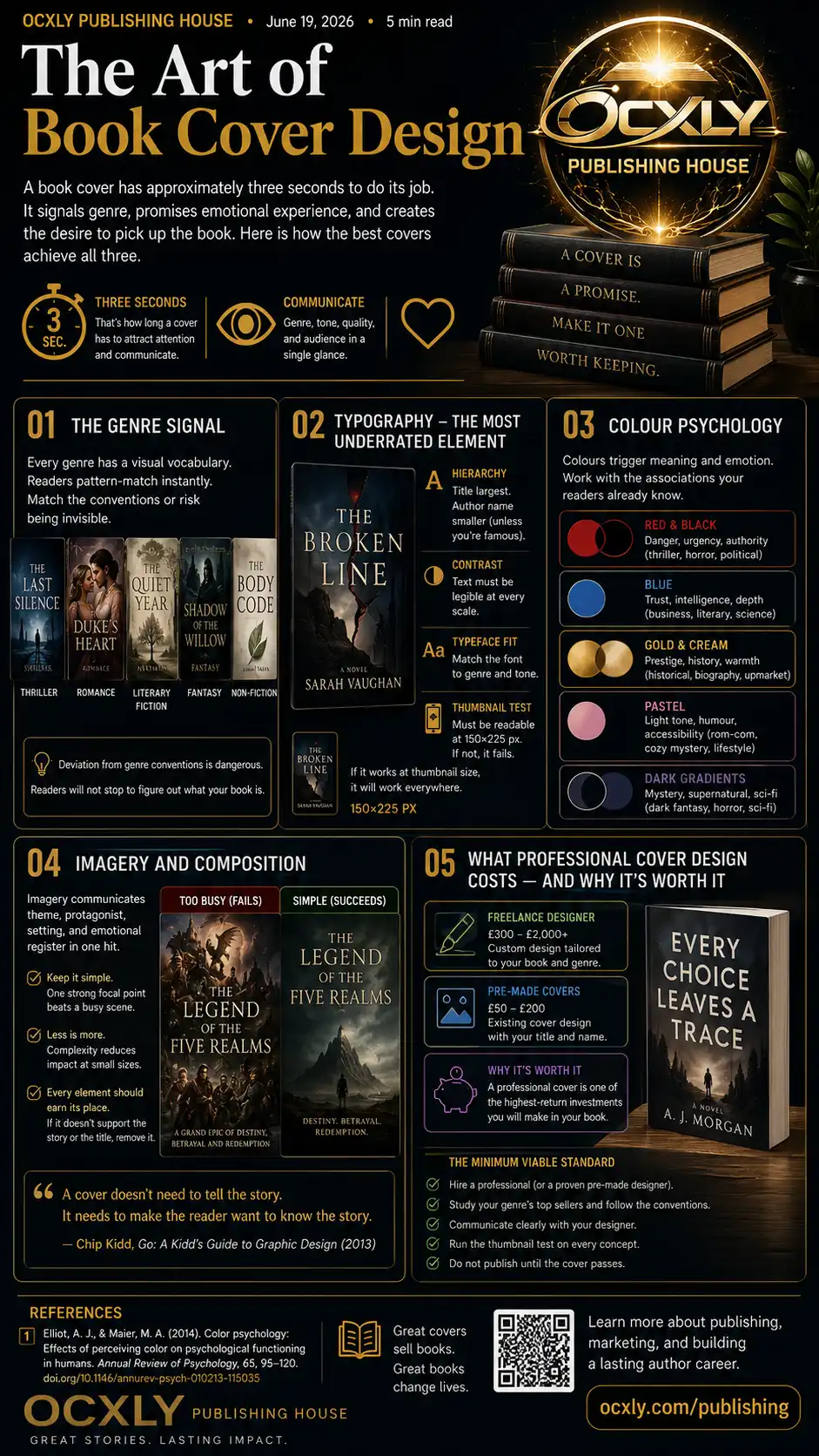
Readers absolutely judge books by their covers. This is not a failure of intellectual rigour; it is entirely rational behaviour. The cover is the most compressed communication a book can make: it signals genre, tone, quality of production, and intended audience in a single image. A reader browsing a physical shelf or a digital storefront has limited time; the cover's job is to stop them.
Understanding how covers work (the mechanics of typography, colour, imagery, and layout) is essential knowledge for any author making publishing decisions. Even authors who hire professional designers need to evaluate their designer's work intelligently and understand why one cover will outperform another.
The genre signal
The first and most important function of a book cover is genre signalling. Every genre has a visual vocabulary, a set of conventions readers have internalized through thousands of previous encounters. Romance covers feature people (typically in close physical proximity), warm or jewel-toned palettes, and script or elegant serif typography. Thrillers use high contrast, fragmented figures, cool palettes, and clean sans-serif type. Literary fiction favours abstract or metaphorical imagery, muted palettes, and minimal text.
Deviation from genre conventions is dangerous. An author who wants a "distinctive" cover that doesn't look like other books in their category is, in effect, making their book invisible to readers browsing that category. Genre-appropriate design is not a creative compromise; it is a marketing imperative. A thriller reader scanning Amazon's thriller bestseller list is pattern-matching against their prior experience of thriller covers; a book that doesn't match that pattern is filtered out before the title is read.
Typography: the most underrated element
Most authors focus on imagery when evaluating covers. Professional designers focus on typography. The title treatment (typeface, size, weight, letterform, colour, and placement) is in most cases the dominant visual element on a successful cover and the element most likely to fail on an amateur design.
Key principles:
- Hierarchy: the title should be the largest element, the author name smaller (for debut authors; established authors with name recognition may reverse this). The reader's eye should move from title to author name to any subtitle in a clear sequence.
- Contrast: text must be legible against the background at every scale, including thumbnail. Light text on light backgrounds fails at small sizes even when it appears to work at full size.
- Typeface fit: the typeface must be appropriate for the genre and the tone. Decorative script fonts are appropriate for historical romance and cozy mystery; they are catastrophic on political thrillers. Condensed sans-serif fonts feel urgent and modern; they do not belong on literary fiction.
- The thumbnail test: the cover must be legible at 150×225 pixels, the size at which most readers first encounter it on Amazon. If the title is unreadable at thumbnail size, the cover has failed at its primary online function.
Colour psychology
Colour carries meaning that operates below conscious processing. Research in environmental psychology and consumer behaviour has consistently demonstrated that colour associations influence purchase intent, perceived product quality, and emotional response.[1]
In book publishing, these associations are reinforced by convention:
- Red and black: danger, urgency, authority (thriller, horror, political non-fiction)
- Blue: trust, intelligence, depth (business non-fiction, literary fiction, science writing)
- Gold and cream: prestige, history, warmth (historical fiction, biography, upmarket fiction)
- Pastel palettes: light tone, humour, accessibility (romantic comedy, cozy mystery, lifestyle non-fiction)
- Dark gradient backgrounds: mystery, the supernatural, sci-fi (dark fantasy, horror, science fiction)
The practical application is straightforward: study the top twenty bestsellers in your category, identify the dominant colour palette, and work within it unless you have a very specific reason to deviate.
Imagery and composition
The imagery on a cover communicates theme, protagonist, setting, and emotional register simultaneously. Stock photography, custom illustration, and abstract design are all legitimate approaches, the choice depends on genre, budget, and the specific communication goal.
A common error is covers that try to do too much: a detailed scene with multiple figures, complex background, text overlay, and decorative borders. The covers that perform best are typically simple, a single strong visual element (a face, an object, a landscape fragment) with text and minimal additional elements. Complexity reduces impact at small sizes and creates visual noise that prevents the single emotional hit a cover should deliver.
"A cover doesn't need to tell the story. It needs to make the reader want to know the story. Those are very different briefs."
— Chip Kidd, Go: A Kidd's Guide to Graphic Design, Workman Publishing, 2013
What professional cover design costs: and why it's worth it
A freelance book cover designer on Reedsy charges between £300 and £2,000 for a trade cover depending on complexity and experience. A pre-made cover (a design already created, available for purchase and title customisation) costs between £50 and £200. The difference in quality is real but the difference in return is often not proportional, a well-chosen pre-made cover from a designer who understands genre conventions will outperform a bespoke cover that ignores them.
The minimum viable standard: hire a professional, study the genre conventions first, communicate those conventions to the designer, run the thumbnail test on every concept, and do not publish until the cover passes.
Related reading
- How a Book Goes from Manuscript to Bookshelf — where design fits the process.
- The Psychology Behind Bestselling Books — what makes readers pick up a book.
- How to Market a Book on a Small Budget — design as a marketing asset.