How to Market a Book
on a Small Budget
Most book marketing advice is written for authors with publisher backing and five-figure promotional budgets. This is not that. Here is what actually works when your budget is under £500, and why it works.
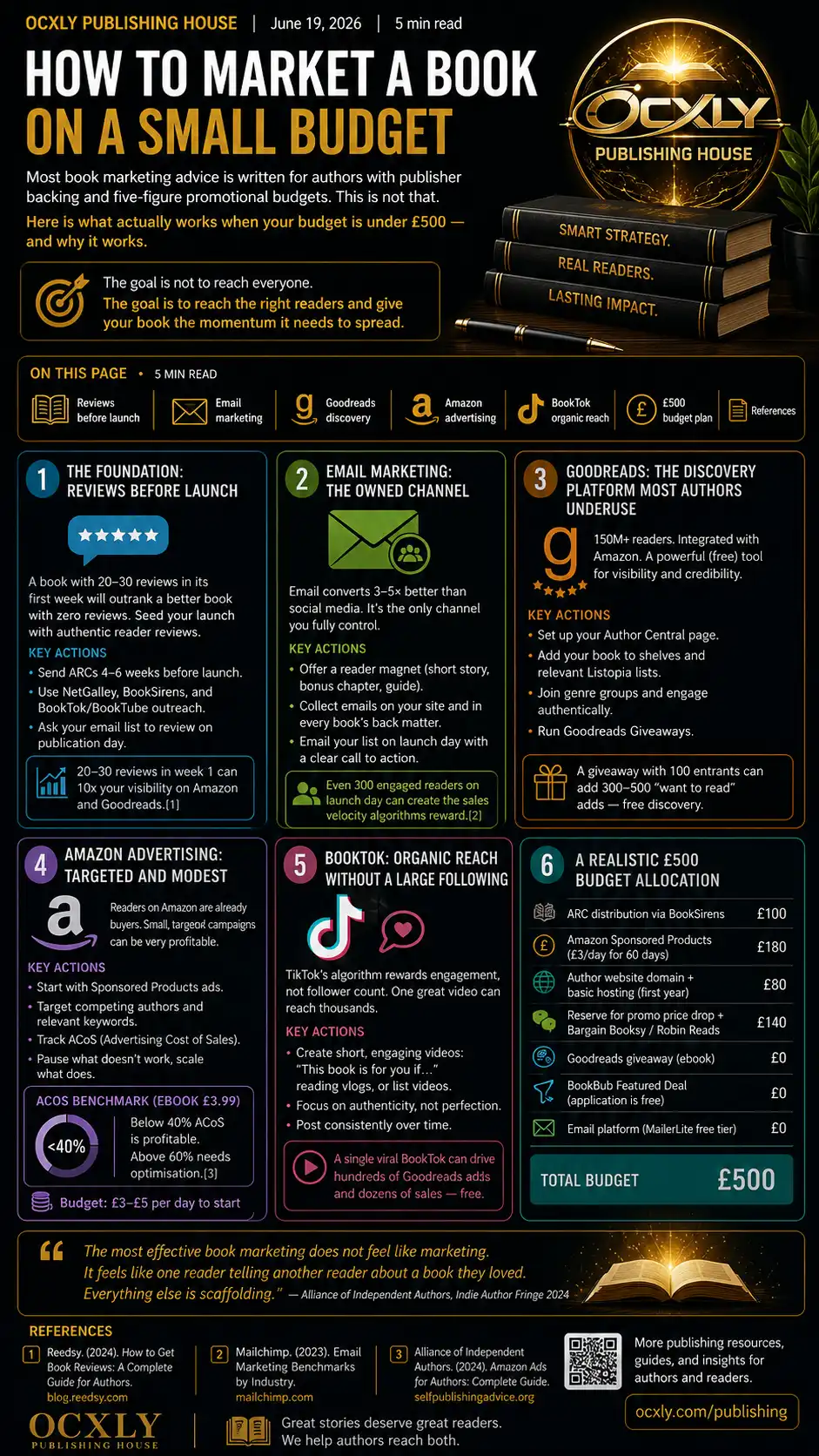
Book marketing is not synonymous with book advertising. Advertising is one tool within marketing, and for authors with small budgets, it is often not the highest-return tool available. The channels that drive the most book discovery for independent authors in 2026 are primarily organic: reader word-of-mouth, community recommendations, email marketing, and algorithmic discovery on retail platforms. Understanding how each of these works, and how to activate them with minimal spend, is more valuable than knowing how to run a Facebook ad campaign.
The foundation: reviews before launch
The single highest-return pre-launch investment is building a base of authentic reader reviews. Amazon's algorithm surfaces books to buyers based partly on review count and quality; Goodreads recommendations work similarly. A book launching with zero reviews starts in a deep hole from which organic recovery is slow.
The mechanism is an Advance Reader Copy (ARC) campaign. Four to six weeks before launch, send free digital copies of the book to readers who have agreed to post an honest review on publication day. ARC readers can be recruited from:
- NetGalley (paid service, £300–£450 for a 6-month listing, but effective for obtaining legitimate reviews from active book reviewers)
- BookSirens (lower cost alternative to NetGalley, £80–£120 per title)
- BookTok and BookTube community outreach, direct messages to genre-relevant creators with small but engaged audiences often yield genuine reviews
- Your existing email list, if you have one
A launch with 20–30 reviews in the first week produces significantly better algorithmic placement than a launch with 3 reviews.[1]
Email marketing: the owned channel
An email list is the only reader communication channel that an author fully controls. Social platforms change algorithms, reduce reach, ban accounts. An email list is permanent, portable, and converts to sales at a far higher rate than social media posts, industry benchmarks suggest email drives 3–5× the click-through rate of social media for book launches.[2]
Building the list costs nothing except time. A simple reader magnet (a free short story, a deleted scene, a companion guide) offered through the book's back matter and a basic author website, grows a list incrementally with every reader who finishes a book. The list is most valuable at launch: a coordinated email to 300 engaged readers on publication day creates the early sales velocity that Amazon's algorithm rewards with improved placement.
Mailchimp's free tier (up to 500 contacts) is sufficient to start. MailerLite offers a free tier up to 1,000 contacts with better deliverability.
Goodreads: the discovery platform most authors underuse
Goodreads has over 150 million members and is the primary platform where readers track what they have read, what they want to read, and what they recommend to each other. Its integration with Amazon means a book's Goodreads rating is surfaced on Amazon product pages. Yet most self-publishing authors treat Goodreads as an afterthought.
The high-return actions on Goodreads are free: setting up an Author Central page, adding the book to relevant shelves and listopia lists, participating in genre-relevant Goodreads groups as an authentic reader (not a promoter), and making the book available for Goodreads Giveaways (print giveaways cost roughly £30–£60 in book and postage costs, ebook giveaways are free). A Goodreads giveaway with 100 entrants typically results in the book being added to 300–500 "want to read" lists, shelf additions that drive ongoing organic discovery.
Amazon advertising: targeted and modest
Amazon Advertising (AMS) is the highest-converting paid advertising channel available to independent authors, because the audience is already on Amazon to buy books. A reader who clicks an Amazon ad for a book is a reader in a buying context. The equivalent click on a social media ad is a reader who was doing something else entirely.
A modest daily budget of £3–£5 on Sponsored Product ads targeting competing authors and relevant keywords is sufficient to test whether a book's cover and description convert at an acceptable rate. The critical metric is Advertising Cost of Sales (ACoS), the percentage of the sale price spent on advertising. For an ebook priced at £3.99 with a 70% royalty (£2.79 net), an ACoS below 40% (i.e., spending under £1.12 to generate each sale) is profitable. Most genre fiction with a strong cover and description achieves ACoS of 25–50% on well-targeted campaigns.[3]
BookTok: organic reach without a large following
TikTok's algorithm distributes content based on engagement, not follower count. A video on a BookTok account with 200 followers can reach 50,000 viewers if the engagement in the first hour signals quality to the algorithm. This makes TikTok structurally different from Instagram or Twitter, where reach is tightly correlated with follower count.
For authors, the practical implication: a single well-framed video (a "this book is for you if you like…" hook, or an aesthetic reading vlog, or a "books that destroyed me" compilation that features your title) can drive hundreds of Goodreads additions and tens of sales with zero advertising spend. The investment is time, not money. Authors who post consistently on BookTok over 6–12 months almost universally report meaningful organic discoverability gains.
"The most effective book marketing does not feel like marketing. It feels like one reader telling another reader about a book they loved. Everything else is scaffolding."
— Alliance of Independent Authors, Indie Author Fringe 2024
A realistic £500 budget allocation
- ARC distribution via BookSirens: £100
- Goodreads ebook giveaway: £0
- Amazon Sponsored Products (£3/day for 60 days): £180
- BookBub Featured Deal application: £0 (free to apply; acceptance rate is low but cost-free)
- Email platform (MailerLite free tier): £0
- Author website domain + basic hosting (first year): £80
- Reserve for promotional price drop + Bargain Booksy/Robin Reads promo: £140
Total: £500. This is not a large marketing budget by any measure. But deployed intelligently (reviews first, algorithm seeded, direct reader channel established, paid ads only after organic validation) it is sufficient to give a well-produced book a genuine launch.
Related reading
- Author Success Stories — marketing that worked.
- The Psychology Behind Bestselling Books — what makes readers buy.
- Publishing Trends to Watch in 2026 — where to spend attention.
References
- Reedsy. (2024). How to Get Book Reviews: A Complete Guide for Authors. Reedsy. blog.reedsy.com ↩
- Mailchimp. (2023). Email Marketing Benchmarks by Industry. Mailchimp. mailchimp.com ↩
- Alliance of Independent Authors. (2024). Amazon Ads for Authors: Complete Guide. ALLi. selfpublishingadvice.org ↩