Editing vs. Proofreading:
What's the Difference?
Most authors use "editing" to mean everything that happens to a manuscript before publication. Professional publishers use four distinct terms for four distinct disciplines. The confusion between them costs authors time, money, and quality.
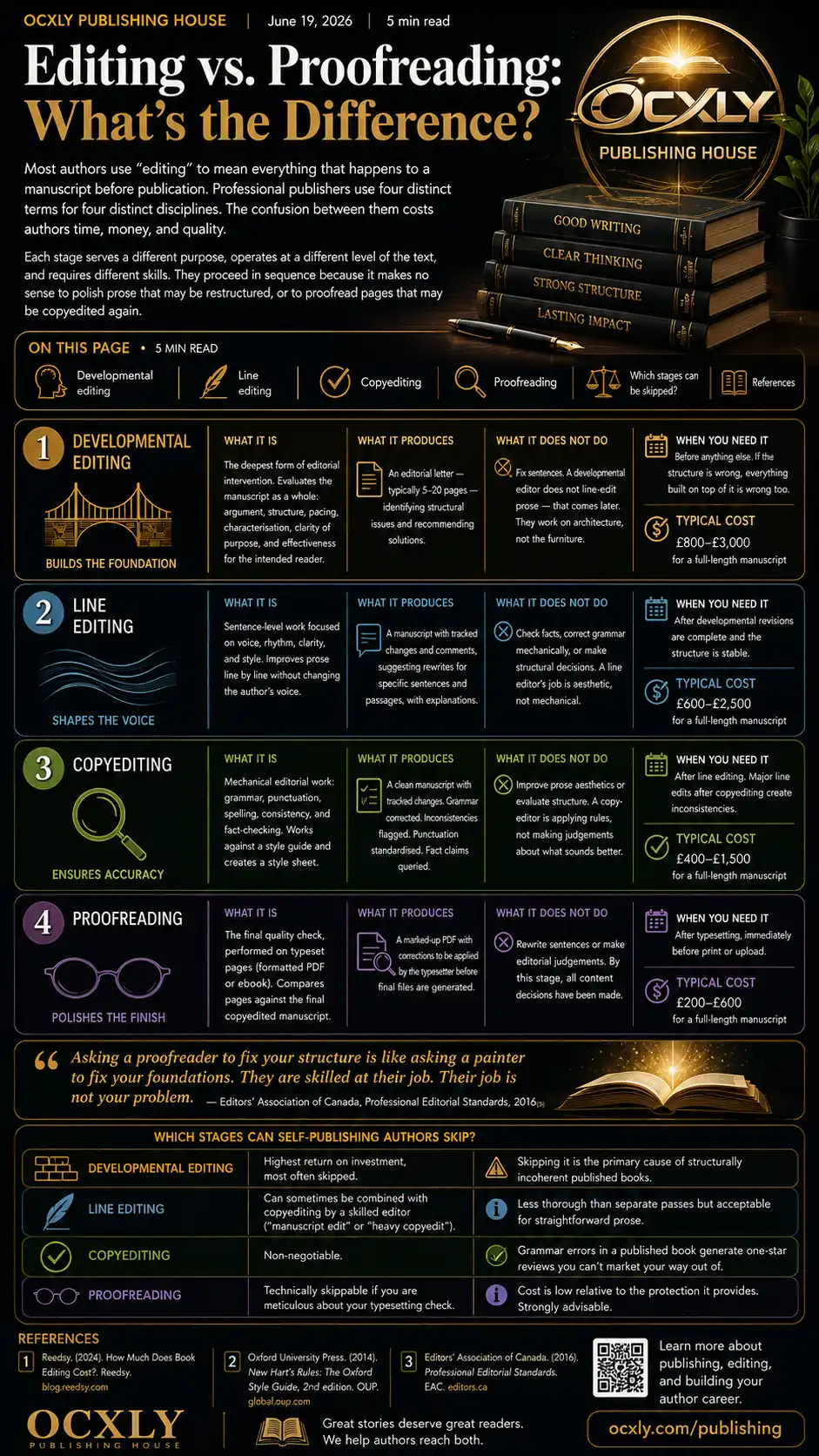
When an author says their book has been "edited," they could mean almost anything: a friend read it, a grammar tool checked it, or a professional developmental editor spent three months restructuring it. These are not equivalent, and confusing them produces manuscripts that appear polished on the surface while retaining fundamental problems underneath.
Professional publishing uses a specific vocabulary for the four distinct stages of editorial work. Each stage serves a different purpose, operates at a different level of the text, and requires different skills. They proceed in sequence because it makes no sense to polish prose that may be restructured, or to proofread pages that may be copyedited again.
1. Developmental editing
What it is: The deepest form of editorial intervention. A developmental editor (also called a structural editor or substantive editor) evaluates the manuscript as a whole: its argument, structure, pacing, characterisation, clarity of purpose, and effectiveness for its intended reader.
What it produces: An editorial letter, typically 5–20 pages, identifying structural issues and recommending solutions. For fiction: plot holes, pacing problems, underdeveloped characters, inconsistent POV. For non-fiction: weak thesis, logical gaps, missing evidence, chapter sequencing issues, audience mismatch.
What it does not do: Fix sentences. A developmental editor does not line-edit prose, that comes later. They are thinking about the architecture of the book, not the furniture inside it.
When you need it: Before anything else. If the structure is wrong, everything built on top of it is wrong too. Developmental editing on a finished, typeset book is a catastrophic waste of money.
Typical cost: £800–£3,000 for a full-length manuscript, depending on the editor's experience and the depth of feedback.[1]
2. Line editing
What it is: Sentence-level work focused on voice, rhythm, clarity, and style. A line editor works through the manuscript line by line, improving prose without changing the author's voice. They notice when a sentence is clunky, when a metaphor is mixed, when a paragraph's structure undercuts its meaning.
What it produces: A manuscript with tracked changes and comments, suggesting rewrites for specific sentences and passages, with explanations of what is not working and why.
What it does not do: Check facts, correct grammar mechanically, or make structural decisions. A line editor's job is aesthetic, not mechanical.
When you need it: After developmental revisions are complete and the structure is stable. Line editing a chapter that may be cut in developmental revision is wasted effort.
Typical cost: £600–£2,500 for a full-length manuscript.
3. Copyediting
What it is: Mechanical editorial work: grammar, punctuation, spelling, consistency, and fact-checking. A copyeditor works against a style guide (the Chicago Manual of Style for most US trade books; New Hart's Rules for UK books[2]) and creates a style sheet recording every proper noun, deliberate spelling deviation, and stylistic choice in the manuscript.
What it produces: A clean manuscript with tracked changes. Grammar corrected. Internal inconsistencies flagged (a character with brown eyes on page 12 and blue eyes on page 247). Punctuation standardised. Fact claims queried.
What it does not do: Improve prose aesthetics or evaluate structure. A copyeditor is applying rules, not making judgements about what sounds better.
When you need it: After line editing. The manuscript's prose should be largely final before copyediting, a major line-editing pass after copyediting creates inconsistencies the copyeditor has already resolved.
Typical cost: £400–£1,500 for a full-length manuscript.
4. Proofreading
What it is: The final quality check, performed on typeset pages (the formatted PDF or ebook file), not on the manuscript document. A proofreader compares the typeset pages against the final copyedited manuscript, catching any errors introduced during typesetting and any that survived all previous editorial passes.
What it produces: A marked-up PDF with corrections to be applied by the typesetter before final files are generated.
What it does not do: Rewrite sentences or make editorial judgements. By the proofreading stage, all content decisions have been made. A proofreader catching a structural problem at this stage means that problem survived three previous editorial passes, an expensive situation for everyone.
When you need it: After typesetting, immediately before print or upload. Proofreading on a Word document is not proofreading; it is a final copyedit pass, which is a valid but different thing.
Typical cost: £200–£600 for a full-length manuscript.
"Asking a proofreader to fix your structure is like asking a painter to fix your foundations. They are skilled at their job. Their job is not your problem."
— Editors' Association of Canada, Professional Editorial Standards, 2016[3]
Which stages can self-publishing authors skip?
None, if quality is the goal. But in practice, the stages have different risk profiles:
- Developmental editing: highest return on investment, most often skipped. Skipping it is the primary cause of structurally incoherent published books.
- Line editing: can sometimes be combined with copyediting by a skilled editor working on both; this is called a "manuscript edit" or "heavy copyedit." Less thorough than separate passes but acceptable for straightforward prose.
- Copyediting: non-negotiable. Grammar errors in a published book generate one-star reviews at a rate that no marketing spend recovers from.
- Proofreading: technically skippable if you are meticulous about your typesetting check, but inadvisable. The cost is low relative to the protection it provides.
Related reading
- How a Book Goes from Manuscript to Bookshelf — where editing fits the pipeline.
- Common Mistakes First-Time Authors Make — the errors editing catches.
- How to Choose the Right Publishing Path — who handles editing on each path.
References
- Reedsy. (2024). How Much Does Book Editing Cost?. Reedsy. blog.reedsy.com ↩
- Oxford University Press. (2014). New Hart's Rules: The Oxford Style Guide, 2nd edition. OUP. global.oup.com ↩
- Editors' Association of Canada. (2016). Professional Editorial Standards. EAC. editors.ca ↩