The Evolution of Programming Languages:
From Assembly to AI
Eight decades. Hundreds of languages. One relentless direction: moving the programmer further from the machine and closer to the problem. Here is how we got from binary opcodes to large language models writing code.
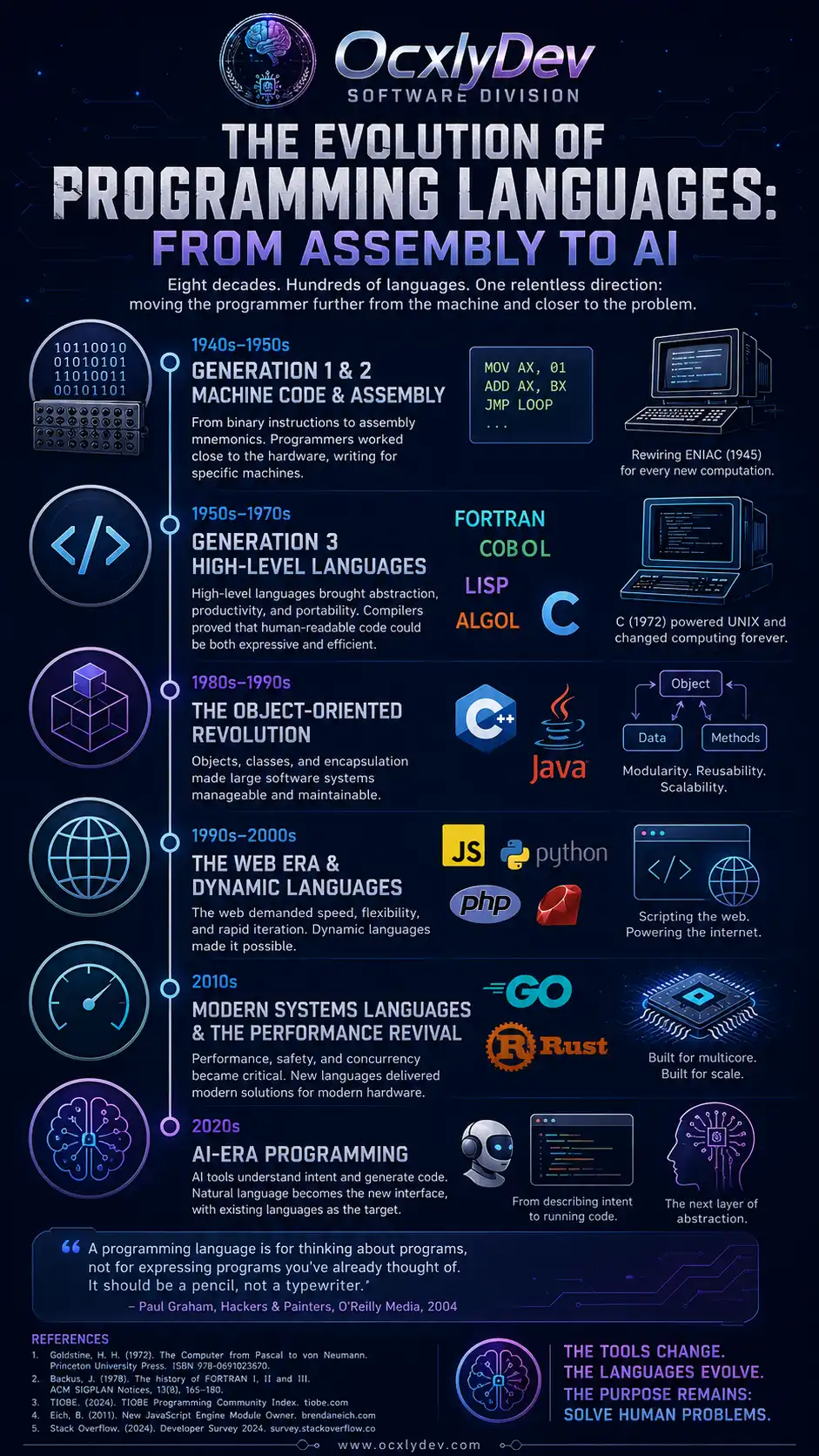
The history of programming languages is the history of abstraction, the progressive separation of human intention from machine execution. Every generation of languages introduced a new layer between what a programmer writes and what a processor actually does. Each layer cost some performance. Each layer bought some human time, some correctness, some expressiveness. The tradeoffs have been relitigated with every new paradigm, and they are being relitigated again today as AI enters the development workflow.
Generation 1 and 2: Machine code and assembly (1940s–1950s)
The earliest computers were programmed directly in binary, sequences of 0s and 1s that corresponded to specific processor instructions. Programming the ENIAC, completed in 1945, required physically rewiring the machine for each new computation.[1]
Assembly language, developed in the early 1950s, introduced the first layer of abstraction: human-readable mnemonics (MOV, ADD, JMP) that an assembler translated to binary. Programs were still written for a specific processor architecture, assembly code for an IBM mainframe ran on nothing else, but the programmer could now work with words rather than numbers.
Assembly programming is still used today for embedded systems, firmware, device drivers, and performance-critical inner loops where the overhead of any higher-level abstraction is unacceptable. But for all general-purpose development, it was superseded within a decade of its introduction.
Generation 3: High-level languages (1950s–1970s)
FORTRAN (Formula Translation), developed at IBM by John Backus and released in 1957, was the first high-level compiled language.[2] It allowed scientists and engineers to write mathematical formulas in a notation resembling algebra, and a compiler translated those formulas into efficient machine code. Backus's team demonstrated that a compiler could produce code competitive with hand-written assembly, eliminating the objection that abstraction was too expensive.
COBOL (1959) followed, designed for business data processing. LISP (1958), conceived by John McCarthy at MIT, introduced the functional programming paradigm and became the foundational language of artificial intelligence research for three decades. ALGOL (1958–1968) introduced block structure and lexical scoping, concepts that directly influenced C, Pascal, and almost every subsequent language.
The 1960s and 1970s produced C (Dennis Ritchie, Bell Labs, 1972), arguably the most influential programming language ever written. C provided low-level memory access, high performance, and portability across hardware architectures. The Unix operating system, written in C, demonstrated that a complex systems program could be written in a high-level language without sacrificing the performance necessary to run an OS. C's influence is visible in the syntax of C++, Java, C#, JavaScript, and many others.
The object-oriented revolution (1980s–1990s)
Object-oriented programming (OOP), conceived in Simula (1967) and developed in Smalltalk at Xerox PARC in the 1970s, reached mainstream adoption in the late 1980s and 1990s through C++ (Bjarne Stroustrup, 1985) and Java (Sun Microsystems, 1995).
OOP organised programs around objects, bundles of data and the functions that operated on that data, rather than around procedures. The paradigm addressed a genuine problem: as software systems grew larger, procedural programs became difficult to maintain because any function could modify any data. OOP's encapsulation principle limited access and created modularity.
Java's "write once, run anywhere" proposition, enabled by the Java Virtual Machine, was transformative for enterprise software distribution. By 2001, Java was the most widely taught programming language in universities and the dominant language in enterprise software development.[3]
The web era and dynamic languages (1990s–2000s)
The World Wide Web created new requirements that existing languages were ill-suited to serve: rapid development, interpreted execution in browsers, loose typing for quick scripting. JavaScript, created by Brendan Eich at Netscape in 1995 in ten days, became the language of the browser by historical accident and has remained so ever since.[4]
Python, designed by Guido van Rossum and first released in 1991, emphasised readability and developer productivity over performance. Ruby, PHP, and Perl served the server-side web. The era's defining feature was dynamic typing, languages that resolved types at runtime rather than compile time, making rapid prototyping faster at the cost of runtime errors that statically typed languages catch at compile time.
Modern systems languages and the performance revival (2010s)
As software systems scaled to billions of users, performance constraints and reliability requirements drove renewed interest in systems languages. Go (Google, 2009) offered garbage collection with performance approaching C, and built-in concurrency primitives suited to the networked, multi-core server environment. Rust (Mozilla, 2010) offered memory safety without garbage collection, a combination previously thought impossible, through its ownership and borrow-checking type system.
AI-era programming (2020s)
The 2020s introduced a genuinely new development: AI tools (GitHub Copilot, launched 2021; subsequent large language model coding assistants) capable of generating syntactically correct, often semantically useful code in response to natural language descriptions. The StackOverflow Developer Survey 2024 found that 76% of developers were using or planned to use AI coding tools in their development workflow.[5]
This does not represent the obsolescence of programming languages, AI-generated code is code in existing languages, evaluated by existing compilers and runtimes. But it does represent a new layer in the abstraction stack: natural language as a programming interface, with existing languages as the compilation target. The direction of travel over eight decades (programmer further from the machine, closer to intention) continues.
"A programming language is for thinking about programs, not for expressing programs you've already thought of. It should be a pencil, not a typewriter."
— Paul Graham, Hackers & Painters, O'Reilly Media, 2004
Related reading
- The Most Influential Programming Languages — the milestones along the way.
- How Programming Languages Shape Software — why the evolution matters.
- The Future of Programming Languages in the Age of AI — where it's heading next.
References
- Goldstine, H. H. (1972). The Computer from Pascal to von Neumann. Princeton University Press. ISBN 978-0691023670. ↩
- Backus, J. (1978). The history of FORTRAN I, II and III. ACM SIGPLAN Notices, 13(8), 165–180. doi.org ↩
- TIOBE. (2024). TIOBE Programming Community Index. TIOBE Software. tiobe.com ↩
- Eich, B. (2011). New JavaScript Engine Module Owner. Mozilla. brendaneich.com ↩
- Stack Overflow. (2024). Developer Survey 2024. Stack Overflow. survey.stackoverflow.co ↩