How to Turn Expertise
into a Published Book
You know things that would genuinely help other people. The gap between that knowledge and a published book is not talent: it is structure, process, and a clear understanding of what a non-fiction book actually is.
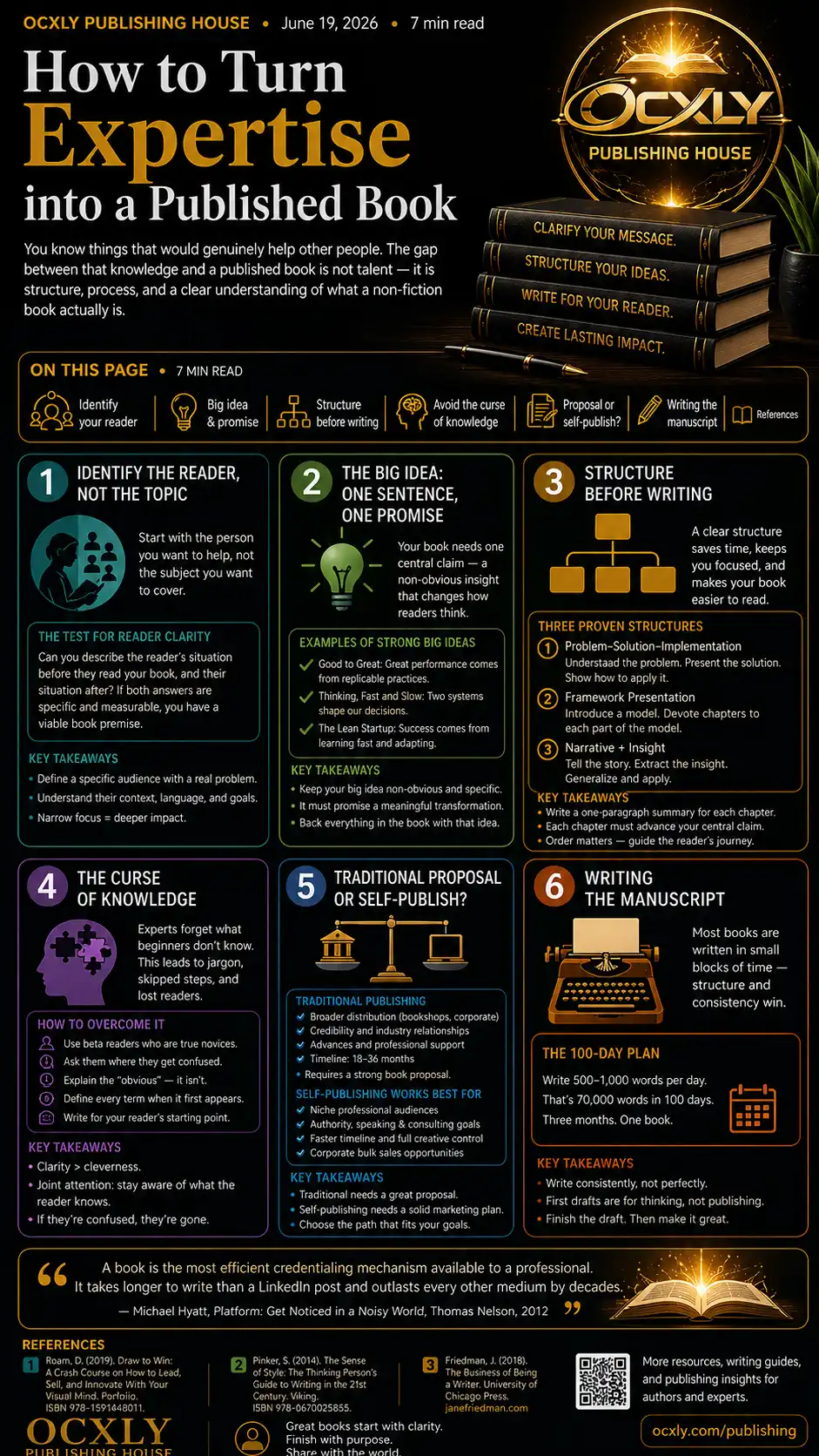
The world has no shortage of experts who believe they should write a book but have not written one. The obstacles are rarely a lack of knowledge or a lack of things to say. They are almost always structural: not knowing how to transform expertise (which is typically networked, contextual, and tacit) into a linear, readable argument that serves a reader who does not share that expertise.
This is a solvable problem. Non-fiction publishing has a well-established set of frameworks for doing exactly this. What follows is those frameworks, applied practically.
Step 1: Identify the reader, not the topic
The most common failure mode for expertise-based books is starting with a topic rather than a reader. "I want to write about leadership" is a topic. "I want to help first-time managers in technology companies stop micromanaging the people they promoted from peer to report" is a reader, with a specific problem, a specific context, and a specific desired outcome.
The distinction matters because books are not encyclopaedias. A book that tries to address everything an expert knows about a topic produces an exhausting, incoherent reading experience. A book that takes a specific reader from a specific problem to a specific transformation, however narrowly defined, produces a book that readers recommend emphatically because it helped them in a way they remember.[1]
The test for reader clarity: can you describe the reader's situation before they read your book, and their situation after? If both answers are specific and measurable, you have a viable book premise. If either is vague, the book premise needs work.
Step 2: The big idea: one sentence, one promise
Every successful non-fiction book rests on a single central claim, a counterintuitive insight, a reframing of a familiar problem, or a synthesis of evidence that changes how readers think about something they thought they understood. This claim must be expressible in one sentence and must be non-obvious. If it is obvious, there is no reason to read the book rather than just accept the premise and move on.
Examples of functional big ideas:
- Good to Great (Jim Collins): The transition from good performance to great performance is driven by a specific set of leadership and management practices that can be identified and replicated.
- Thinking, Fast and Slow (Daniel Kahneman): Human decision-making is governed by two systems (one fast, intuitive, and error-prone; one slow, deliberate, and effortful) and understanding the interaction between them changes how you evaluate your own judgements.
- The Lean Startup (Eric Ries): Business success is not determined by the quality of the initial plan but by the speed at which the business can learn from real customer feedback and adapt.
Each of these is a single claim. Each is non-obvious. Each promises a specific change in how the reader understands something. This is the template.
Step 3: Structure before writing
The most efficient path to a completed non-fiction manuscript is a thoroughly worked-out structure before a single chapter is written. Structure means knowing what each chapter argues, how each chapter's argument supports the book's central claim, and what order the chapters must appear in.
A practical approach: write a one-paragraph summary of each chapter before writing any chapter in full. If you cannot summarise what a chapter argues in one paragraph, the chapter does not yet have a clear argument, and writing it at length will not solve that problem, it will conceal it.
The most durable non-fiction structures are:
- Problem–solution: Part 1 establishes the problem in detail; Part 2 presents the solution; Part 3 shows implementation. Reliable for business and self-help.
- Framework presentation: Introduces a framework (often a model with 3–5 components) and devotes a chapter or section to each component. Reliable for books that aim to change how practitioners think about their field.
- Narrative + insight: Uses a story (case study, historical account, personal experience) to generate an insight, then generalises the insight. Reliable for popular science and narrative non-fiction.
Step 4: The curse of knowledge
The single greatest challenge in converting expertise to prose is the curse of knowledge, the cognitive difficulty of imagining not knowing something you know well. Experts systematically underestimate how much foundational context their readers are missing, skip explanations that seem obvious but aren't, use jargon without defining it, and assume readers share mental models they have never encountered.
The practical fix: beta readers who are genuine novices in your field, not colleagues. A colleague will nod at the things that are unclear because they can fill in the gaps from their own knowledge. A genuine novice will tell you exactly where you lost them. Losing them early in the manuscript is valuable information; losing them at the printer is not.
Steven Pinker's The Sense of Style (2014) remains the best single resource on writing clearly about complex subjects for non-expert audiences, specifically his chapters on the curse of knowledge and the "joint attention" problem in academic and expert writing.[2]
Step 5: Traditional proposal or self-publish?
For expertise-based non-fiction, the traditional publishing route has specific advantages that are less available to fiction authors: established business book publishers (Portfolio, Harvard Business Review Press, Wiley, Kogan Page) have sales relationships with corporate buyers, airport retailers, and bulk purchasers that dramatically amplify reach for the right title. A business book distributed by a major publisher will appear in bookshop business sections and reach corporate procurement channels that a self-published book simply will not.
The traditional route requires a book proposal, a document of 25–50 pages comprising a chapter-by-chapter outline, sample chapters, market analysis, competitive title analysis, and author platform assessment. Literary agencies and acquisitions editors evaluate proposals, not manuscripts, for non-fiction. A strong proposal for a well-positioned expertise book, from an author with a demonstrable platform (speaking engagements, blog readership, professional network), can attract significant advances.[3]
Self-publishing works better for:
- Books aimed at a specific professional niche rather than a general business audience
- Books intended primarily to generate speaking and consulting work rather than retail royalties
- Authors who want to publish on their own timeline rather than waiting 18–36 months for traditional publication
- Books with a specific corporate bulk-sale opportunity (many consultants self-publish specifically so they can buy copies at cost and give them to clients)
"A book is the most efficient credentialing mechanism available to a professional. It takes longer to write than a LinkedIn post and outlasts every other medium by decades."
— Michael Hyatt, Platform: Get Noticed in a Noisy World, Thomas Nelson, 2012
Step 6: Writing the manuscript
Most expertise-based books are written in stolen time, early mornings, weekends, the weeks between major projects. The primary enemy is not time scarcity but completion avoidance: the manuscript that is 60% done but never gets to 100% because perfectionism, scope creep, or simple inertia prevents it.
The structural antidote to non-completion is a fixed word count target per session (500–1,000 words per session is realistic for most working professionals) applied consistently to a pre-defined structure. Writing 700 words per day on a structure you know produces a 70,000-word first draft in 100 days. That is roughly three months of daily sessions. Most expertise books are written in that window or less, by authors who decided the book existed and then wrote it on schedule rather than waiting for inspiration.
The draft does not need to be good. First drafts are a thinking tool, they externalise the argument so it can be evaluated and improved. The revision process, not the first draft, is where the quality of the finished book is determined.
Related reading
- How to Choose the Right Publishing Path — getting your book to market.
- Author Success Stories — experts who did it.
- How a Book Goes from Manuscript to Bookshelf — the road ahead.
References
- Roam, D. (2019). Draw to Win: A Crash Course on How to Lead, Sell, and Innovate With Your Visual Mind. Portfolio. ISBN 978-1591848011. ↩
- Pinker, S. (2014). The Sense of Style: The Thinking Person's Guide to Writing in the 21st Century. Viking. ISBN 978-0670025855. ↩
- Friedman, J. (2018). The Business of Being a Writer. University of Chicago Press. janefriedman.com ↩