Common Mistakes
First-Time Authors Make
Most first books fail for predictable reasons. The good news: every one of those reasons is avoidable. Here is the list, from weak editing to neglected marketing, with the fix for each.
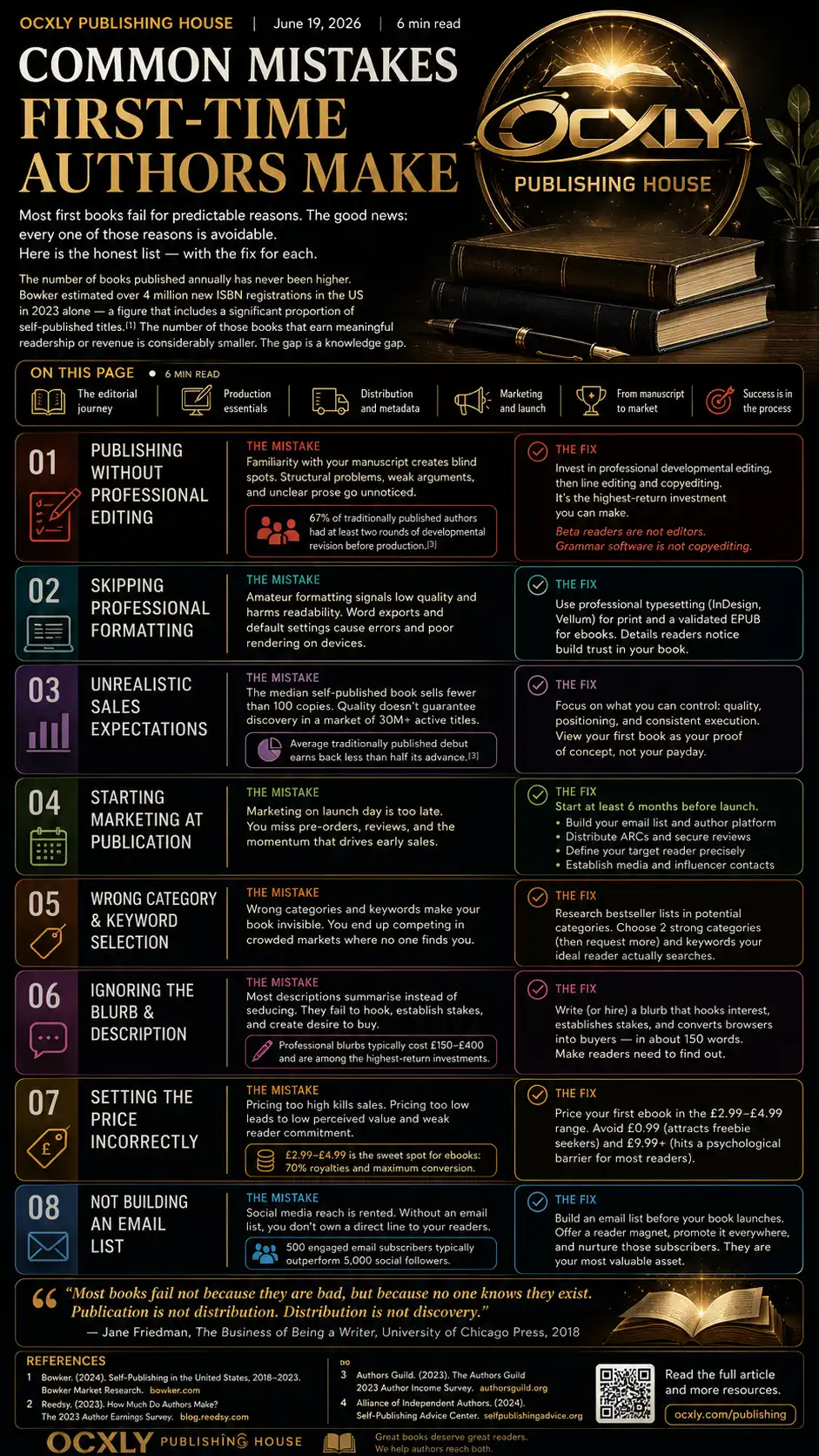
The number of books published annually has never been higher. Bowker estimated over 4 million new ISBN registrations in the US in 2023 alone, a figure that includes a significant proportion of self-published titles.[1] The number of those books that earn meaningful readership or revenue is considerably smaller. The gap between publication and success is not primarily a talent gap. It is a knowledge gap, and it is concentrated in a predictable set of mistakes that first-time authors make at a high rate.
Mistake 1: Publishing without professional editing
This is the most common and most consequential error. Authors who have spent months or years writing a manuscript are the worst possible judges of whether it is ready for readers. Familiarity with the text creates blind spots, structural problems that feel resolved because the author knows what they meant, prose that reads as clear because the author supplied the missing context in their own head.
Professional editing is not optional for a book that will be sold to strangers. It is the single highest-return investment a self-publishing author can make. A Reedsy survey of 1,400 self-published authors found that those who hired professional editors earned 13% more revenue per book and received significantly higher average ratings on retail platforms.[2]
The specific mistake within this category is confusing rounds of editing. Beta readers are not editors. Grammar-checking software is not copyediting. A friend who "loves to read" is not a developmental editor. Each of these has a place in the process, none replaces the others.
Mistake 2: Skipping professional formatting
Readers notice bad formatting even when they cannot name it. A book typeset in Microsoft Word with default settings (incorrect margins, inconsistent chapter headings, poor widow and orphan control, improper handling of front matter) signals amateur production in a way that erodes trust in the content before a single word is evaluated on its merits.
For print books, professional typesetting in Adobe InDesign or a dedicated tool like Vellum (Mac) produces results that are immediately distinguishable from word-processor output. For ebooks, a properly structured EPUB with validated metadata, a working table of contents, and correct heading hierarchy is the minimum standard. Ebooks exported directly from Word with default settings frequently have rendering issues on Kindle and Kobo devices that generate one-star reviews citing formatting rather than content.
Mistake 3: Unrealistic sales expectations
The median self-published book sells fewer than 100 copies in its lifetime. The average traditionally published debut novel earns back less than half its advance. These are not discouraging statistics deployed to dampen enthusiasm; they are data points that should calibrate planning.[3]
First-time authors routinely enter the market expecting their book to sell itself based on its quality. Quality is necessary but not sufficient. The book market has approximately 30 million active titles competing for reader attention at any given time. Quality determines whether a reader who discovers your book recommends it to others. It does not determine whether they discover it in the first place. That is a marketing problem.
Mistake 4: Starting marketing at publication
The optimal time to begin building marketing infrastructure for a book is six months before publication, not on publication day. Marketing that begins on launch day is too late to generate pre-orders, secure advance reviews, build an email list of readers primed to buy on day one, or establish the author platform that drives algorithmic discoverability.
The specific elements that should be in place before launch: an author website with an email signup, a Goodreads author profile, an Amazon Author Central page, a minimum of 10–15 advance reader copies distributed and converted into reviews, and a clear articulation of the book's target reader, not "everyone who likes books" but a specific demographic whose reading habits, platform preferences, and discovery behaviours are understood.
Mistake 5: Wrong category and keyword selection
On Amazon, BISAC category placement and keyword selection determine which readers encounter a book organically. A book miscategorised as "General Fiction" rather than "Psychological Thriller" will compete in a category with 200,000 titles rather than one with 8,000, and will be invisible to readers browsing the thriller charts. Amazon allows two categories at publication and additional categories can be requested post-launch; most first-time authors select categories based on vague genre fit rather than competitive analysis of category bestseller lists.
Mistake 6: Ignoring the blurb and description
The back-cover description (or online book description) is the second-most-important piece of copy in book publishing after the title. It must accomplish three things in approximately 150 words: hook the reader's interest, establish the stakes or promise of the book, and create enough desire to convert browser to buyer. Most first-time author descriptions fail because they summarise instead of seduce, they tell you what happens rather than making you need to find out.
Professional copywriters specialising in book descriptions charge between £150 and £400 for this service. It is consistently among the highest-return investments available to a self-publishing author.
Mistake 7: Setting the price incorrectly
Ebook pricing follows a counterintuitive curve. Books priced at £0.99 or free generate downloads but rarely generate readers who become fans. Books priced above £9.99 face a psychological barrier in the ebook market. The £2.99–£4.99 range generates 70% royalties on Amazon KDP and sits in the sweet spot of perceived value versus affordability for most genre fiction and non-fiction categories. Pricing a first ebook at £9.99 to match traditional publisher pricing is a mistake that costs the author both sales and reviews.
"Your first book is not your retirement plan. It is your proof of concept, your audience-building tool, and your most important long-term asset. Treat it accordingly."
— Alliance of Independent Authors, Self-Publishing Advice, 2024[4]
Mistake 8: Not building an email list
Social media platforms change algorithms, reduce organic reach, and occasionally disappear. An email list is the one direct, owned channel an author has to reach readers who have explicitly opted in to hearing from them. Authors who build an email list before their first book launches have a structural advantage over those who do not, they have a guaranteed distribution channel for every subsequent launch.
The mechanism is simple: a reader magnet (a free short story, a resource guide, a sample chapter) offered in exchange for an email address, promoted through the book's back matter and the author's web presence. Authors who launch subsequent books to an email list of 500 genuine readers consistently outperform authors launching to social media audiences ten times that size.
Related reading
- Editing vs. Proofreading — avoid the most common polish mistakes.
- How to Choose the Right Publishing Path — pick the right route early.
- How to Market a Book on a Small Budget — plan promotion before launch.
References
- Bowker. (2024). Self-Publishing in the United States, 2018–2023. Bowker Market Research. bowker.com ↩
- Reedsy. (2023). How Much Do Authors Make? The 2023 Author Earnings Survey. Reedsy. blog.reedsy.com ↩
- Authors Guild. (2023). The Authors Guild 2023 Author Income Survey. Authors Guild. authorsguild.org ↩
- Alliance of Independent Authors. (2024). Self-Publishing Advice Center. ALLi. selfpublishingadvice.org ↩