How Programming Languages
Shape Software Development
The language you use does not merely express the program you had in mind. It shapes which programs you can think of, which bugs you will write, and how your team communicates about the codebase. Language design is software culture design.
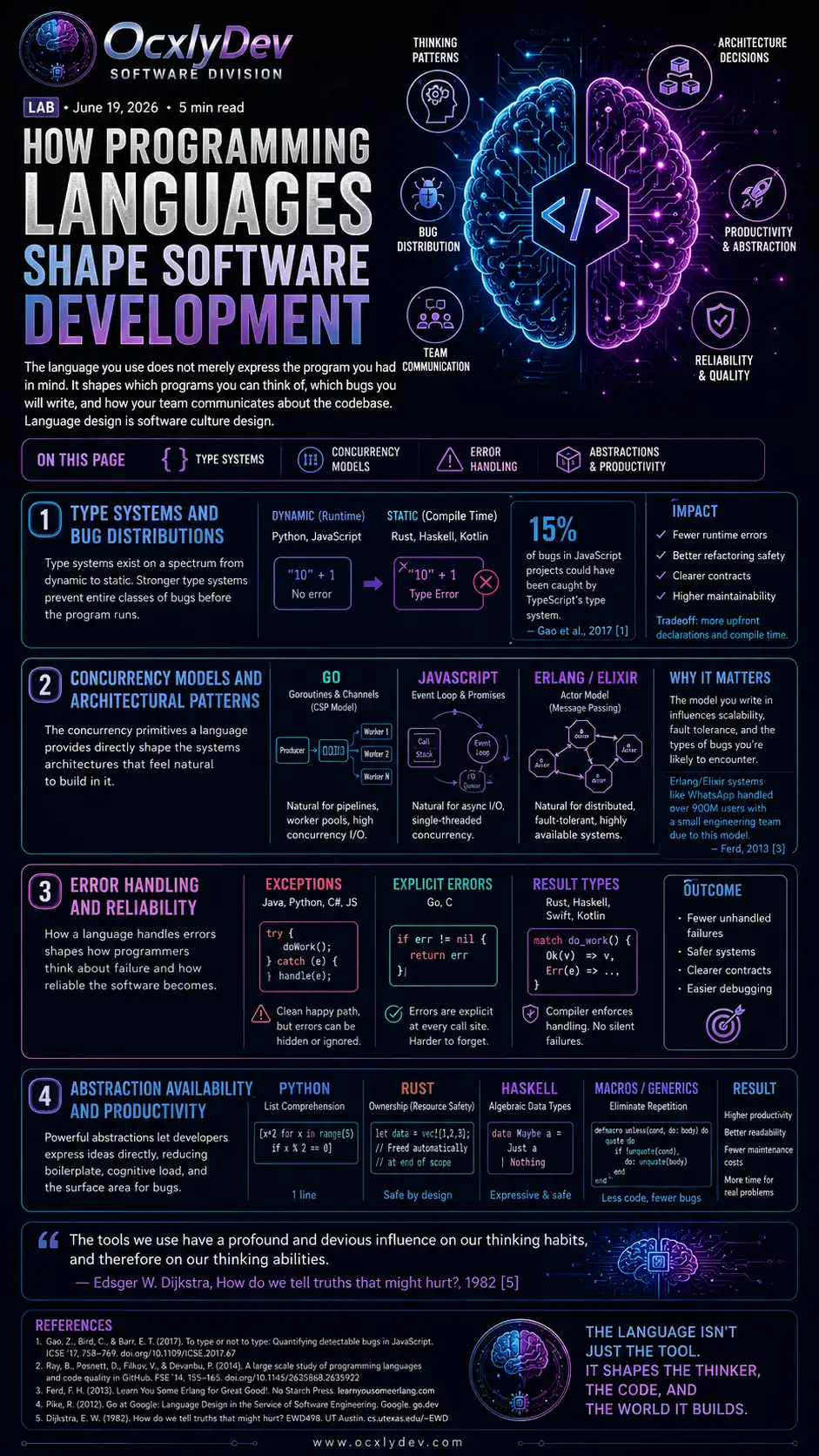
Linguist Benjamin Lee Whorf proposed in the 1940s that language shapes thought, that the categories and distinctions available in a language influence how its speakers perceive the world. The "Sapir-Whorf hypothesis" remains contested in linguistics, but in programming its weaker form is clearly true: the constructs a programming language provides, or withholds, measurably influence what solutions programmers reach for, what bugs they write, and how they reason about problems.
This is not an abstract philosophical point. It has concrete implications for software quality, team productivity, and architecture decisions that play out in every codebase.
Type systems and bug distributions
A language's type system is perhaps the most consequential dimension of its design for software quality. Type systems exist on a spectrum from fully dynamic (Python, JavaScript, Ruby (types checked at runtime) to fully static (Rust, Haskell) types checked at compile time) with hybrid systems (TypeScript's optional types, Java's generics) in between.
The empirical evidence on type systems and bug rates is mixed but directionally consistent: a large-scale study by Gao et al. (2017) analysing 400 JavaScript projects found that 15% of bugs in sampled projects could have been detected by TypeScript's type system had it been applied.[1] A study by Ray et al. (2014) analysing 729 GitHub projects across 17 languages found that statically typed languages were associated with fewer defects than dynamically typed ones, controlling for project size.[2]
The mechanism is straightforward: static type systems make certain classes of errors impossible to express. A function typed to return a String cannot return an integer at compile time. A null pointer dereference on a non-nullable type is a compile error in Kotlin or Swift. These constraints eliminate entire categories of bugs before the program runs.
The tradeoff: static typing requires more upfront declaration, longer compile cycles, and can make rapid prototyping more friction-laden. The industry trend (TypeScript's rapid adoption, Python's type hints (PEP 484), Kotlin replacing Java for Android) reflects a broad conclusion that the bug-prevention benefits of static types outweigh the friction for production codebases above a certain size and longevity.
Concurrency models and architectural patterns
The concurrency primitives a language provides directly shape the architectures that are natural to build in it. This influence is profound and often invisible to developers working within a single language.
Go's goroutines and channels make communicating sequential processes (CSP) natural. A Go developer reaches for goroutines (lightweight threads, cheap to create by the thousands) and channels for communication. The result is architectures built around concurrent pipelines and worker pools. Go's standard library and ecosystem are built around this model; fighting it produces awkward code.
JavaScript's single-threaded event loop and Promises/async-await make callback-driven, non-blocking I/O natural. JavaScript developers reach for asynchronous patterns for anything that touches I/O. The language's single-threaded model eliminates entire categories of race conditions that plague multi-threaded languages, at the cost of callback complexity (largely resolved by async/await) and the inability to saturate multiple CPU cores in a single process.
Erlang's actor model makes distributed, fault-tolerant systems natural. Erlang processes are isolated, share no memory, communicate only by message passing, and can be supervised and restarted by supervisor processes. WhatsApp's infrastructure, built on Erlang (and Elixir, its modern descendant), handled over 900 million users with a remarkably small engineering team, a direct consequence of the language's concurrency model mapping onto the problem.[3]
Error handling and reliability
How a language handles errors shapes how programmers think about failure. Three dominant approaches have measurably different outcomes:
Exceptions (Java, Python, C#, JavaScript) allow errors to propagate implicitly up the call stack. The advantage is clean "happy path" code; the disadvantage is that callers may not know which functions can throw, and uncaught exceptions surface as runtime crashes rather than compile-time errors. Java's checked exceptions attempted to make exception contracts explicit, but the community largely rejected them as too verbose.
Explicit error values (Go, C) require every caller to explicitly handle or propagate errors. Go's if err != nil { return err } pattern is verbose but explicit, every site where an error can occur must be handled or deliberately ignored. Google's own research found that Go teams wrote more defensive, error-conscious code than equivalent Java teams, attributed partly to Go's error handling idiom.[4]
Result types (Rust, Haskell, Swift, Kotlin) encode the possibility of failure in the return type, a Result<T, E> must be unwrapped before the value is accessible, and the compiler enforces handling. This makes error paths as explicit as success paths and prevents a large class of "I forgot to check the error" bugs.
Abstraction availability and productivity
Languages that provide powerful abstractions (higher-order functions, pattern matching, algebraic data types, macros) allow developers to express domain concepts directly and reduce the amount of boilerplate code needed to express an idea. Less boilerplate means less surface area for bugs and less code to maintain.
Python's list comprehensions, generators, and context managers allow certain patterns to be expressed in a fraction of the code required in Java. Rust's ownership types encode resource management logic that C developers must manage manually. Haskell's monads and type classes enable generic programming that reduces code duplication. These are not merely stylistic preferences, they represent different amounts of code that must be written, read, and maintained for equivalent functionality.
"The tools we use have a profound and devious influence on our thinking habits, and therefore on our thinking abilities."
— Edsger W. Dijkstra, How do we tell truths that might hurt?, 1982[5]
Related reading
- The Evolution of Programming Languages — the history behind the ideas.
- Compiled vs Interpreted Languages — how execution shapes design.
- Best Languages for Different Career Paths — choosing a language for a goal.
References
- Gao, Z., Bird, C., & Barr, E. T. (2017). To type or not to type: Quantifying detectable bugs in JavaScript. ICSE '17, 758–769. doi.org ↩
- Ray, B., Posnett, D., Filkov, V., & Devanbu, P. (2014). A large scale study of programming languages and code quality in GitHub. FSE '14, 155–165. doi.org ↩
- Ferd, F. H. (2013). Learn You Some Erlang for Great Good!. No Starch Press. learnyousomeerlang.com ↩
- Pike, R. (2012). Go at Google: Language Design in the Service of Software Engineering. Google. go.dev ↩
- Dijkstra, E. W. (1982). How do we tell truths that might hurt? EWD498. UT Austin. cs.utexas.edu ↩