How a Book Goes
from Manuscript to Bookshelf
Most readers never see the months of invisible labour between a finished manuscript and a book in their hands. Here is what actually happens, stage by stage, decision by decision.
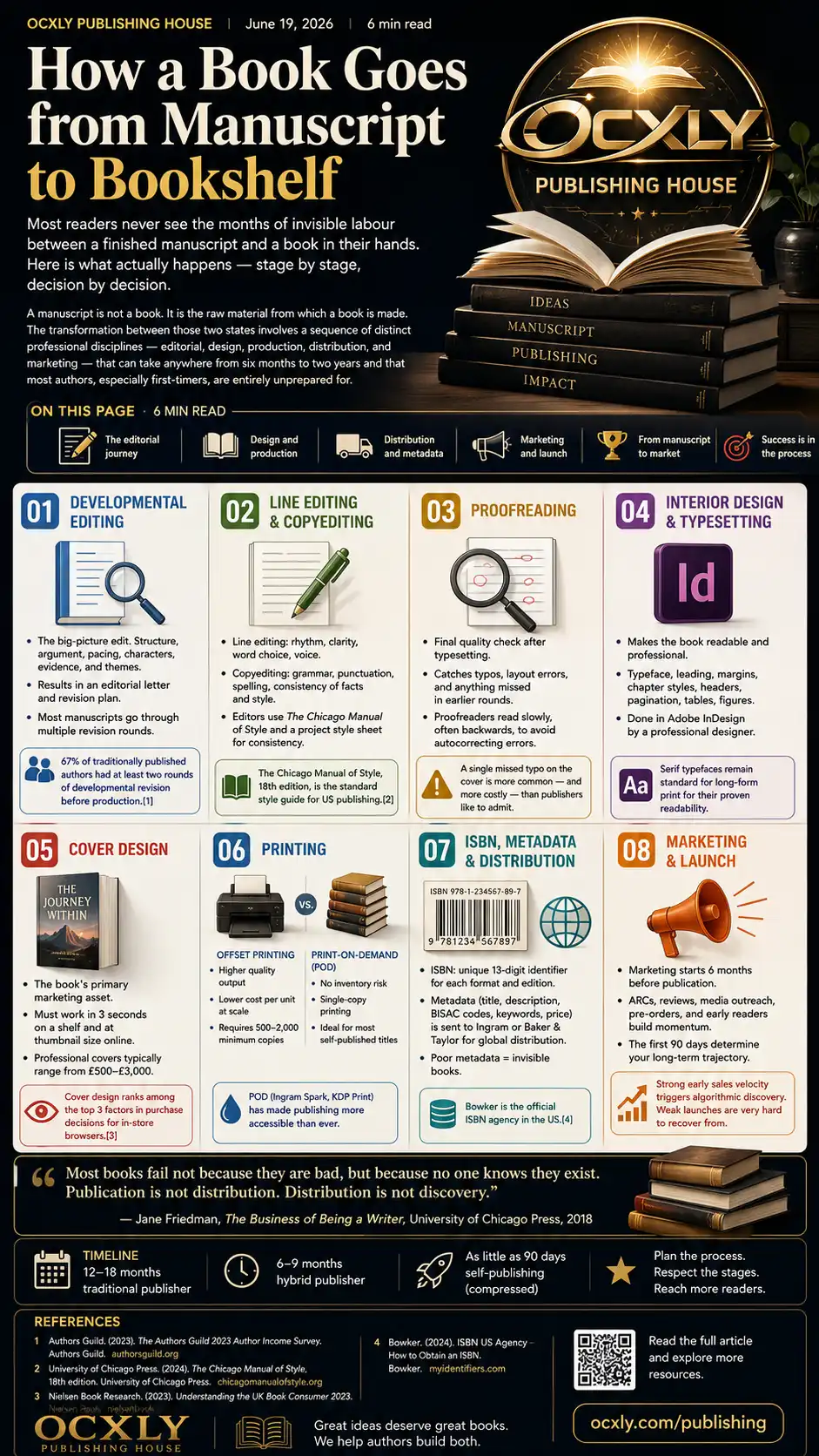
A manuscript is not a book. It is the raw material from which a book is made. The transformation between those two states involves a sequence of distinct professional disciplines (editorial, design, production, distribution, and marketing) that can take anywhere from six months to two years and that most authors, especially first-timers, are entirely unprepared for.
Understanding this process is not merely interesting. It is strategically essential for any author who wants to make informed decisions about how their work reaches the world.
Stage 1: Developmental editing
The first editorial pass is the most comprehensive and the most humbling. A developmental editor reads the manuscript not to correct grammar but to evaluate structure: Is the argument coherent? Does the narrative arc hold? Are characters consistent? Is the central thesis present on every page?
For non-fiction, developmental editing often involves restructuring entire chapters, identifying gaps in evidence, and ensuring the book delivers on its promise to the reader. For fiction, it addresses pacing, plot holes, character motivation, and thematic coherence. The result is typically a detailed editorial letter, sometimes twenty pages or more, followed by one or more revision rounds.
According to the Authors Guild's 2023 survey, 67% of traditionally published authors underwent at least two rounds of developmental revision before their manuscripts were accepted for production.[1] Self-published authors who skip this stage account for a disproportionate share of books that receive negative reviews citing structural problems.
Stage 2: Line editing and copyediting
Line editing works at the sentence level: rhythm, clarity, word choice, consistency of voice. It is distinct from copyediting, which is more mechanical, checking grammar, punctuation, spelling, and internal consistency (character names, dates, place names, facts).
The Chicago Manual of Style, now in its eighteenth edition, remains the dominant style guide for US book publishing.[2] Copyeditors work against style sheets, documents that record every deliberate deviation from the style guide and every proper noun in the manuscript, to ensure consistency across what may be 80,000 words or more.
Stage 3: Proofreading
Proofreading is the final quality check before a book goes to print, and it is not the same as copyediting. By the proofreading stage, the book has been typeset, laid out in its final print format, and the proofreader is checking the typeset pages against the final copyedited manuscript, catching any errors introduced during typesetting as well as any that survived earlier rounds.
Professional proofreaders read differently from normal readers: slowly, word by word, often reading backwards through paragraphs to prevent the brain from autocorrecting errors. A missed typo on the cover of a published book, a more common occurrence than publishers would prefer to admit, is typically traceable to a failure at this stage.
Stage 4: Interior design and typesetting
The interior design of a book determines its readability: typeface selection, leading (line spacing), margins, chapter heading treatment, running headers, page numbering, and the handling of any special elements, tables, figures, pull quotes, sidebars.
Professional book typesetting is most commonly done in Adobe InDesign. The choice of typeface alone, from a catalogue of thousands of options, has measurable effects on reader comprehension and perceived authority. Serif typefaces (Garamond, Caslon, Minion) remain standard for long-form print text due to their readability at small sizes; sans-serif faces are increasingly common in non-fiction and business books where a contemporary aesthetic is prioritised.
Stage 5: Cover design
The cover is the book's primary marketing asset. In physical retail, it has approximately three seconds to attract a browser's attention from a shelf. Online, it must be legible as a thumbnail at 150×225 pixels. These constraints drive cover design decisions as much as aesthetic ones.
Nielsen BookData's research on buyer behaviour consistently shows that cover design ranks among the top three factors in purchase decisions for browsers who discover books in physical retail, alongside title and author name.[3] The investment in professional cover design (which for a trade book typically ranges from £500 to £3,000 depending on complexity) has one of the highest returns of any single publishing investment.
Stage 6: Printing
The economics of printing have been fundamentally transformed by print-on-demand (POD) technology. Traditional offset printing requires minimum print runs (typically 500 to 2,000 copies) to achieve unit economics that make retail pricing viable. POD printing (Ingram Spark, KDP Print) allows single-copy printing at economically rational prices, eliminating inventory risk entirely.
Offset printing still produces higher quality output (sharper text, better colour reproduction, lower cost per unit at scale) and remains standard for traditionally published books with significant anticipated print runs. POD is standard for most self-published titles and for titles with uncertain demand profiles.
Stage 7: ISBN, metadata, and distribution
Before a book can be sold, it requires an ISBN (International Standard Book Number), a 13-digit identifier that uniquely identifies each format of each edition. In most countries, ISBNs are issued by the national ISBN agency; in the US, Bowker is the sole ISBN agency.[4]
Metadata (title, subtitle, author, description, BISAC category codes, keywords, price) is submitted to Ingram Content Group or Baker & Taylor, the two major book distributors, who make it available to booksellers worldwide. Poor metadata is one of the most common and most costly errors in self-publishing: books with incorrect BISAC codes or weak descriptions are effectively invisible to both booksellers and online recommendation algorithms.
Stage 8: Marketing and launch
A book published without a marketing plan is a book published in obscurity. The marketing phase ideally begins six months before publication: building advance reader copy (ARC) distribution, securing pre-publication reviews from Publishers Weekly, Kirkus, or Booklist, generating early Amazon and Goodreads reviews, and building media relationships for launch coverage.
The launch window, typically the first 90 days, is disproportionately important for a book's long-term trajectory. Algorithms on Amazon and other retail platforms use early sales velocity to determine discoverability. A strong launch builds the sales history that drives organic recommendation. A weak launch is very difficult to recover from, regardless of the book's quality.
"Most books fail not because they are bad, but because no one knows they exist. Publication is not distribution. Distribution is not discovery."
— Jane Friedman, The Business of Being a Writer, University of Chicago Press, 2018
The entire process, from manuscript acceptance to bookshop availability, takes between 12 and 18 months at a traditional publisher, 6 to 9 months at a hybrid publisher, and as little as 90 days for a self-published author willing to compress timelines (at the cost of some quality checkpoints). Understanding which stages can be compressed and which cannot is the practical knowledge that separates authors who publish successfully from those who rush to publication and regret it.
Related reading
- How to Choose the Right Publishing Path — traditional, self, or hybrid.
- Editing vs. Proofreading — the passes every manuscript needs.
- The Art of Book Cover Design — what sells a book on the shelf.
References
- Authors Guild. (2023). The Authors Guild 2023 Author Income Survey. Authors Guild. authorsguild.org ↩
- University of Chicago Press. (2024). The Chicago Manual of Style, 18th edition. University of Chicago Press. press.uchicago.edu ↩
- Nielsen Book Research. (2023). Understanding the UK Book Consumer 2023. Nielsen Book. nielsenbookdata.co.uk ↩
- Bowker. (2024). ISBN US Agency, How to Obtain an ISBN. International ISBN Agency. International Standard Book Number (ISBN) ↩