The Most Influential
Programming Languages of All Time
Every language you use today borrows from languages written decades earlier. Here are the ones whose ideas proved durable enough to shape the entire field, not just their contemporaries, but everything that followed.
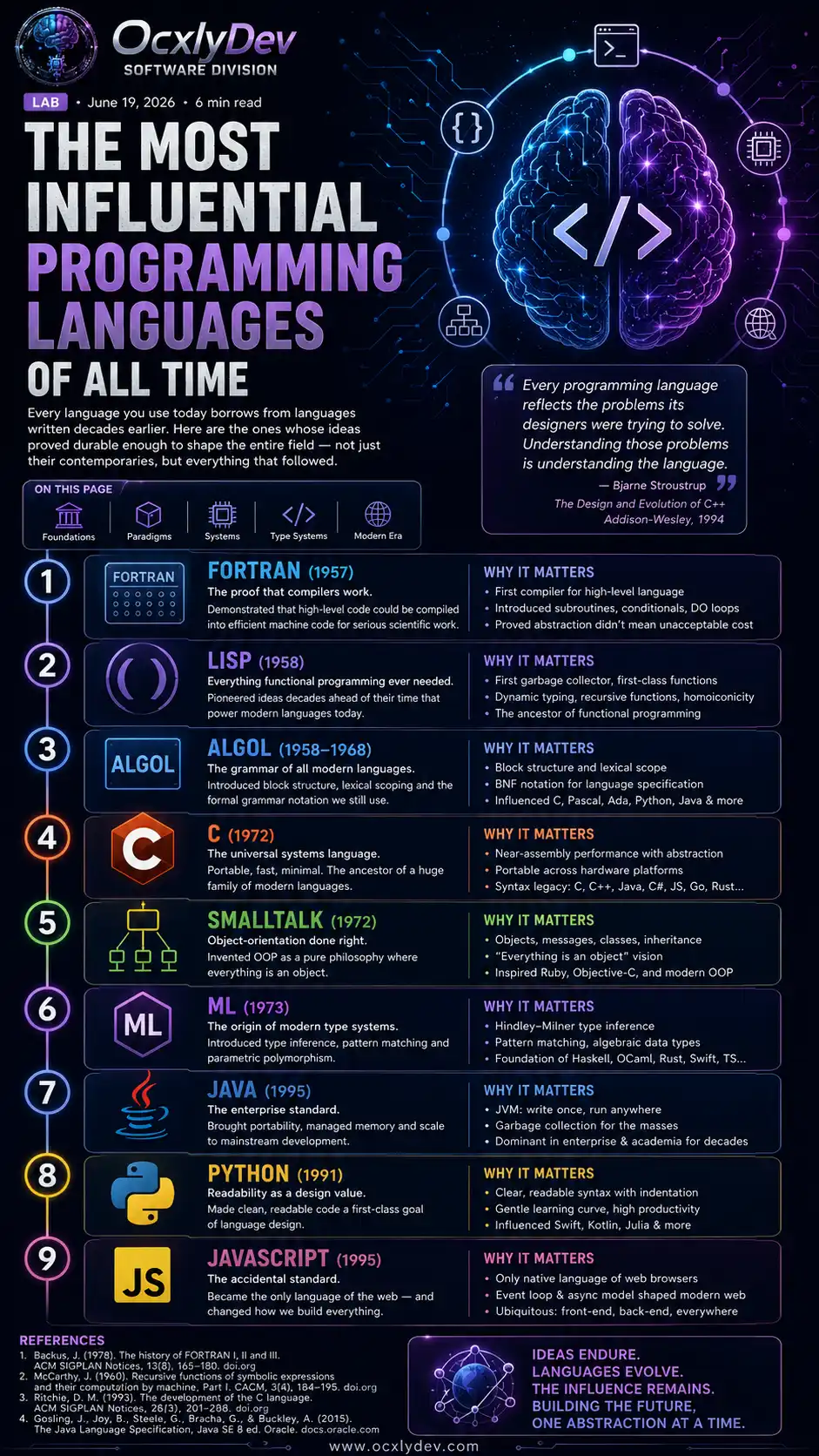
Influence in programming language design is measured differently from popularity. A language can be used by millions of developers while introducing no new ideas; another can be used by a handful of researchers while introducing concepts that live in every mainstream language a generation later. This list prioritises intellectual influence, the degree to which a language introduced ideas, paradigms, or abstractions that changed how all subsequent languages were designed.
FORTRAN (1957): the proof that compilers work
FORTRAN's influence is foundational in the literal sense: it demonstrated that high-level language compilation was viable. Before FORTRAN, the consensus among programmers was that a compiler could not produce code efficient enough for serious scientific work, only hand-written assembly could do that. John Backus and his IBM team proved the consensus wrong.[1]
FORTRAN also introduced: the concept of a named subroutine (function), conditional branching, and DO loops, structured control flow constructs that every subsequent language adopted in some form. Its contribution is not in its syntax, which looks archaic today, but in the proof of concept it represented.
LISP (1958): everything functional programming ever needed
John McCarthy's LISP (LISt Processing) introduced ideas so far ahead of their time that some of them only became mainstream decades later. LISP was the first language with: garbage collection; first-class functions (functions as values that can be passed to other functions); dynamic typing; self-modifying code (code that treats code as data, the homoiconicity property); and recursive function definitions as the primary control structure.
Modern languages with garbage collection (Java, Python, Go, JavaScript) are descendants of LISP's memory management ideas. Functional programming languages (Haskell, Erlang, Clojure, F#) are direct intellectual descendants of LISP. JavaScript's first-class functions and Python's lambdas trace directly to LISP. The language is 67 years old and its core ideas are more relevant than ever.[2]
ALGOL (1958–1968): the grammar of all modern languages
ALGOL (Algorithmic Language) introduced block structure, the concept that code could be organised into nested blocks with their own local scope. It introduced BNF (Backus-Naur Form) notation for formal grammar specification, used to define programming language syntax to this day. It introduced call-by-value and call-by-name parameter passing, and lexical scoping.
ALGOL was never widely deployed commercially, but its influence on language design was enormous. C, Pascal, Ada, Python, Java, JavaScript, and effectively every structured imperative language descends from ALGOL's design principles. Computer scientist Tony Hoare described ALGOL 60 as "a great improvement on its successors."
C (1972): the universal systems language
Dennis Ritchie's C, developed at Bell Labs alongside the Unix operating system, is arguably the most practically influential programming language ever written. Its direct descendants and languages heavily influenced by its syntax include C++, Objective-C, Java, C#, JavaScript, PHP, Perl, Go, and Rust.[3]
C's influence stems from several factors: it provided near-assembly performance with high-level abstraction; it was portable across hardware (unusual in 1972); Unix, written in C, became the dominant operating system and spread C with it; and its clean, minimal design made it teachable. The curly brace, the semicolon, the if/else/while/for construct: these are C's syntactic legacy, visible in billions of lines of code written in languages that didn't exist when C was created.
Smalltalk (1972): object-orientation done right
Smalltalk, developed at Xerox PARC by Alan Kay, Adele Goldberg, and Dan Ingalls, invented object-oriented programming as a coherent philosophy, not merely a syntactic feature. Kay's vision: everything is an object, objects communicate by sending messages, objects can be instances of classes, and classes can inherit from other classes.
C++ added objects to C but retained C's procedural underpinnings. Smalltalk was objects all the way down. Modern languages that carry Smalltalk's influence most directly include Ruby (explicitly inspired by Smalltalk's elegance) and Objective-C (used for iOS development until Swift). Kay's definition of OOP remains a touchstone in programming language design debates today.
ML (1973): the origin of modern type systems
ML (MetaLanguage), developed at Edinburgh by Robin Milner, introduced the Hindley-Milner type inference algorithm, a system in which a compiler can automatically deduce the types of expressions without requiring explicit type annotations, while still providing the safety guarantees of static typing. This idea underlies the type systems of Haskell, OCaml, F#, Rust, Swift, and TypeScript's inference engine.
ML also introduced pattern matching as a primary control structure, algebraic data types, and parametric polymorphism (generics). The modern statically typed functional languages (Haskell, OCaml, F#, Scala) are direct descendants. Rust's ownership system is built on top of an ML-family type system.
Java (1995): the enterprise standard
Java's influence operated primarily through scale and institutional adoption rather than language innovation. The JVM (Java Virtual Machine) model (compiled to bytecode, interpreted by a runtime, "write once, run anywhere") was transformative for software distribution. Java introduced managed memory and garbage collection to the mainstream systems programming audience for the first time. Its strict object-orientation and verbose but readable syntax made it the dominant language for teaching computer science in universities from the late 1990s through the 2010s.[4]
Python (1991): readability as a design value
Python's most influential design decision was treating readability as a first-order language property. Guido van Rossum's use of mandatory indentation for block structure, controversial when Python was released, enforced a visual consistency that made Python code more readable across authors. Python's influence on language design is visible in languages that adopted similar "clean syntax" philosophies: Swift, Kotlin, and Julia all reflect Python's readability priority.
JavaScript (1995): the accidental standard
JavaScript's influence is an accident of distribution rather than design excellence. As the only language that runs natively in web browsers, JavaScript became mandatory for client-side programming, not because it was the best design, but because it was the only option. Its subsequent evolution (ES6 in 2015, async/await, modules) substantially improved it. Node.js's use of JavaScript's event loop model for server-side I/O influenced the asynchronous programming models of Go, Dart, and Kotlin.
"Every programming language reflects the problems its designers were trying to solve. Understanding those problems is understanding the language."
— Bjarne Stroustrup, The Design and Evolution of C++, Addison-Wesley, 1994
Related reading
- The Evolution of Programming Languages — how they emerged over time.
- What Makes a Programming Language Successful? — why some stuck and others faded.
- Why Rust Is Gaining Popularity — a modern language on the rise.
References
- Backus, J. (1978). The history of FORTRAN I, II and III. ACM SIGPLAN Notices, 13(8), 165–180. doi.org ↩
- McCarthy, J. (1960). Recursive functions of symbolic expressions and their computation by machine, Part I. Communications of the ACM, 3(4), 184–195. doi.org ↩
- Ritchie, D. M. (1993). The development of the C language. ACM SIGPLAN Notices, 28(3), 201–208. doi.org ↩
- Gosling, J., Joy, B., Steele, G., Bracha, G., & Buckley, A. (2015). The Java Language Specification, Java SE 8 ed. Oracle. docs.oracle.com ↩