The Best Programming Languages
for Different Career Paths
Language choice is not universal: it is career-specific. The languages that dominate AI research are not the languages that dominate game engines, which are not the languages that dominate mobile apps. Here is the map.
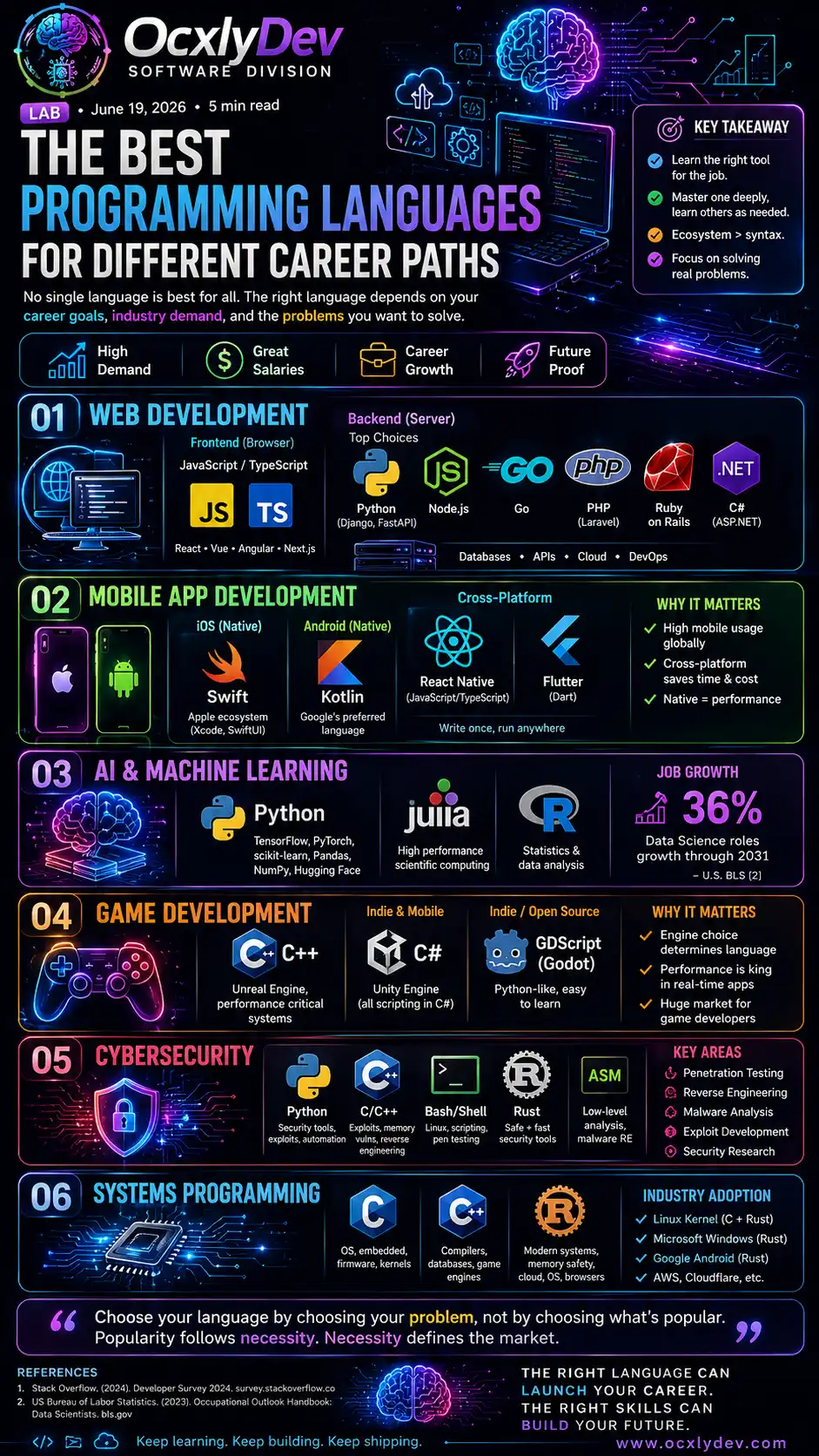
No single programming language is best for all purposes. The optimal language for a given career is determined by ecosystem maturity, industry adoption, performance requirements, and the availability of relevant libraries and frameworks. What follows is a career-by-career breakdown grounded in current industry data and hiring trends.
Web development
Frontend: JavaScript (or TypeScript) is non-negotiable. It is the only language that runs natively in browsers, and TypeScript has become the professional standard for large-scale frontend development. The dominant frameworks (React, Vue, and Angular) are all JavaScript/TypeScript. CSS and HTML are also required, though they are not programming languages in the traditional sense.
Backend: The options are broader. Node.js (JavaScript) enables full-stack development in a single language. Python (Django, FastAPI) is popular for backends that need to integrate with data science workflows. Go is widely adopted for high-performance backend services. PHP powers a significant portion of existing web infrastructure (WordPress, Laravel). Ruby on Rails remains relevant in startups. Java and C# (ASP.NET) dominate enterprise backend development.
The Stack Overflow Developer Survey 2024 found that JavaScript was the most commonly used technology among web developers for the twelfth consecutive year, with TypeScript adoption at 38%.[1]
Mobile app development
iOS: Swift is Apple's official language for iOS, macOS, watchOS, and tvOS development. Objective-C remains in legacy codebases but all new iOS development uses Swift. Swift's safety features, modern syntax, and first-class tooling (Xcode, SwiftUI) make it the only practical choice for native iOS development in 2026.
Android: Kotlin became Google's preferred language for Android development in 2017 and has effectively replaced Java for new Android development. Kotlin compiles to JVM bytecode and is 100% interoperable with Java, making migration gradual. Kotlin Multiplatform (KMP) is also gaining traction for sharing business logic between iOS and Android.
Cross-platform: React Native (JavaScript/TypeScript) and Flutter (Dart) enable building apps for both iOS and Android from a single codebase. Flutter in particular has seen rapid adoption, Dart is purpose-built for Flutter and has a gentle learning curve. For teams that want native-quality performance with cross-platform development, Flutter/Dart is increasingly the choice.
AI and machine learning
Python is the dominant language for AI/ML with no near-term challenger. TensorFlow, PyTorch, JAX, Hugging Face Transformers, scikit-learn, NumPy, and Pandas are all Python-first. The research community publishes in Python; model checkpoints are distributed as Python packages; deployment tooling (FastAPI, BentoML, MLflow) is Python-native.
Julia is used in scientific computing and numerical analysis where Python's performance overhead is problematic, Julia achieves C-level performance with Python-like syntax and is strong in computational linguistics and physics simulations. R remains the language of academic statistics and is still widely used in biostatistics, epidemiology, and social sciences.
The US Bureau of Labor Statistics projects 36% job growth in data science roles through 2031, the fastest of any occupation category tracked.[2] Python proficiency is the table-stakes requirement for entry into this market.
Game development
C++ is the language of AAA game engines. Unreal Engine is written in C++ and exposes C++ APIs for game logic. The performance requirements of real-time 3D rendering (millions of draw calls per frame, complex physics simulations, tight memory budgets) make C++ the practical choice at the engine level. Learning C++ is necessary for any developer targeting engine programming, rendering, or physics systems at major studios.
C# is the language of Unity, the dominant engine for indie and mobile games and an important engine for AA titles. Unity's scripting API is entirely C#-based. C# is more beginner-accessible than C++ while providing sufficient performance for most game logic.
GDScript (Godot's scripting language, Python-adjacent) is gaining ground in the indie space following Godot's rapid growth as a free, open-source Unity alternative post-2023.
Cybersecurity
Cybersecurity professionals typically need proficiency in multiple languages depending on their specialisation. Core requirements:
- Python: the dominant language for security tooling, exploit development, malware analysis, scripting, and automation. Most publicly available security tools (Scapy, Impacket, Metasploit modules) are Python-based.
- C/C++: essential for understanding memory exploitation, buffer overflows, and reverse engineering. You cannot effectively exploit or defend against memory corruption vulnerabilities without understanding how C manages memory.
- Bash/shell scripting: ubiquitous in Linux environments, which dominate server infrastructure and are standard in penetration testing workflows.
- Rust: increasingly used for writing security tools where performance and memory safety are both required.
- Assembly: needed for reverse engineering, malware analysis, and low-level exploit development. Not a primary language but a necessary reading skill.
Systems programming
Systems programming (operating systems, device drivers, embedded firmware, compilers, databases, runtime environments) has historically been the domain of C and C++. In 2026, Rust is making significant inroads.
C remains the language of the Linux kernel (with Rust now also accepted), most embedded systems, and firmware. C++ is used in systems where OOP and abstraction are valued without sacrificing performance, compilers (LLVM is C++), databases (RocksDB, Cassandra), game engines.
Rust is the choice for new systems projects where memory safety matters: browser components (Firefox), OS components (Microsoft Windows, Google Android), cloud infrastructure (AWS Firecracker, Cloudflare Workers). The hiring market for Rust systems engineers is small but growing rapidly, with salaries reflecting the scarcity of expertise.
"Choose your language by choosing your problem, not by choosing what's popular. Popularity follows necessity. Necessity defines the market."
Related reading
- Python vs JavaScript in 2026 — the classic beginner choice.
- Why Rust Is Gaining Popularity — a language worth learning now.
- How Programming Languages Shape Software — matching a language to the work.
References
- Stack Overflow. (2024). Developer Survey 2024. Stack Overflow. survey.stackoverflow.co ↩
- US Bureau of Labor Statistics. (2023). Occupational Outlook Handbook: Data Scientists. BLS. bls.gov ↩