The Psychology Behind
Bestselling Books
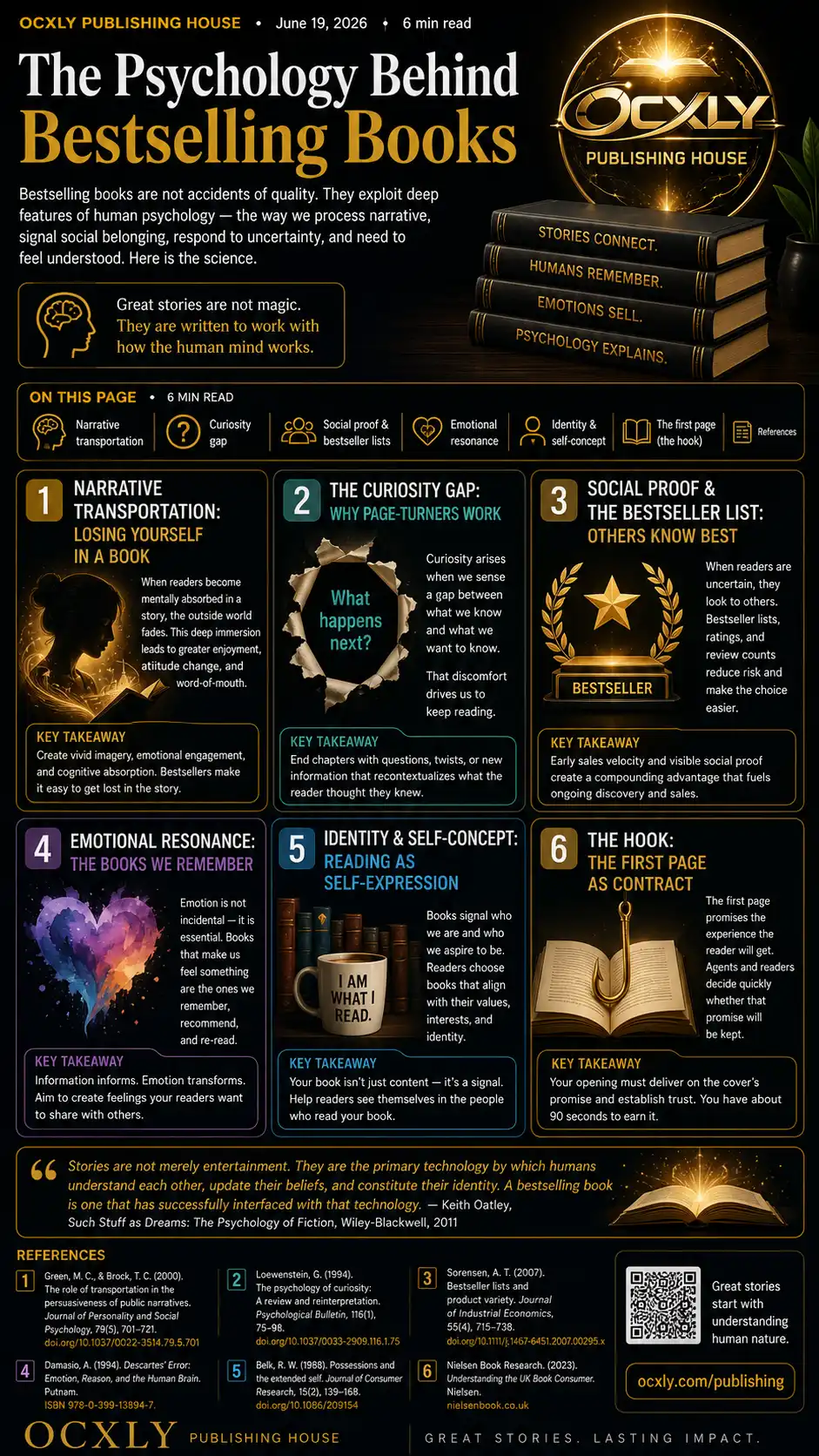
Bestselling books are not accidents of quality. They exploit deep features of human psychology: the way we process narrative, signal social belonging, respond to uncertainty, and need to feel understood. Here is the science.
The publishing industry operates on taste, instinct, and editorial judgement refined over careers. But beneath that professional culture lies a body of empirical research on why humans read, what we remember, what we recommend, and what we buy. Understanding this research does not replace good writing, but it explains why good writing succeeds when it does, and why capable writing sometimes fails to connect.
Narrative transportation: losing yourself in a book
The most foundational concept in reader psychology is narrative transportation, the phenomenon in which readers become mentally absorbed in a story to the point where the external world recedes. Psychologists Melanie Green and Timothy Brock coined the term in their influential 2000 paper, demonstrating through controlled experiments that readers who experienced high narrative transportation were more likely to have their attitudes and beliefs changed by a story, more likely to find the story enjoyable, and more likely to recommend it.[1]
Transportation requires three conditions: vivid mental imagery (readers must be able to construct the scene in their minds), emotional engagement (readers must care about what happens to at least one character), and cognitive absorption (the text must not require so much effort to process that self-awareness breaks through). Bestselling commercial fiction consistently achieves all three, and typically sacrifices stylistic complexity to protect the third. This is not literary compromise; it is reader psychology, applied.
The curiosity gap: why page-turners work
Information-gap theory, developed by George Loewenstein at Carnegie Mellon University, proposes that curiosity arises when a person is aware of a gap between what they know and what they want to know.[2] The discomfort of the gap creates motivation to close it. Every thriller chapter that ends on an unanswered question, every mystery that withholds the killer's identity, every romance that delays the inevitable meeting: these are structural implementations of information-gap theory.
The practical craft implication: chapter endings that resolve questions reduce the compulsion to continue reading. Chapter endings that open questions, or recontextualise what the reader thought they knew, create it. This is why "just one more chapter" is a genuine cognitive experience, not a metaphor. The unresolved curiosity gap is mildly aversive; closing the book leaves it open; continuing reading is the path to relief.
Social proof and the bestseller list
The bestseller list is not merely a measurement of sales. It is a marketing tool that exploits social proof, the tendency of humans to use other people's choices as evidence of quality when their own assessment is uncertain. A reader browsing 30 million available titles has no independent basis for evaluating most of them. "This book sold 100,000 copies" is information that substitutes for that evaluation.
Research by economist Alan Sorensen demonstrated that New York Times bestseller list placement causes a measurable increase in a book's subsequent sales, not because the list contains only books of exceptional quality, but because the list itself functions as a social proof signal that reduces purchase uncertainty.[3] The same mechanism operates on Amazon bestseller rankings, Goodreads ratings, and BookTok view counts: visible evidence of other readers' choices makes individual purchase decisions easier.
The implication for authors: early sales velocity matters disproportionately, not because early buyers are better readers, but because the social proof signals generated in the first weeks of publication compound into discovery advantages that persist for months or years.
Emotional resonance: the books we remember
Cognitive neuroscientist Antonio Damasio's research on emotion and decision-making established that emotional engagement is not incidental to rational evaluation; it is a prerequisite for it.[4] Patients with damage to brain regions governing emotional processing struggle to make decisions even when their analytical faculties are intact. They can evaluate options but cannot choose between them.
In reader psychology, this means that books which generate emotional responses (awe, grief, hope, terror, love, moral outrage) are more likely to be remembered, recommended, and re-read than books that are merely competent or informative. The most recommended books are almost never the most intellectually rigorous ones. They are the ones that made readers feel something they wanted others to feel too.
Non-fiction books are not exempt from this principle. The most commercially successful non-fiction titles (Sapiens, The Body, Thinking, Fast and Slow) are emotionally engaging as well as intellectually substantive. They create a sense of wonder, or urgency, or self-recognition. The information is the vehicle; the feeling is the product.
Identity and self-concept: reading as self-expression
Books function as identity signals. The books displayed on a shelf, carried in a bag, or featured in a social media post communicate something about the reader's self-concept, who they are or who they aspire to be. Research in consumer behaviour consistently finds that products that align with self-concept are purchased at higher rates and retained longer than products selected purely on functional grounds.[5]
For authors and publishers, this means that books which allow readers to signal a valued identity (intellectual curiosity, social awareness, sophisticated taste, progressive values, or genre expertise) have a marketing advantage beyond their content quality. Cover design, title, author endorsements, and publication context all contribute to the identity signal a book carries. A book that says something appealing about its reader, by virtue of being owned and displayed, will sell more than an identical book that does not.
"Stories are not merely entertainment. They are the primary technology by which humans understand each other, update their beliefs, and constitute their identity. A bestselling book is one that has successfully interfaced with that technology."
— Keith Oatley, Such Stuff as Dreams: The Psychology of Fiction, Wiley-Blackwell, 2011
The hook: the first page as contract
The opening pages of a book serve a psychological function distinct from their narrative function. They are a contract: a demonstration to the reader that the author knows their genre, can deliver the expected emotional experience, and will not waste their time. Literary agents who read 50 query submissions per week make keep/discard decisions in the first page or less, not because they are dismissive, but because the first page reliably predicts whether the contract will be honoured throughout the manuscript.
Readers who pick up books in shops make the same assessment. Research on retail browsing behaviour shows that most purchase decisions are made within 90 seconds of picking up a book, a time window that covers the cover assessment, the back cover read, and the first page sample.[6] A first page that delivers on the cover's promise converts browsers to buyers; a first page that doesn't, regardless of what follows on page 50, does not.
Related reading
- The Art of Book Cover Design — the visual side of appeal.
- How to Market a Book on a Small Budget — turning appeal into sales.
- How to Turn Expertise into a Published Book — writing a book people want.
References
- Green, M. C., & Brock, T. C. (2000). The role of transportation in the persuasiveness of public narratives. Journal of Personality and Social Psychology, 79(5), 701–721. doi.org ↩
- Loewenstein, G. (1994). The psychology of curiosity: A review and reinterpretation. Psychological Bulletin, 116(1), 75–98. doi.org ↩
- Sorensen, A. T. (2007). Bestseller lists and product variety. Journal of Industrial Economics, 55(4), 715–738. doi.org ↩
- Damasio, A. (1994). Descartes' Error: Emotion, Reason, and the Human Brain. Putnam. ISBN 978-0-399-13894-7. ↩
- Belk, R. W. (1988). Possessions and the extended self. Journal of Consumer Research, 15(2), 139–168. doi.org ↩
- Nielsen Book Research. (2023). Understanding the UK Book Consumer. Nielsen. nielsenbookdata.co.uk ↩