Publishing Trends
to Watch in 2026
The book industry is changing faster than at any point since the ebook disruption of 2008–2012. Here are the forces that matter: what they mean for authors, publishers, and readers.
Publishing is a conservative industry in many respects, it resists change, moves slowly, and has a long institutional memory of disruptions that turned out to be less disruptive than predicted. Ebooks were supposed to kill print. They didn't. Self-publishing was supposed to flood the market with unreadable content and devalue books. The market adapted. Subscription models were supposed to replace ownership. They coexist with it.
And yet the industry is genuinely changing. Some of that change is incremental; some of it is structural. Understanding which trends have real staying power and which are noise is essential for anyone making publishing decisions in 2026.
1. Audiobooks: the fastest-growing format
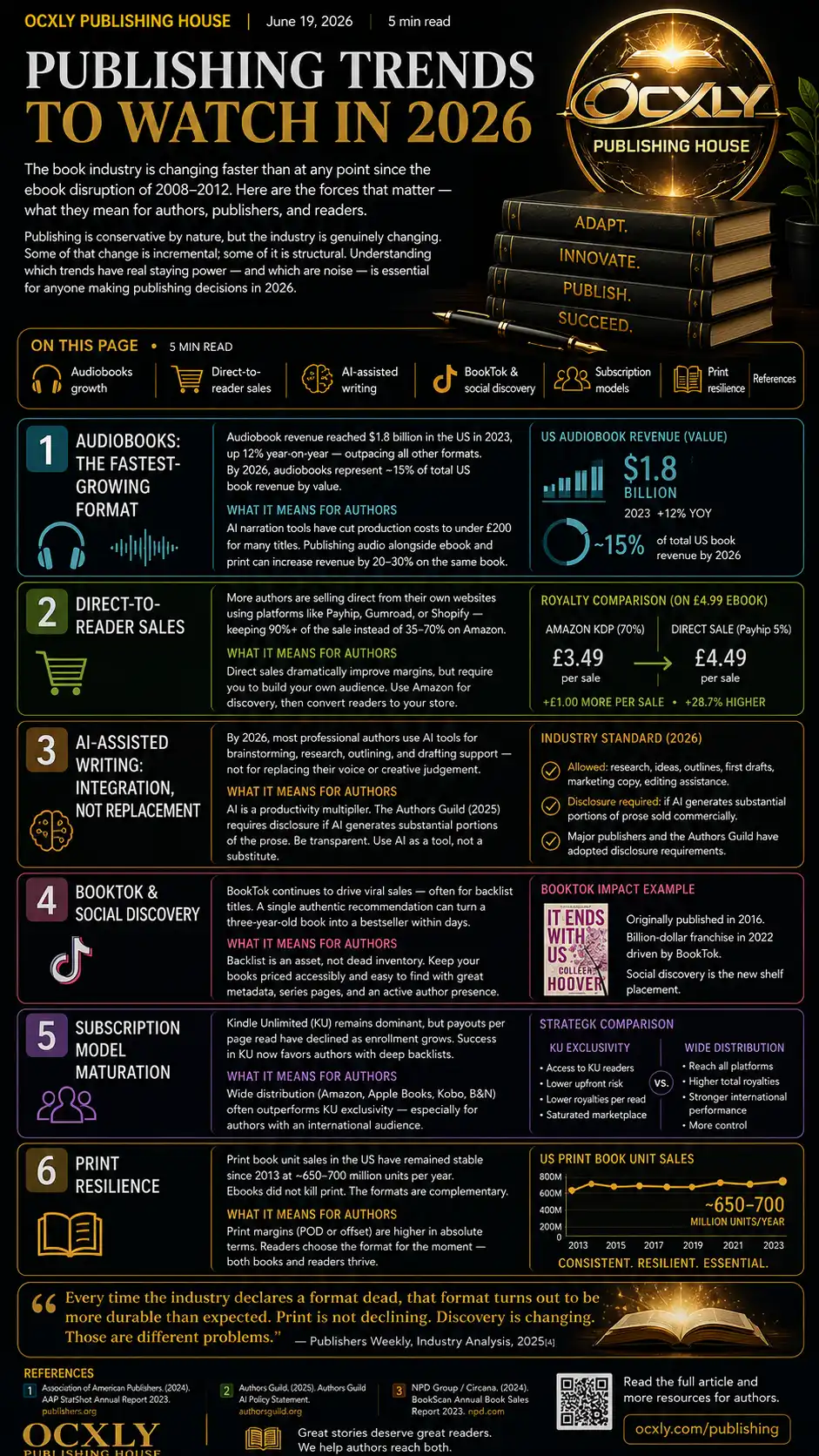
Audiobook revenue has grown consistently for ten consecutive years. The Association of American Publishers reported audiobook revenue of $1.8 billion in the US in 2023, representing 12% year-on-year growth, significantly outpacing all other book formats.[1] By 2026, audiobooks represent approximately 15% of total US book revenue by value.
For self-publishing authors, the audiobook opportunity has been transformed by AI narration tools (ElevenLabs, Descript, Amazon's ACX AI narration). The cost of producing a professional-quality audiobook has dropped from £2,000–£5,000 (human narrator) to under £200 for many titles. Distribution through Findaway Voices, ACX, and direct licensing to Spotify and Apple Books is now accessible to any author. Authors who publish audio alongside their ebook and print editions routinely see 20–30% revenue uplift on the same title.
2. Direct-to-reader sales
The most significant strategic shift in author business in 2025–2026 is the move toward direct sales, authors selling ebooks and print books directly from their own websites using platforms like Payhip, Gumroad, or Shopify, bypassing Amazon and receiving 90%+ royalties instead of 35–70%.
The driver is economics: a self-publishing author selling an ebook at £4.99 through Amazon receives £3.49 (70% royalty). The same author selling directly receives £4.49 (after Payhip's 5% fee). At scale, this difference is substantial. The obstacle is discovery, Amazon's algorithm surfaces books to buyers; the author's own website does not. Authors who are successfully going direct typically use Amazon for discovery, then convert readers to their direct store via back-matter links, offering exclusive content or bundle pricing as incentive.
3. AI-assisted writing: integration, not replacement
The discourse around AI in publishing oscillated wildly between 2023 and 2025, AI will replace authors; AI will be banned from publishing; AI is useless for creative work. By 2026, the reality is more pragmatic: AI tools are used by the majority of professional authors for specific functions, brainstorming, research synthesis, first-draft generation of mechanical content (character backstory documents, series bibles, marketing copy), and editing assistance, without replacing the author's voice or narrative judgement.
The Authors Guild's position, updated in 2025, acknowledges AI assistance while requiring disclosure on AI-generated content sold commercially.[2] The major publishing houses have adopted similar disclosure requirements. For self-publishing authors, the practical standard is: disclose if AI generated substantial portions of the prose; no disclosure required for AI as a research or planning tool.
4. BookTok and social discovery
TikTok's #BookTok community has driven measurable sales impact on backlist titles, books published years or decades ago, in a way that no previous social media platform managed. It Ends With Us by Colleen Hoover, originally published in 2016, became a billion-dollar franchise in 2022 driven almost entirely by BookTok recommendation cycles. The phenomenon is not an anomaly; it reflects how the platform's algorithm surfaces content based on engagement velocity rather than recency.
For authors, the practical implication is: backlist titles are not dead assets. A single BookTok video with genuine reader enthusiasm can revive a three-year-old book to bestseller status within days. Authors who maintain their backlist at accessible price points and ensure their books are easily findable once a reader is interested (good metadata, a working series page, an active author website) are positioned to benefit from these viral cycles.
5. Subscription model maturation
Kindle Unlimited (KU) remains the dominant subscription model for ebooks, but its economics have shifted. Page-read payouts in KU have declined as the pool of books enrolled grows faster than subscription revenue. Romance, science fiction, and fantasy, the genres most dependent on KU, are seeing a bifurcation: authors with large backlists and loyal KU readerships doing well; newer authors entering an increasingly crowded market finding KU payouts insufficient.
The counter-trend is wide distribution, publishing across all platforms (Amazon, Apple Books, Kobo, Barnes & Noble) rather than Amazon-exclusive. For authors with a non-US readership base, wide distribution consistently outperforms KU exclusivity. Kobo's market share in Canada, Australia, and the UK makes it significant for English-language books with international audiences.
6. Print resilience
Print book unit sales in the US have remained remarkably stable since 2013, consistently around 650–700 million units per year according to NPD BookScan data.[3] Ebooks did not kill print. If anything, the formats have proved complementary, readers consume both, depending on context. The continued strength of print benefits authors because print margins (through POD or offset) are higher in absolute dollar terms than ebook royalties at most price points.
"Every time the industry declares a format dead, that format turns out to be more durable than expected. Print is not declining. Discovery is changing. Those are different problems."
— Publishers Weekly, Industry Analysis, 2025[4]
Related reading
- How to Choose the Right Publishing Path — adapting your route to the trends.
- How to Market a Book on a Small Budget — marketing in the new landscape.
- Author Success Stories — authors riding these trends.
References
- Association of American Publishers. (2024). AAP StatShot Annual Report 2023. AAP. publishers.org ↩
- Authors Guild. (2025). Authors Guild AI Policy Statement. Authors Guild. authorsguild.org ↩
- NPD Group / Circana. (2024). BookScan Annual Book Sales Report 2023. Circana. circana.com ↩
- Publishers Weekly. (2025). Annual Industry Report 2025. Publishers Weekly. publishersweekly.com ↩