Python vs JavaScript in 2026:
Which Should You Learn First?
Both languages dominate the most-used rankings. Both are beginner-accessible. Both lead to well-paying jobs. The answer to which you should learn first is not the same for every person, but it is answerable.
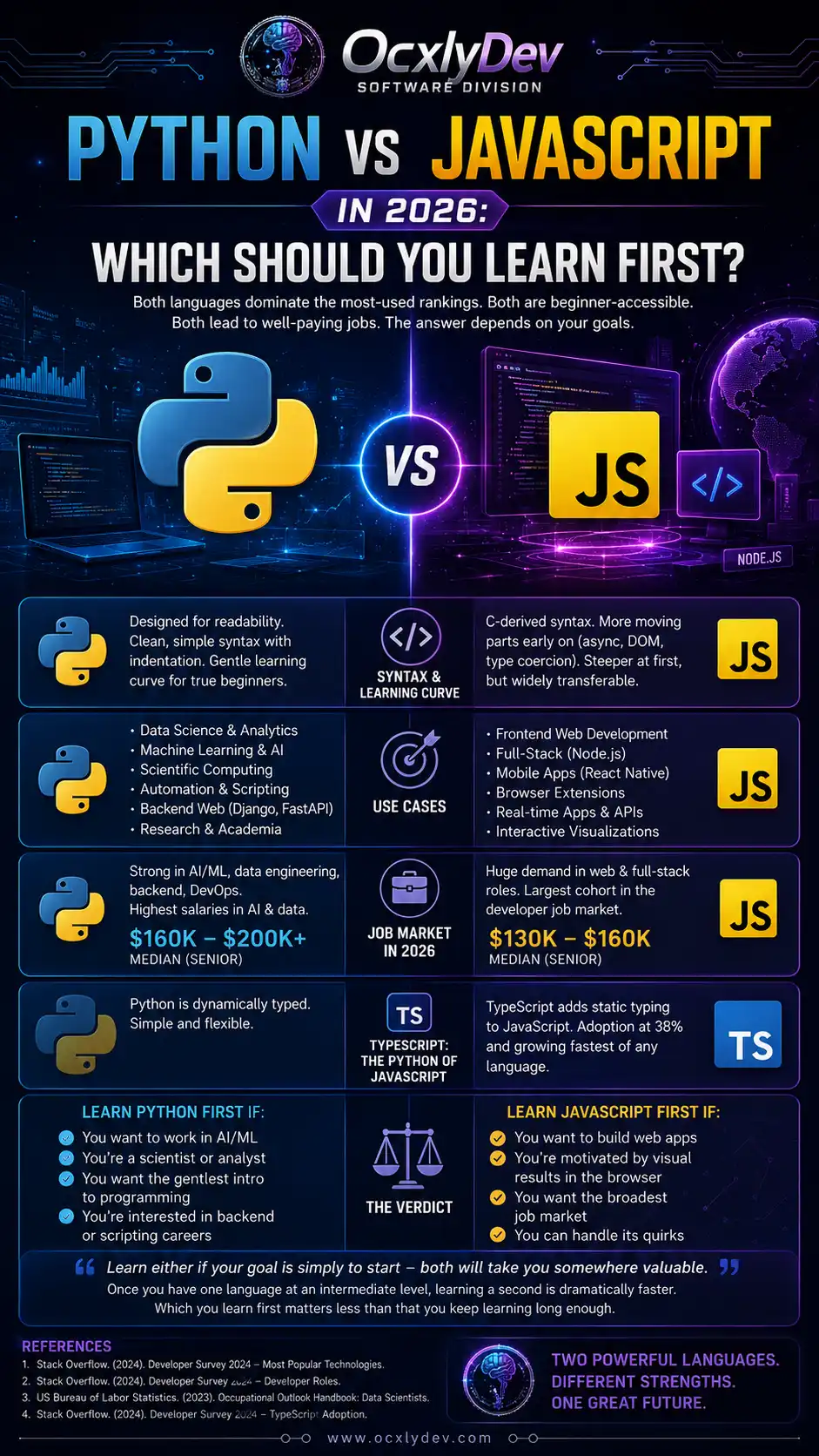
Python and JavaScript are the two most widely used programming languages in the world in 2026. The Stack Overflow Developer Survey 2024 ranked JavaScript as the most commonly used language for the twelfth consecutive year, with Python second and growing fastest among learners.[1] Both are legitimate answers to "what should I learn first." Neither is the right answer for everyone. The choice depends on what you want to build, which job market you are entering, and which learning experience will keep you motivated enough to finish.
Syntax and learning curve
Python was explicitly designed for readability. Its syntax enforces indentation-based block structure, uses English keywords where other languages use symbols, and has minimal boilerplate for basic operations. A complete, working Python program that reads a file and prints its contents is three lines. The same program in Java is twelve.
JavaScript's syntax is C-derived, curly braces, semicolons (optional but conventionally present), and a family resemblance to C++, Java, and C# that makes it easier to read for anyone with prior experience in those languages. For a true beginner, however, JavaScript has several characteristics that make early learning harder: asynchronous programming patterns (callbacks, Promises, async/await) appear very early in practical use; the browser environment adds a layer of DOM complexity; and JavaScript's type coercion rules produce surprising results ("1" + 1 === "11" rather than 2).
For most beginners, Python has a more forgiving initial learning curve. The concepts of variables, loops, functions, and data structures can be explored without encountering the browser environment or asynchronous complexity.
Use cases
Python dominates: data science and analytics, machine learning and AI (TensorFlow, PyTorch, scikit-learn are Python-first), scientific computing (NumPy, SciPy, Pandas), automation and scripting, backend web development (Django, FastAPI, Flask), and academic research. Python's position in AI is structural, the major ML frameworks are built around it, and this is unlikely to change in the near term.
JavaScript is the only language that runs natively in web browsers, making it non-optional for frontend web development. Node.js extended JavaScript to server-side development, and React Native extended it to mobile apps. A full-stack developer working exclusively with JavaScript (React frontend, Node.js backend) has a coherent, high-demand skill set. JavaScript is also the dominant language for browser extensions, interactive data visualisations (D3.js), and real-time applications.
Job market in 2026
Both languages offer strong employment prospects, but in different segments of the market.
JavaScript/TypeScript roles are predominantly frontend, full-stack, and web-focused. The demand is very high, virtually every company with a web presence needs JavaScript developers. The Stack Overflow survey consistently shows JavaScript developers as the largest single cohort in the developer job market.[2]
Python roles are concentrated in data engineering, machine learning, backend API development, and DevOps/automation. Python developers in AI and data science roles command the highest median salaries in the software industry, the US Bureau of Labor Statistics projects data scientist roles (predominantly Python-based) to grow 36% through 2031, far above average job growth.[3]
The salary differential at the senior level: Python/AI engineers in the US earn median salaries of $160,000–$200,000+, reflecting the acute shortage of ML expertise. Senior JavaScript developers earn $130,000–$160,000 median. Both represent strong career outcomes; the gap is real but requires years of specialisation to access.
TypeScript: the Python of JavaScript
A significant trend in the JavaScript ecosystem is the adoption of TypeScript, a statically typed superset of JavaScript developed by Microsoft. TypeScript adds optional type annotations that are stripped at compile time, producing plain JavaScript. The Stack Overflow survey found that TypeScript adoption has grown faster than any other language for five consecutive years, now used by 38% of developers.[4]
For learners planning to work in production JavaScript environments, learning TypeScript alongside (or shortly after) JavaScript is now essentially mandatory for professional web development roles.
The verdict
"Learn Python if your goal is data, AI, or scripting. Learn JavaScript if your goal is the web. Learn either if your goal is simply to start — both will take you somewhere valuable."
More specifically:
- Learn Python first if: you want to work in AI/ML; you're a scientist or analyst automating workflows; you want the gentlest introduction to programming concepts; you're interested in backend or scripting careers.
- Learn JavaScript first if: you want to build web applications; you're motivated by seeing immediate visual results in a browser; you want the broadest possible job market; you already have some coding experience and can handle its quirks.
The honest longer answer: once you have one language at an intermediate level, learning a second is dramatically faster. The question of which to learn first matters less than the question of which will keep you learning long enough to reach that intermediate level.
Related reading
- Best Languages for Different Career Paths — which fits your goal.
- Python for Absolute Beginners — start with Python, hands-on.
- Compiled vs Interpreted Languages — how both actually run.
References
- Stack Overflow. (2024). Developer Survey 2024, Most Popular Technologies. Stack Overflow. survey.stackoverflow.co ↩
- Stack Overflow. (2024). Developer Survey 2024, Developer Roles. Stack Overflow. survey.stackoverflow.co ↩
- US Bureau of Labor Statistics. (2023). Occupational Outlook Handbook: Data Scientists. BLS. bls.gov ↩
- Stack Overflow. (2024). Developer Survey 2024, TypeScript Adoption. Stack Overflow. survey.stackoverflow.co ↩