What Makes a
Programming Language Successful?
The history of programming languages is littered with technically superior languages that failed and technically mediocre ones that conquered the world. Language design is necessary but not sufficient. Here is what else matters.
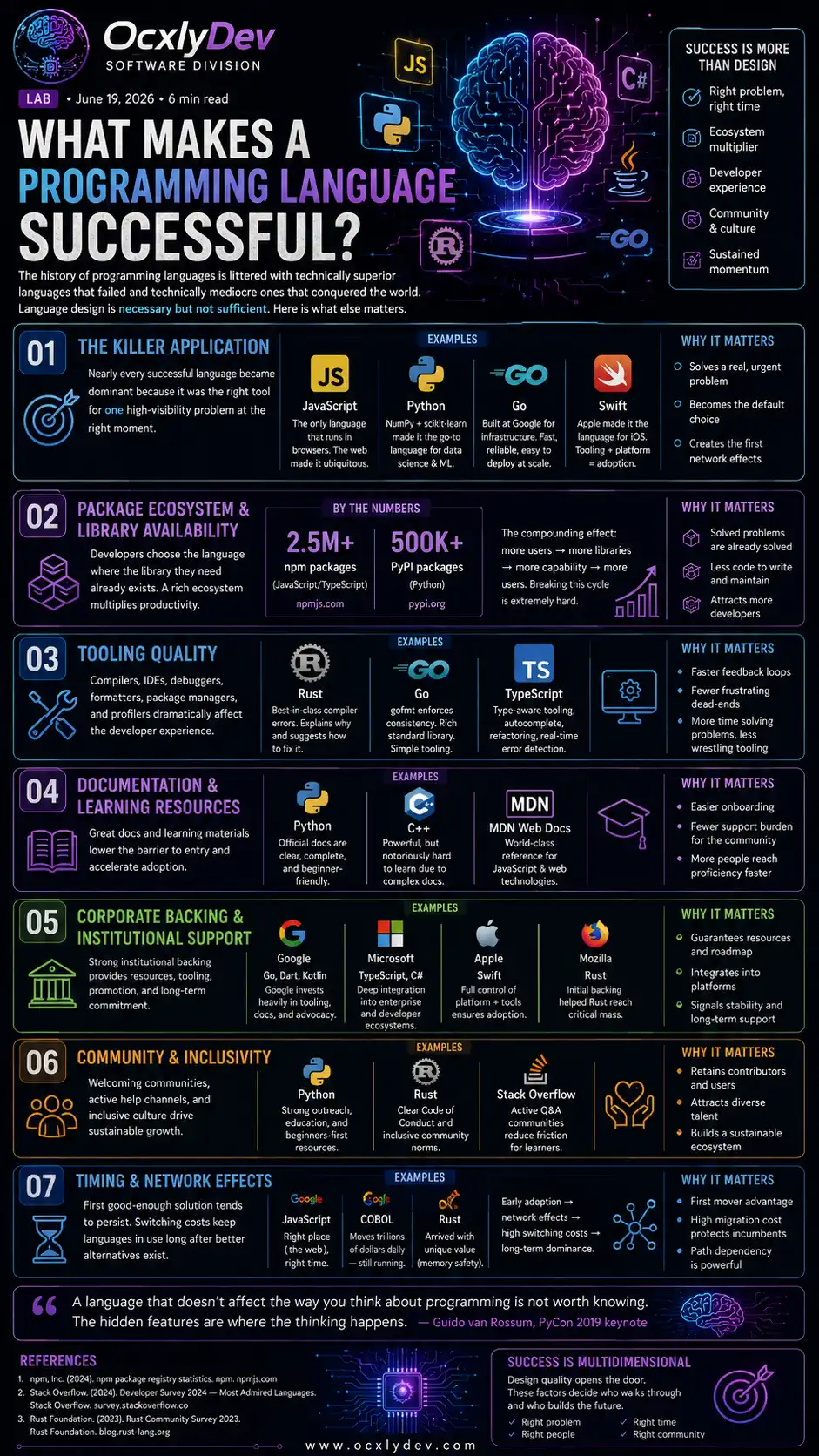
If programming language success correlated with design quality, the industry would look very different. LISP would power the web. Haskell would run enterprise backends. Ada would write operating systems. Instead, JavaScript (created in ten days, inconsistent by design, famously full of quirks) is the most widely used programming language on Earth. C, designed in 1972 with no memory safety, writes critical infrastructure in 2026. PHP, widely derided by computer scientists, powers 77% of all websites with server-side code.
Understanding language success requires looking beyond design quality to the social, economic, and historical factors that determine adoption. These factors are more predictive than any measure of technical elegance.
The killer application
Nearly every successful programming language became dominant because it was the right tool for one high-visibility problem at the right moment. This is the single most reliable predictor of language success.
- JavaScript was Netscape's browser scripting language. The web's explosive growth dragged it to ubiquity. There was no competition; it was the only language browsers supported.
- Python became the language of data science because NumPy (2006) and scikit-learn (2007) were Python-first. When the ML research community moved to Python, everyone who wanted to use their tools followed.
- Go was designed at Google for Google's infrastructure problems, large-scale networked services, fast compilation, easy deployment. Google's internal adoption and subsequent open-sourcing brought it to the cloud infrastructure community.
- Swift is the language of iOS development because Apple made it so. Apple's control of the iOS developer tools meant Swift's adoption was guaranteed the moment it replaced Objective-C as the recommended language.
The implication: a language does not need to be the best general-purpose language to succeed. It needs to be the best, or most available, language for one important problem.
Package ecosystem and library availability
No developer uses a language in isolation. They use the language plus its ecosystem, the libraries, frameworks, and tools available for it. A language with a rich ecosystem multiplies developer productivity; a language without one requires building everything from scratch.
Python's PyPI hosts over 500,000 packages. npm (JavaScript) hosts over 2.5 million. The sheer availability of solved problems in these ecosystems creates a gravitational pull: developers choose the language where the library they need already exists, not the language where they would have to write it.[1]
This creates a compounding advantage: popular languages attract library authors, which makes the language more capable, which attracts more users, which attracts more library authors. Breaking this cycle, as Rust is attempting to do for systems programming, requires either significantly superior technical properties or strong institutional backing.
Tooling quality
The quality of a language's surrounding tooling (compiler error messages, IDE support, debuggers, profilers, package managers, build systems) dramatically affects the developer experience independently of the language itself.
Rust's compiler is widely regarded as producing the most helpful error messages of any compiled language. When the borrow checker rejects code, it typically explains exactly why, suggests a fix, and often links to documentation. This pedagogical quality in the compiler is a significant factor in Rust's developer satisfaction scores.[2]
Go ships with gofmt, an opinionated formatter that produces identical output for all Go code, eliminating style debates. Go's standard library is famously comprehensive: HTTP servers, JSON encoding, cryptography, testing, and more are available without third-party dependencies. This reduces decision fatigue and makes the "getting started" experience unusually smooth.
TypeScript's IDE integration (type-aware autocompletion, refactoring support, real-time error detection) transformed the JavaScript development experience and is a primary driver of its rapid adoption within the JavaScript community.
Documentation and learning resources
Python's official documentation is often cited as an exemplar of language documentation, comprehensive, well-organised, accessible to beginners, and precise for experts. The existence of high-quality, freely available learning resources (Python.org tutorials, the Python documentation, Real Python, countless books) dramatically lowers the barrier to adoption.
By contrast, C++ documentation is notoriously difficult, cppreference.com is accurate but dense, and learning C++ in 2026 requires navigating 40 years of accumulated features, idioms, and anti-patterns. This does not prevent C++ adoption where it is necessary, but it does slow adoption by developers who have alternatives.
Corporate backing and institutional support
The history of programming language success correlates strongly with institutional support. Languages without institutional backing, regardless of technical quality, face an uphill battle against languages with a major company committed to their development, tooling, and promotion.
- Google backs Go, Dart, and Kotlin (Android). All three have achieved significant adoption.
- Microsoft backs TypeScript and C#. TypeScript has become the professional JavaScript standard. C# dominates .NET development.
- Apple backs Swift. Swift has essentially replaced Objective-C for all new Apple platform development.
- Mozilla backed Rust. Rust achieved community critical mass after Mozilla adoption and has since been adopted by Microsoft, Google, Amazon, and the Linux kernel team.
Languages designed by individuals without institutional backing, regardless of quality, rarely achieve broad adoption. Elm is an excellent functional language for browser development; it has not achieved significant market penetration. Nim is technically impressive; it remains niche. The pattern is consistent.
Community and inclusivity
A language's community culture affects its growth trajectory. Communities that are welcoming to beginners, active in answering questions (Stack Overflow participation rates, Discord server responsiveness), and productive in governance attract more contributors and users than insular or hostile ones.
Python's community has historically invested heavily in documentation, tutorials, and outreach, particularly toward beginners and underrepresented groups in tech. This contributed to Python's popularity in data science education and in non-traditional programming contexts (journalism, scientific research, arts). The Rust community's Code of Conduct and documentation of community norms have been credited with attracting a more diverse contributor base than comparable systems languages.[3]
"A programming language is not just a notation. It is a community. The language succeeds or fails with the community around it — and communities are built by people, not compilers."
— Guido van Rossum, PyCon 2019 keynote
Timing and network effects
Language success is path-dependent: the first good-enough language for a given problem domain tends to persist long after better alternatives emerge, because the cost of migrating an existing codebase and retraining an existing team is high. COBOL still processes an estimated $3 trillion in daily commerce transactions not because it is the best available language but because the switching cost of moving off it is enormous.
For new entrants, timing matters enormously. A language that arrives before a market is ready finds no users. A language that arrives after a language has achieved dominance faces network-effect barriers that require exceptional technical differentiation to overcome, which is why Rust's memory safety guarantees had to be genuinely unique to succeed in a C/C++ world that had resisted previous challengers.
Related reading
- The Most Influential Programming Languages — success stories in practice.
- Why Rust Is Gaining Popularity — a language earning its adoption.
- The Evolution of Programming Languages — what survived and why.
References
- npm, Inc. (2024). npm package registry statistics. npm. npmjs.com ↩
- Stack Overflow. (2024). Developer Survey 2024, Most Admired Languages. Stack Overflow. survey.stackoverflow.co ↩
- Rust Foundation. (2023). Rust Community Survey 2023. Rust Foundation. blog.rust-lang.org ↩