Why Rust Is Gaining
Popularity Among Developers
For nine consecutive years, Rust has been the most admired programming language in the Stack Overflow Developer Survey. That is not hype: it reflects something genuine about what Rust offers that no other language does.
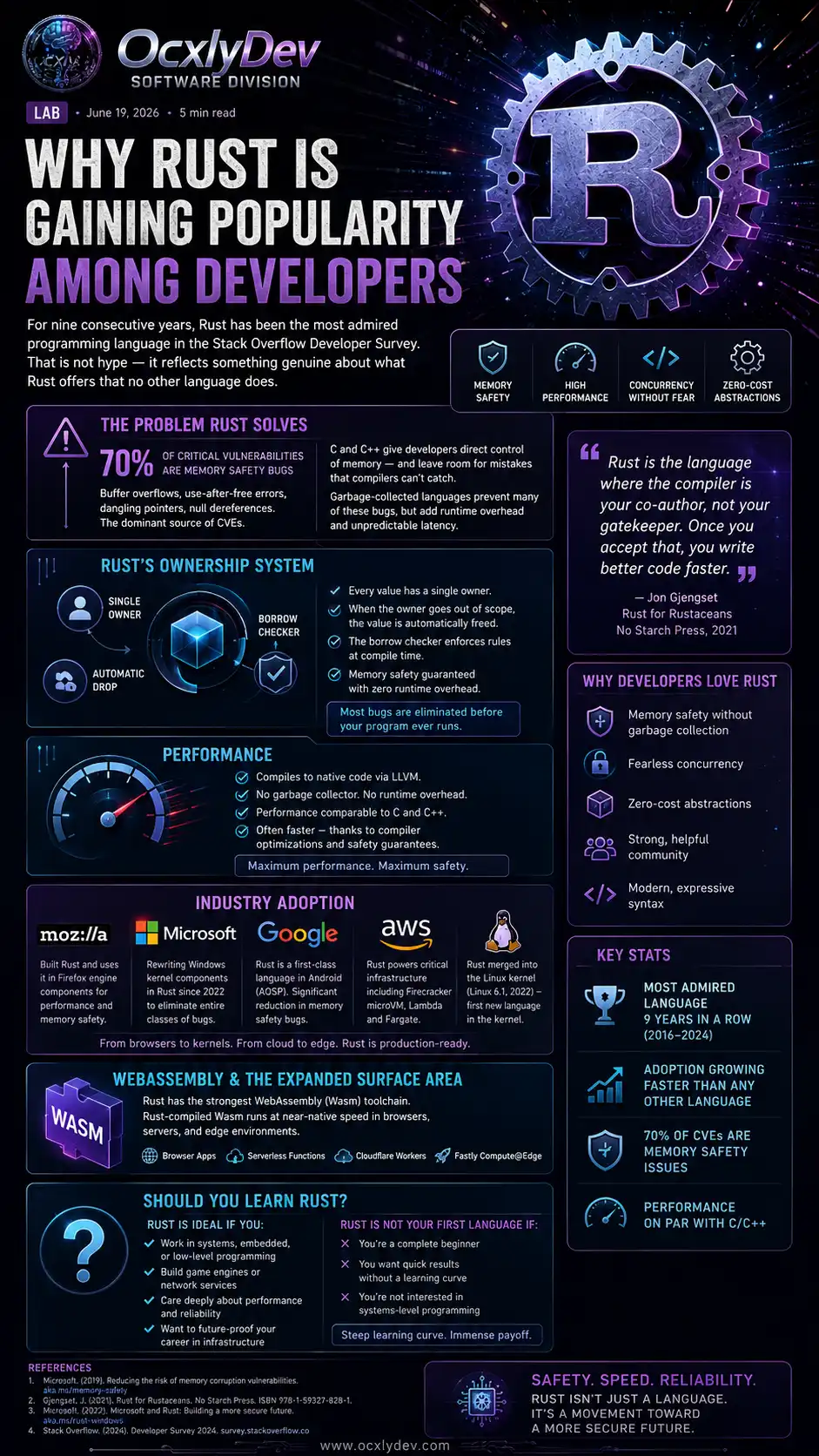
Rust occupies an unusual position in programming language history. It solves a problem that many thought unsolvable: providing memory safety guarantees equivalent to a garbage-collected language at runtime performance equivalent to C, without a garbage collector. That claim requires unpacking, because the problem it solves is one that has caused some of the most expensive software failures in history.
The problem Rust solves
Memory safety bugs are the dominant source of critical vulnerabilities in systems software. A 2019 analysis of Microsoft's security bulletins found that approximately 70% of CVEs (Common Vulnerabilities and Exposures) over the preceding decade were memory safety issues, buffer overflows, use-after-free errors, dangling pointers, null pointer dereferences.[1] Similar analyses of the Chrome and Android codebases produced comparable numbers.
These bugs occur in C and C++ because those languages give programmers direct control over memory (allocating it, accessing it, and freeing it) without enforcing rules about when memory can be accessed. A pointer to memory that has been freed remains valid syntax; the program will compile and may run for years before the use-after-free triggers a crash or is exploited.
The traditional solutions were either: accept the memory safety bugs (C/C++), or use a garbage collector (Java, Go, Python, C#) that tracks live memory automatically and prevents most memory bugs. Garbage collection works, but it introduces latency pauses when the collector runs, and its overhead in memory and CPU usage makes it unsuitable for systems programming contexts where predictable, low-latency performance is required.
Rust's ownership system
Rust's solution is a compile-time ownership and borrowing system. Every value in Rust has a single owner. When the owner goes out of scope, the value is automatically freed, no garbage collector needed. References to values must follow borrow-checker rules: at any point, there can be either one mutable reference or any number of immutable references, but never both simultaneously. These rules are enforced by the compiler; programs that violate them do not compile.
The result: memory safety is guaranteed at compile time, with zero runtime overhead. The borrow checker eliminates the class of bugs that constitutes 70% of systems software vulnerabilities, before the program ever runs.
The cost is a steeper learning curve. The borrow checker rejects code patterns that C and C++ accept freely, and new Rust programmers spend significant time learning to satisfy it. This "fighting the borrow checker" experience is often cited as Rust's primary barrier to adoption. Experienced Rust developers describe the transition as a shift in mental model rather than a difficulty, once the ownership model is internalised, writing Rust feels natural.[2]
Performance
Rust compiles to native code via LLVM, the same compiler backend used by C and C++. Rust programs have no garbage collector, no runtime overhead beyond what the programmer explicitly pays for, and can be tuned as aggressively as C. Benchmark comparisons between Rust and C consistently show Rust within a few percent of C performance, with Rust occasionally outperforming C due to optimisations the compiler can make given the ownership guarantees.
For systems where both performance and correctness matter (operating systems, browsers, game engines, network services, embedded systems) Rust represents a genuinely superior option to C and C++ for new development.
Industry adoption
The adoption of Rust at major technology companies is no longer a curiosity; it is a trend with strategic implications. Key milestones:
- Mozilla developed Rust and used it to rewrite parts of the Firefox browser engine (Servo project). Rust's ownership model was directly motivated by the memory safety bugs Mozilla engineers encountered in C++.
- Microsoft has been rewriting Windows kernel components in Rust since 2022, citing memory safety as the primary motivation.[3] Azure infrastructure components are increasingly Rust-based.
- Google made Rust a first-class language in the Android Open Source Project in 2021. New code in Android's lower layers is increasingly written in Rust, and Google has reported a significant reduction in memory safety vulnerabilities in components rewritten from C/C++ to Rust.
- Amazon Web Services uses Rust in performance-critical components of its cloud infrastructure, including the Firecracker microVM that powers AWS Lambda and Fargate.
- Linux kernel merged Rust as the second official language for kernel development in Linux 6.1 (2022), the first new language in the kernel since C.
WebAssembly and the expanded surface area
Rust's role in WebAssembly (Wasm) has expanded its relevance beyond systems programming. Wasm is a binary instruction format that runs at near-native speed in web browsers and server environments. Rust has the strongest Wasm toolchain of any language, and Rust-compiled Wasm is used in performance-critical browser applications, serverless functions, and plugins for platforms including Cloudflare Workers and Fastly Compute@Edge.
"Rust is the language where the compiler is your co-author, not your gatekeeper. Once you accept that, you write better code faster."
— Jon Gjengset, Rust for Rustaceans, No Starch Press, 2021
Should you learn Rust?
Rust is not the right first language for most developers, its learning curve is steep and its practical application is concentrated in systems programming contexts. But for developers working in systems, embedded, game development, network services, or WebAssembly, or for developers who want to deeply understand memory management, Rust offers something no other language does: the ability to write systems-level software with memory safety guarantees. That combination is rare, valuable, and increasingly sought by employers working on infrastructure that cannot afford to fail.
Related reading
- What Makes a Programming Language Successful? — why Rust is winning adoption.
- The Most Influential Programming Languages — the lineage Rust builds on.
- Best Languages for Different Career Paths — where Rust fits a career.
References
- Microsoft Security Response Center. (2019). A proactive approach to more secure code. Microsoft. msrc.microsoft.com ↩
- Stack Overflow. (2024). Developer Survey 2024, Most Admired Languages. Stack Overflow. survey.stackoverflow.co ↩
- Klabnik, S., & Nichols, C. (2023). The Rust Programming Language, 2nd ed. No Starch Press. doc.rust-lang.org ↩