The ROI of an ad-free strategy: why removing banner ads is a long game, not a loss
Banner ads look like free money. The cost shows up later and somewhere else — in attention, page speed, and the one asset that compounds: trust. This is the multi-year business case for taking them out.
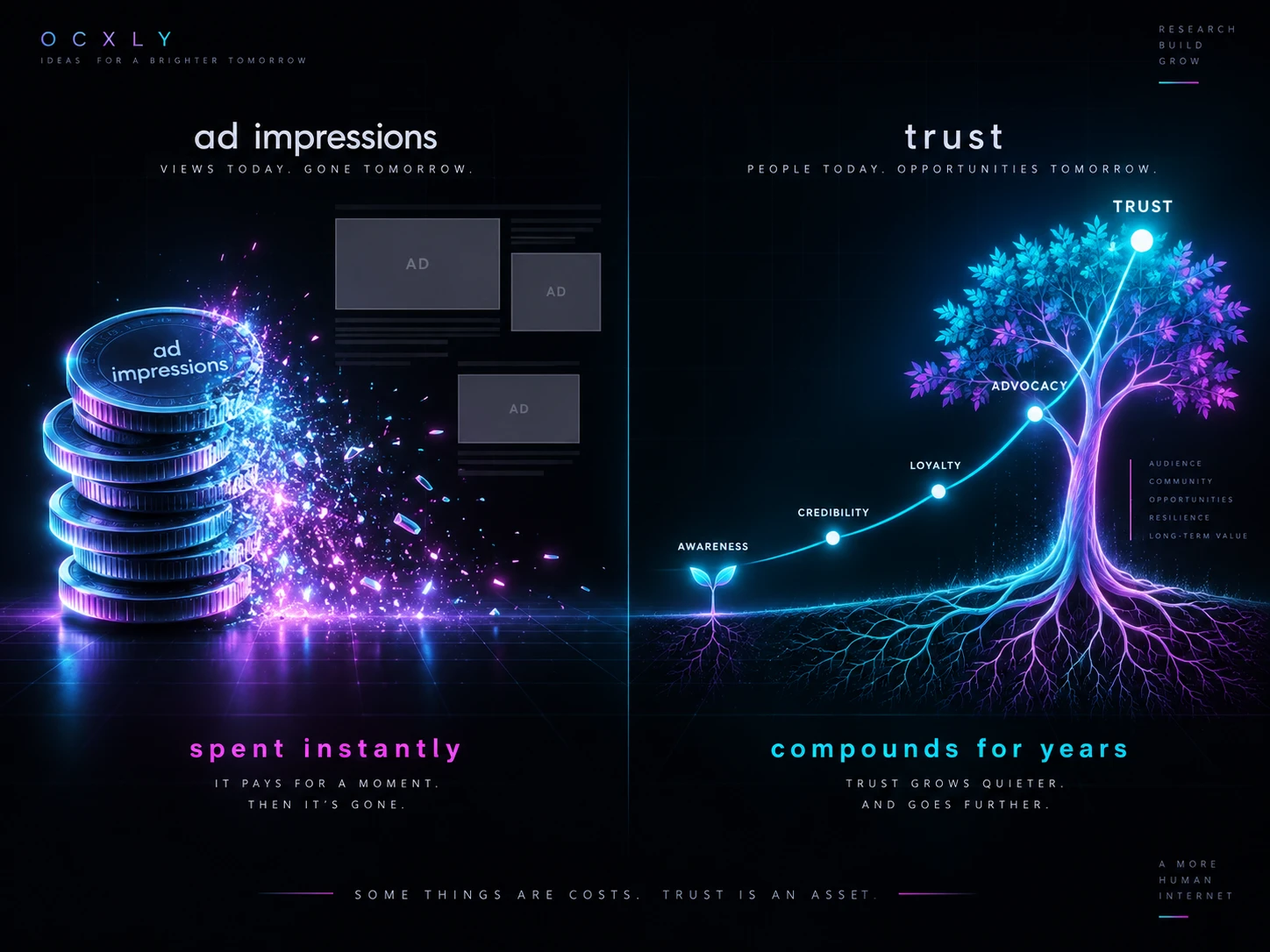
Putting banner ads on a product you own is one of the easiest revenue decisions a team ever makes, and one of the hardest to undo. The money is immediate and legible; the cost is deferred, diffuse, and paid by someone who never signed off on it — the user. This piece makes the case that on a core website or app, over a multi-year horizon, an ad-free strategy is not a sacrifice of revenue but an investment in the compounding asset that actually drives it: user trust, and the brand equity trust becomes.
01The bargain that looks free
The appeal of display advertising is that it seems to conjure revenue from nothing. You already have the traffic; the ads just monetise it. But users have been quietly voting on that bargain for a decade, and the verdict is blunt: they install software specifically to make the ads go away. Depending on how you count, somewhere around a third of internet users run an ad blocker at least some of the time — well over a billion people — and adoption skews sharply toward the young, with 18–34-year-olds making up the majority of blockers.1 When a large share of your most valuable future customers actively pays (in effort, if not money) to refuse a thing you are doing to them, that thing is not free. It is a cost you have decided not to measure.
02Banner blindness: renting attention nobody gives
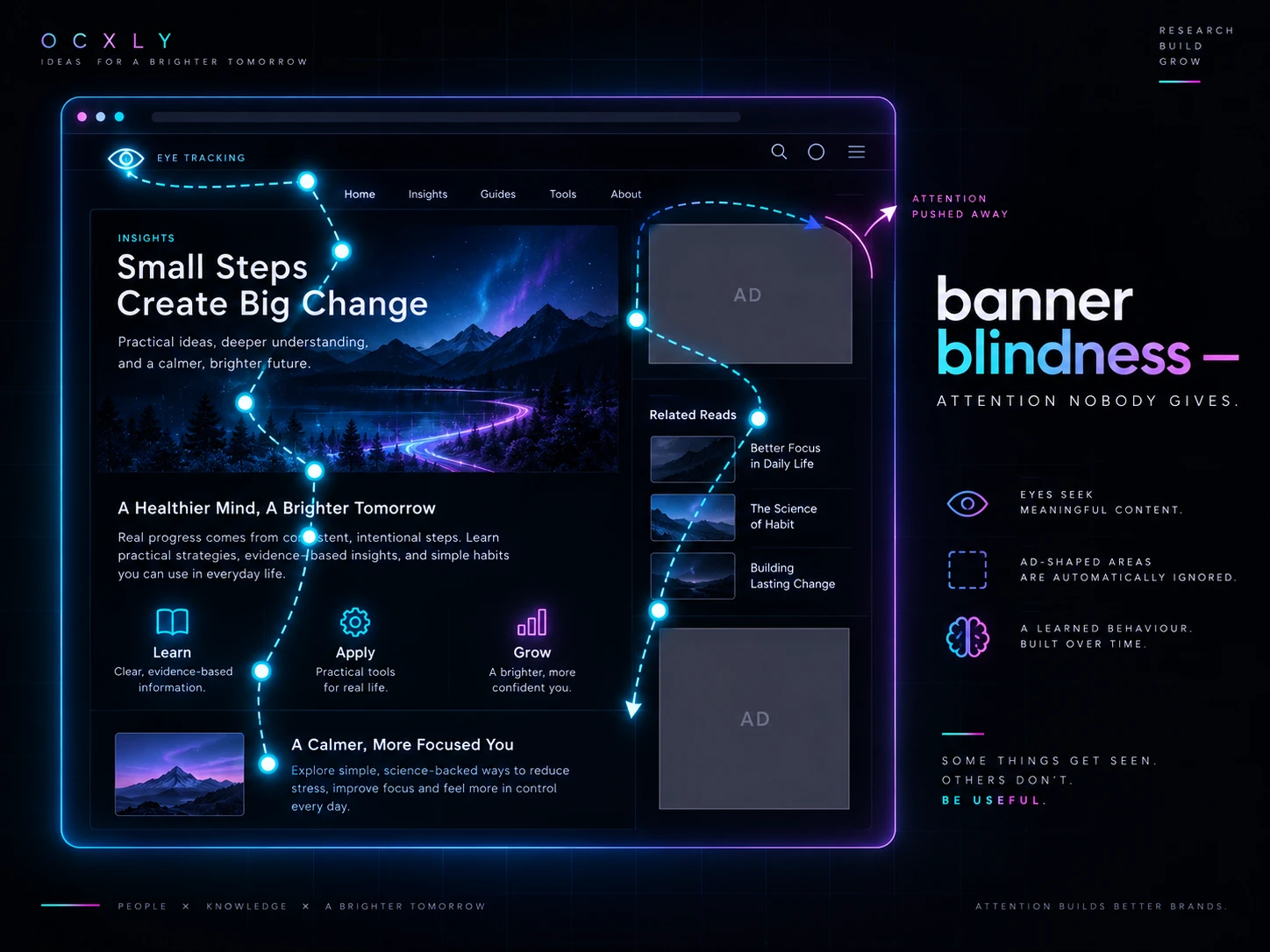
Here is the first irony. Even the users who don't block your ads mostly don't see them. Nielsen Norman Group's long-running eye-tracking research documents banner blindness: people have learned to ignore anything that looks like an advertisement, or that sits where advertisements usually sit, whether or not it actually is one.2 It is a trained reflex, refreshed every day across the whole web, and it applies on mobile and desktop alike.
Worse, the same research finds that ad-like elements don't just get ignored — they can push a user's gaze away from a region of the page, so they miss real content nearby and sometimes don't return to it.2 So the on-page banner frequently delivers neither the attention the advertiser paid for nor a neutral outcome for you: it degrades how well your own content lands. You are renting out a room nobody looks into, and the tenants rearrange the furniture on the way through.
03The tax on speed
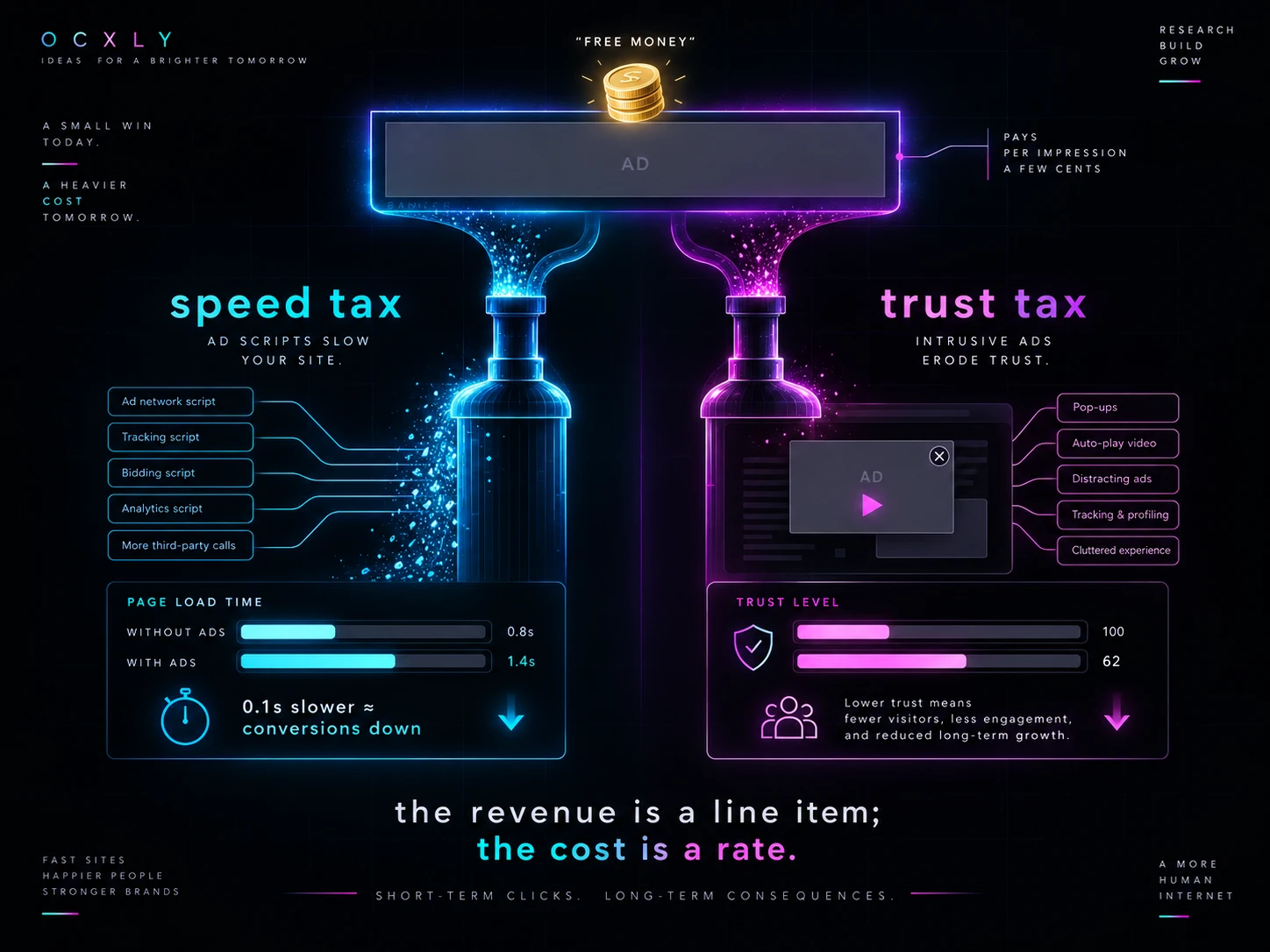
Ads are not pixels; they are code. A typical ad slot pulls in third-party scripts, trackers, and creative from ad exchanges, each adding network requests, JavaScript, and layout shifts. That makes ad-heavy pages slow pages — and speed is not a cosmetic concern, it is a revenue lever with hard numbers behind it.
In a study commissioned by Google and run by Deloitte and 55 across 37 retail, travel, luxury, and lead-generation brands, improving mobile load time by as little as 0.1 seconds lifted conversion rates by around 8% for retail sites and 10% for travel, with higher average order values and more page views, and no site redesign involved — the speed change alone did it.5 Read that in reverse: the weight ads add to a page is a continuous, silent drag on conversion, engagement, and search ranking, applied to every visitor on every page, forever. The ad revenue is a line item; the speed tax is a rate.
Banner ads are the only product feature you deliberately ship to make your own site slower, harder to read, and easier to leave.
04The tax on trust
The deepest cost is the least visible. Users do not neatly separate "the annoying ad" from "the brand that showed it to me" — the interruption, the auto-playing video, the pop-up with the hidden close button, the creative that turns out to be a scam all attach, at least a little, to you. The industry itself concedes which formats do the damage: the Coalition for Better Ads publishes the Better Ads Standards, a list of formats that consumer research identifies as the ones people dislike most,3 and since 2018 Google Chrome has removed advertising outright from sites that repeatedly run them — an admission that bad ads were pushing people toward blocking ads entirely.4
Trust is not a soft metric; it is a purchase driver. Edelman's Trust Barometer work finds that a large majority of consumers — around 81% in its brand research — say they must be able to trust a brand to do what is right before they will buy it, placing trust alongside quality and price as a core purchase consideration, and the gateway from consideration to loyalty and advocacy.9 Every intrusive ad spends a little of that balance. An ad-free surface spends none of it, and quietly signals the opposite: we would rather have your trust than three cents of impression revenue.
05The ad model is getting weaker anyway
Even setting trust aside, the economics that justified intrusive advertising are eroding under the industry's feet. Apple's App Tracking Transparency, introduced in 2021, requires apps to ask permission before tracking users across other apps and sites — and most users decline.10 Third-party cookies, the load-bearing beam of web ad targeting, have been deprecating across browsers, and privacy regulation like the GDPR constrains the data collection the model runs on.11 The result is that behavioural targeting and measurement — the things that made a cheap impression worth buying — have become materially harder and less precise, pushing the whole industry toward first-party data.11
That trend cuts one way for this decision: the revenue you would earn per intrusive ad is trending down, while the trust it costs is trending up in value as privacy becomes a mainstream expectation. A trade that was marginal five years ago gets worse every year you keep it. Betting the multi-year direction of your brand on a business model the platforms themselves are dismantling is a strange place to plant a flag.
06The counterintuitive data: fewer ads, more of everything
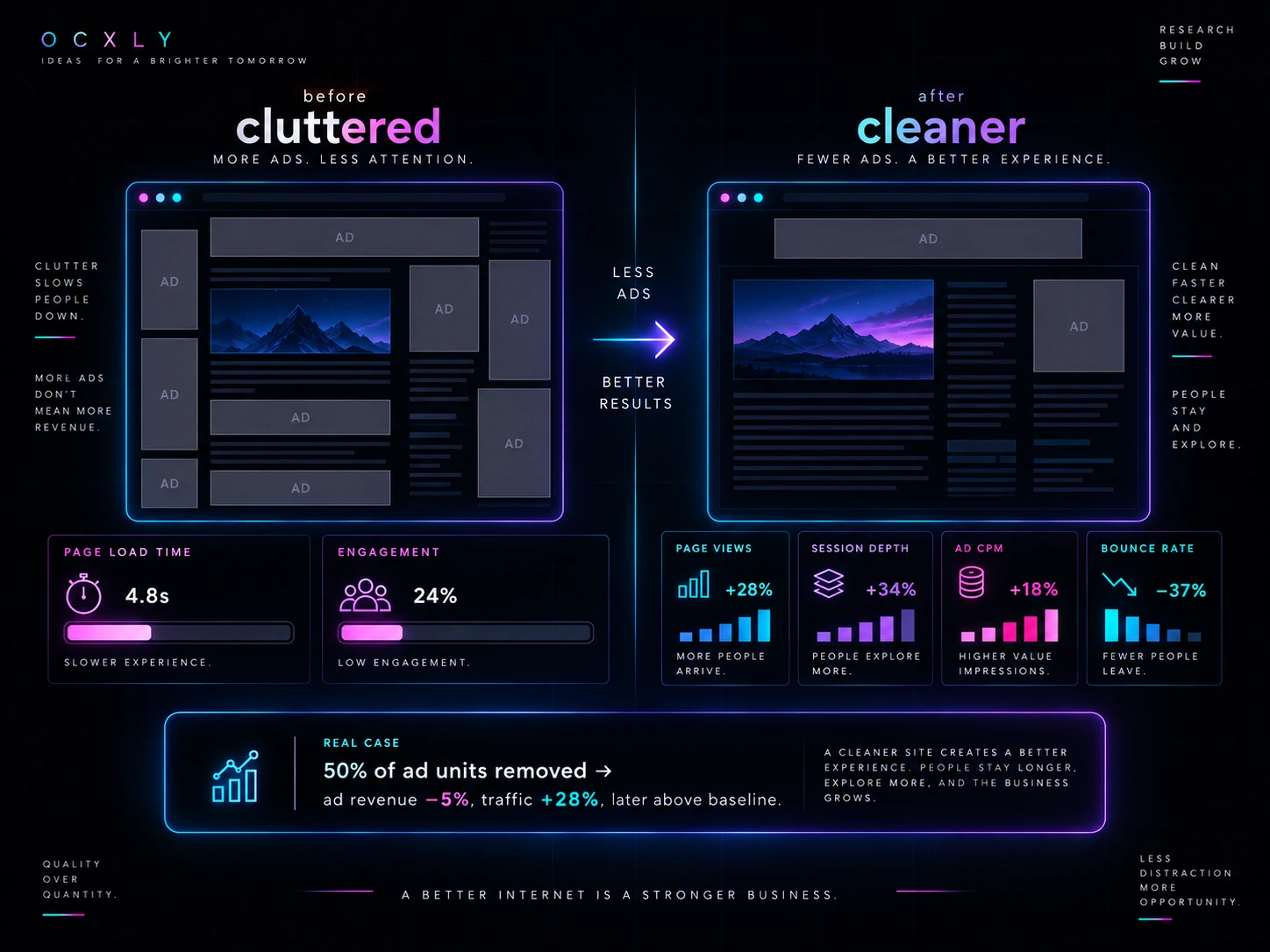
The strongest argument is not ideological, it is empirical: teams that cut ads often find the revenue barely moves — and everything else improves. The clearest public example comes from the ad-optimisation firm Freestar: one publisher removed 50% of its ad units, and after 45 days ad revenue had fallen just 5%, while traffic from its top five sources rose 28% and both page views and CPMs climbed about 10%; revenue later surpassed its pre-cleanup level.6 Fewer, better-placed ads on faster, cleaner pages were worth more, not less.
It is a repeated pattern. Analysis from The Media Trust found that cutting sub-par ad vendors drove a 3.8% increase in session depth, a 4.2% drop in bounce rate, and a 34% improvement in effective CPMs;7 other publishers have reported that reducing ad load raised, rather than lowered, total ad earnings, because the remaining inventory performed so much better on a faster, less cluttered page.8 The mechanism is simple: a cleaner page keeps users longer, and an engaged, returning user is worth far more over time than the fraction of a cent an extra banner earns on their way out the door.
07Trust compounds: brand equity as a multi-year asset
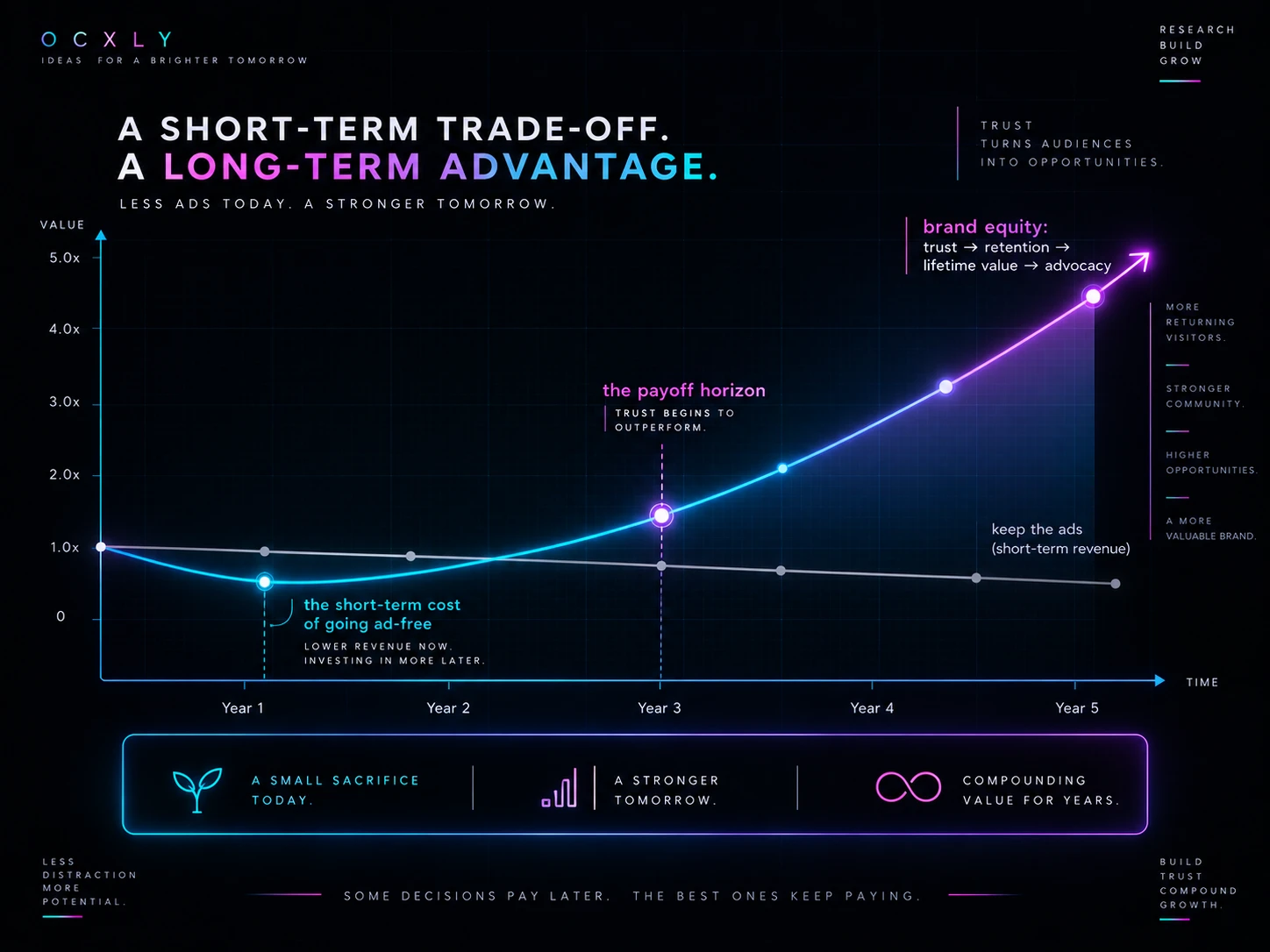
This is why the horizon matters. Judge an ad-free move on next month's revenue and it looks like a loss. Judge it on the multi-year arc and it looks like what it is: an investment. Trust earned by respecting a user's attention feeds a virtuous cycle — retention rises, so lifetime value rises; satisfied users recommend you, so acquisition gets cheaper; a reputation for not exploiting attention becomes a reason to choose you over a competitor who does.9 The accumulated result of that cycle is brand equity — the premium in preference, pricing power, and loyalty that a trusted name carries.
Brand equity behaves like a capital asset, not an expense: it is built slowly, it appreciates with consistent behaviour, and it cannot be bought back quickly once spent. Banner ads trade a durable, appreciating asset (trust) for a liquid, depreciating one (this month's impressions). That can be the right trade for a business with no other model — but as a permanent strategy for a product you intend to still own in five years, it is selling the orchard to make this season's cider.
08What replaces the ad revenue — and who shouldn't do this
Going ad-free is only defensible if something funds the work, so the honest question is what. The proven replacements are subscriptions and freemium tiers (the model behind ad-free music, video, and news), first-party products and services the free surface earns permission to sell, and the free-tool funnel: give real, unconditional value away, earn trust by respecting the user completely, and convert a fraction of that goodwill into paid products, higher-tier offerings, or a durable brand relationship. In every case the free surface is not a billboard; it is the top of the funnel and the proof of character.
And the honest caveats, because a one-sided case is just an ad for the other side. Not every business can do this: publications whose only product is content, with no adjacent thing to sell, genuinely depend on advertising, and for them the work is making ads better — fewer, faster, non-intrusive — not zero. The transition has a real short-term revenue cost that a cash-constrained team may not be able to absorb. And removing ads is necessary, not sufficient: an ad-free product that is slow, hostile, or dishonest earns no trust at all. Ad-free is a signal of respect; it only pays off if the rest of the product tells the same story.
09Where OcxlyDev lands
OCXLY runs its entire toolkit the way this piece argues: every tool is free, runs client-side in your browser, and carries no banner ads and no tracking — not as a marketing gimmick, but because the tools are the marketing. A tool that solves your problem cleanly, quickly, and without trying to monetise your attention does more for how you regard the brand than any impression could, and it does it every time you return.
The bet underneath is simple and long: attention respected is trust earned, trust earned is a brand asset, and a brand asset compounds while an ad impression is spent the instant it loads. An ad-free strategy is not charity and it is not purity — it is a wager that over years, the compounding asset wins. The data on speed, on banner blindness, on cleaner pages, and on trust all point the same way. The only thing it asks of you is patience, and the willingness to measure the return on the horizon where it actually appears.