How breathing talks to the nervous system
Your autonomic nervous system runs on two branches. The sympathetic branch is the accelerator — fight-or-flight, alertness, stress. The parasympathetic branch is the brake — rest, digest, recovery. Most of the time they balance each other without any input from you. Heart rate, blood pressure, digestion: all automatic.
Breathing is the exception. It is the one autonomic function you can consciously override, and that makes it a deliberate lever on a system that is otherwise out of reach.3 The link runs through the vagus nerve, the main parasympathetic pathway, which is directly modulated by the breath.5
Here is the mechanism that every technique below exploits. When you inhale, your heart rate naturally rises slightly; when you exhale, it falls. This beat-to-beat coupling is called respiratory sinus arrhythmia. Because the heart slows on the out-breath, making the exhale longer and slower than the inhale tilts the whole system toward the parasympathetic brake — lowering heart rate and signalling safety to the brain.3,8 That single fact — longer exhale, calmer body — is most of what you need to know.
The five techniques, and what each is for
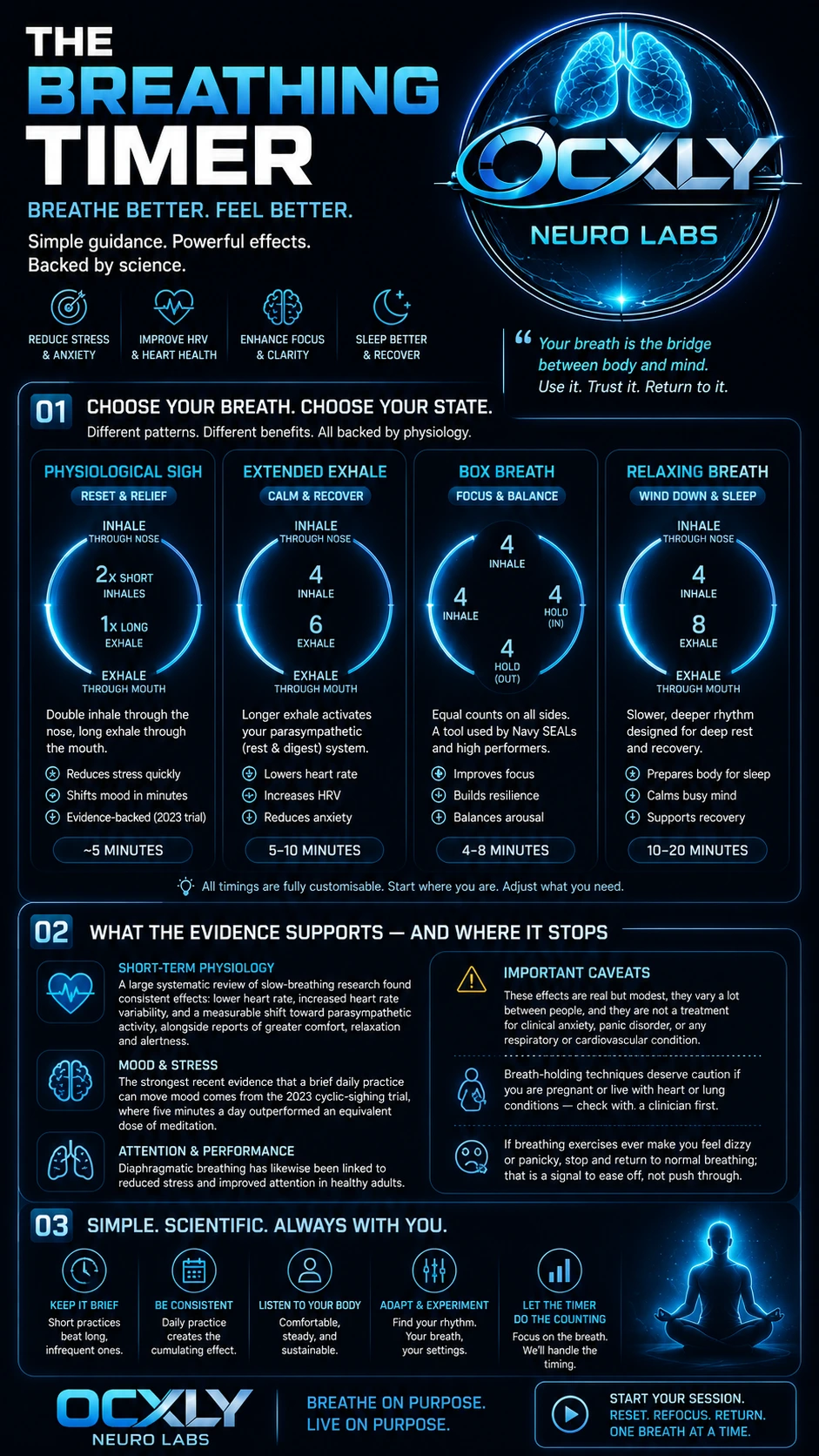
Box breathing (4-4-4-4). Inhale four, hold four, exhale four, hold four. The equal segments and the holds make it easy to track, which is part of the point: the rhythm gives a racing mind something simple to hold onto. It is widely taught in high-pressure professions for exactly that grounding, focusing quality, and slow breathing of this kind reliably shifts autonomic balance toward calm.2
4-7-8. Inhale four, hold seven, exhale eight. The long retention and the even longer exhale push hard on the parasympathetic response, which is why it is so often used as a wind-down before sleep. The breath-hold also lets carbon dioxide rise gently, which has its own quietening effect on the system.2,3
The physiological sigh. A full inhale, then a second short sip of air on top, followed by a long, slow exhale. That double inhale is doing real anatomical work: the second breath re-inflates alveoli — tiny air sacs in the lungs — that collapse during ordinary breathing, restoring the surface area needed to offload carbon dioxide efficiently on the way out. A 2023 Stanford study found that just five minutes a day of this "cyclic sighing" improved mood and lowered resting respiratory rate more than mindfulness meditation or other breathwork patterns over a month.1 It is the fastest-acting tool here for a spike of acute stress.
Coherent breathing (about 5.5 per side). Slow, smooth, equal breaths at roughly five to six per minute. This is not arbitrary: near six breaths a minute the cardiovascular system hits a resonance, where the rhythms of heart rate, blood pressure and breathing line up and reinforce each other, driving heart rate variability to its peak.4,6 It is the technique with the deepest evidence base for raising HRV and easing blood pressure and mood.
Extended exhale (4-6). The simplest of all: just make the out-breath longer than the in-breath. No holds, no counting gymnastics. Because exhalation is when the vagus applies the brake, a longer exhale is a dependable everyday nudge toward calm — the one to reach for when anything more elaborate feels like too much.8
Heart rate variability and the "resonance" sweet spot
Heart rate variability — the small, constant variation in the time between heartbeats — is one of the cleaner windows we have onto autonomic balance. Counter-intuitively, more variability is healthier: it reflects a flexible nervous system that can respond and recover. Higher resting HRV tracks with better stress resilience and emotional regulation.4
The reason slow breathing works so well is that respiratory sinus arrhythmia and the body's blood-pressure feedback loop share a natural frequency right around six cycles per minute. Breathe at that pace and the oscillations stack constructively, producing large, coherent swings in heart rate — the signature of a system in balance. Deliberately training at this frequency, known as HRV biofeedback, has measurable effects on anxiety, stress and blood pressure across a range of studies.4,6 Coherent breathing and the extended exhale are both, in effect, lightweight versions of the same idea.
What the evidence supports — and where it stops
The short-term physiology is on solid ground. A large systematic review of slow-breathing research found consistent effects: lower heart rate, increased heart rate variability, and a measurable shift toward parasympathetic activity, alongside reports of greater comfort, relaxation and alertness.2,3 The strongest recent evidence that a brief daily practice can move mood comes from the 2023 cyclic-sighing trial, where five minutes a day outperformed an equivalent dose of meditation.1 Diaphragmatic breathing has likewise been linked to reduced stress and improved attention in healthy adults.7
The honest caveats matter just as much. These effects are real but modest, they vary a lot between people, and they are not a treatment for clinical anxiety, panic disorder, or any respiratory or cardiovascular condition. Breath-holding techniques in particular deserve caution if you are pregnant or live with heart or lung conditions — check with a clinician first. If breathing exercises ever make you feel dizzy or panicky, stop and return to normal breathing; that is a signal to ease off, not push through.
Used within those limits, though, the breath is a genuinely useful instrument — free, always with you, and backed by a clear physiological story. Start with the extended exhale or the physiological sigh, keep it short, and let the ring do the counting.
References
- Balban, M. Y., et al. (2023). Brief structured respiration practices enhance mood and reduce physiological arousal. Cell Reports Medicine, 4(1), 100895.
- Zaccaro, A., et al. (2018). How breath-control can change your life: a systematic review on psycho-physiological correlates of slow breathing. Frontiers in Human Neuroscience, 12, 353.
- Russo, M. A., Santarelli, D. M., & O'Rourke, D. (2017). The physiological effects of slow breathing in the healthy human. Breathe, 13(4), 298–309.
- Lehrer, P. M., & Gevirtz, R. (2014). Heart rate variability biofeedback: how and why does it work? Frontiers in Psychology, 5, 756.
- Gerritsen, R. J. S., & Band, G. P. H. (2018). Breath of life: the respiratory vagal stimulation model of contemplative activity. Frontiers in Human Neuroscience, 12, 397.
- Steffen, P. R., et al. (2017). The impact of resonance frequency breathing on measures of heart rate variability, blood pressure, and mood. Frontiers in Public Health, 5, 222.
- Ma, X., et al. (2017). The effect of diaphragmatic breathing on attention, negative affect and stress in healthy adults. Frontiers in Psychology, 8, 874.
- Noble, D. J., & Hochman, S. (2019). Hypothesis: pulmonary afferent activity patterns during slow, deep breathing contribute to the neural induction of physiological relaxation. Frontiers in Physiology, 10, 1176.