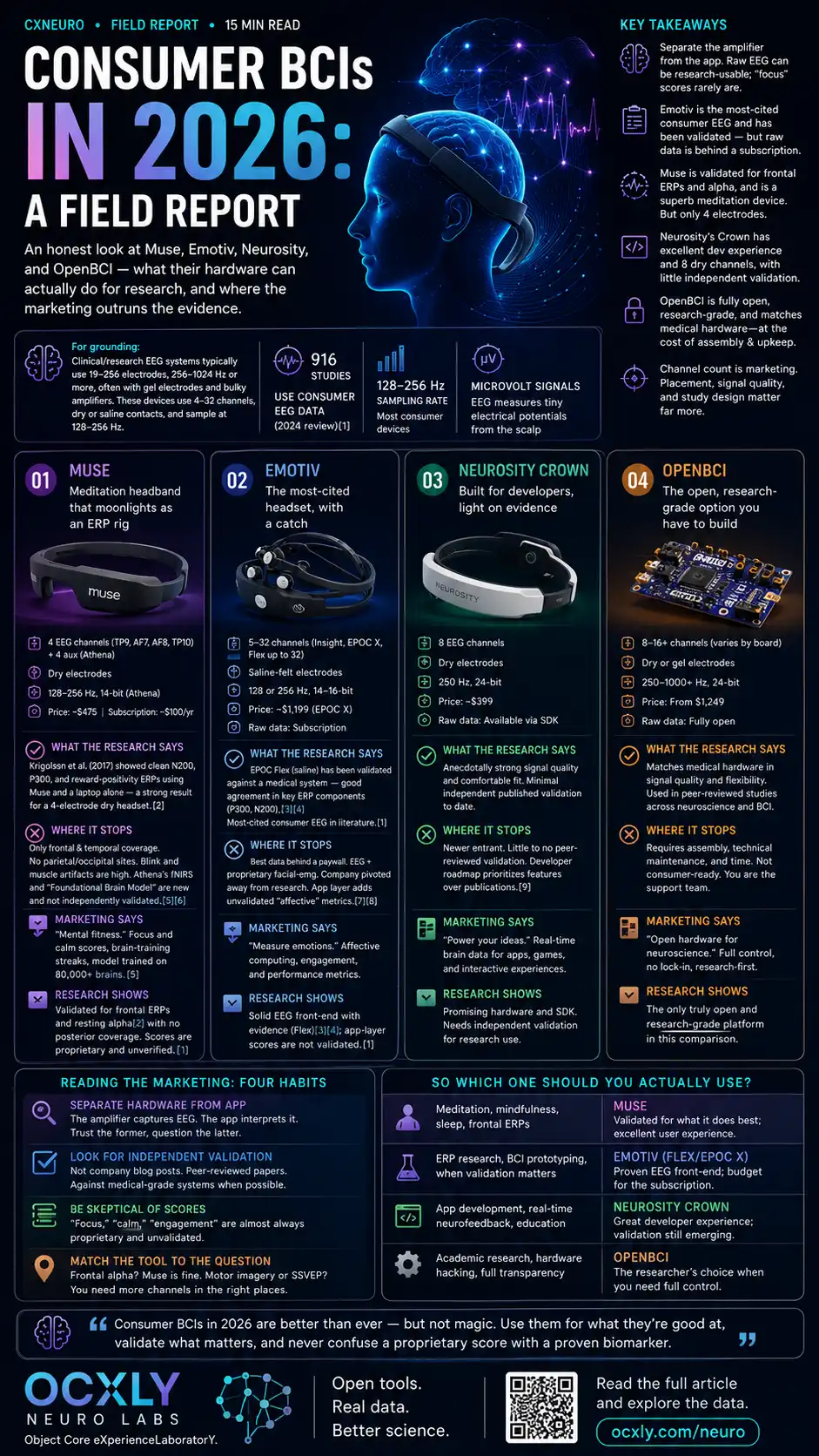
The pitch in 2026 is wellness: mental fitness, focus training, better sleep, a number that tells you how calm you are. The research question underneath it is narrower and much older, can a cheap, dry- or saline-electrode headset capture EEG that is good enough to answer a real scientific question? It is worth answering, because consumer EEG is now everywhere in research. A 2024 scoping review identified 916 studies built on consumer-grade EEG data, most commonly for brain-computer interface work[1].
But "used in research" and "validated for your research" are different claims, and the single most useful habit when reading consumer-BCI marketing is to separate the amplifier from the app. Underneath every one of these products is an EEG front-end that does one job: turn microvolt scalp potentials into numbers. On top sits a consumer layer (scores, streaks, guided sessions) that interprets those numbers. The front-ends are increasingly good and, in several cases, peer-reviewed. The interpretive layer is almost always proprietary and rarely tested in public.
For grounding: a clinical or research EEG system typically records from 19 to 256 electrodes at 256–1024 Hz or more, often with gel electrodes and a bulky amplifier[9]. The devices below use 4 to 32 channels, dry or saline contacts, and sample at 128–256 Hz. They trade fidelity and coverage for portability, comfort, and price. The interesting question is what that trade actually costs, and the answer differs sharply across the four platforms a researcher or serious builder is most likely to consider.