Pomodoro Timer
The Pomodoro Technique is one of the most evidence-aligned productivity methods ever documented. This page gives you a fully functional timer and the cognitive science behind why it works — grounded in peer-reviewed research on attention, memory consolidation, and mental fatigue.
What Is the Pomodoro Technique?
The Pomodoro Technique was developed by Francesco Cirillo in the late 1980s while he was a university student in Rome. Struggling to concentrate, he used a tomato-shaped kitchen timer (pomodoro is Italian for tomato) to commit to 25 minutes of uninterrupted work, followed by a 5-minute rest.[1] The interval length was not arbitrary — Cirillo chose 25 minutes based on personal experimentation with what felt cognitively sustainable without diminishing returns. Subsequent research has lent that intuition substantial neurological credibility.
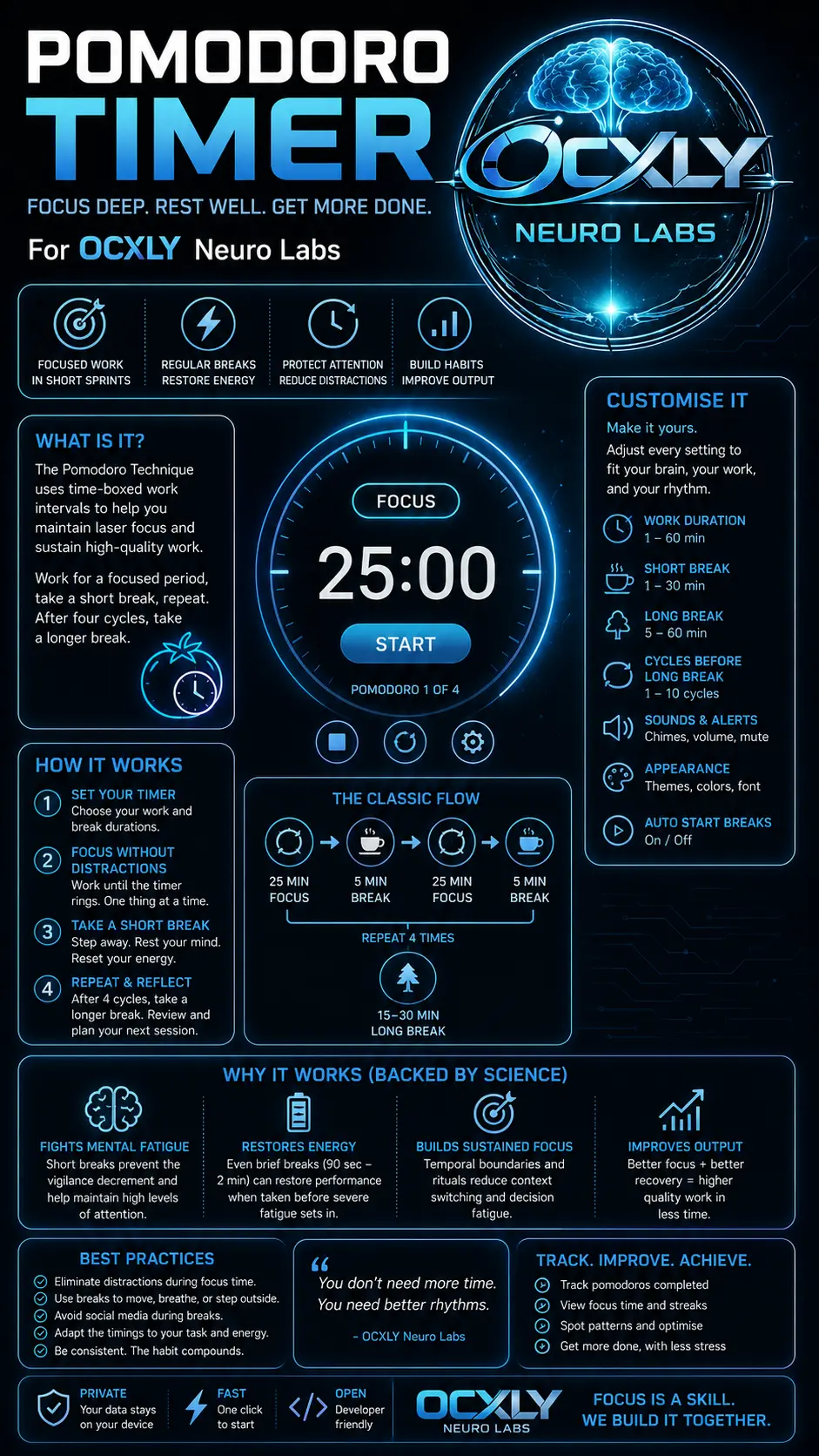
The standard protocol consists of four repeating elements:
- Choose a single task to work on
- Set a timer for 25 minutes and work without interruption
- When the timer rings, take a 5-minute break
- Every four intervals, take a longer break of 15–30 minutes
Its power lies in what it does psychologically: it converts an abstract, open-ended task into a finite, bounded commitment. The timer externalises the decision about when to stop, removing one of the most cognitively expensive micro-decisions from the working session: should I take a break yet?
The Neuroscience of Attention and Why It Depletes
To understand why structured breaks restore focus, we first need to understand how attention works — and why it fails.
Sustained Attention and the Vigilance Decrement
Sustained attention — the ability to maintain focus on a single task over time — is not a stable state. It degrades reliably and predictably, a phenomenon first documented by Norman Mackworth in 1948 and now termed the vigilance decrement.[2] Signal detection performance drops measurably within the first 20–30 minutes of a monotonous task, suggesting that the human attentional system is not designed for extended, uninterrupted engagement.
The neurological substrate of this effect is increasingly understood. The prefrontal cortex — which governs top-down attentional control, working memory, and goal-directed behaviour — shows reduced activation as a task continues, even when the task is not physically demanding.[3] Sustained attention is metabolically expensive, consuming glucose and oxygen at above-baseline rates in the prefrontal networks responsible for maintaining task-relevant representations against interference.[3]
Habituation: Why the Brain Stops Responding
A second mechanism underlying attention fatigue is neural habituation — the tendency of neurons to reduce their response to unchanging stimuli. The brain is a prediction engine; once it has modelled a stimulus as constant and non-threatening, it allocates fewer resources to monitoring it. This is adaptive in most contexts but deeply problematic for sustained cognitive work, where the "stimulus" is the task itself.
A landmark 2011 study by Ariga and Lleras at the University of Illinois provided direct experimental evidence for this mechanism in the context of prolonged cognitive tasks. They found that brief, infrequent mental breaks — even very short diversions of attention — prevent the vigilance decrement from occurring, maintaining performance at the levels observed in the first few minutes of the task.[4] The key finding was counterintuitive: it was not the rest that restored attention, but the momentary shift of attentional focus to something else. The break effectively "reset" the habituation process, allowing the prefrontal circuits to re-engage with the original task as if approaching it freshly.
Ego Depletion and the Self-Control Resource Model
Roy Baumeister's influential (if contested) ego depletion model proposes that self-regulatory capacity — the cognitive resource underlying focused attention, impulse control, and decision-making — draws on a limited pool of mental energy that is consumed through use and restored through rest.[5] Although the original glucose-resource framing has been challenged in replication studies, the core phenomenological observation — that willpower and focused attention feel harder to sustain as time passes — remains robust and is consistent with the neurological evidence of prefrontal fatigue described above. The Pomodoro Technique's mandatory breaks map directly onto this model: by enforcing rest before depletion becomes severe, the technique preserves the regulatory capacity needed for the next interval.
Structured Breaks and Memory Consolidation
The benefit of Pomodoro-style intervals extends beyond preventing fatigue. Breaks actively support learning and memory formation — a finding with profound implications for students and knowledge workers.
The Default Mode Network and Offline Processing
During rest — particularly unstructured, mind-wandering rest — the brain does not go idle. A large-scale network of regions including the medial prefrontal cortex, posterior cingulate cortex, and angular gyrus, collectively termed the Default Mode Network (DMN), becomes highly active precisely when external task demands are reduced.[6] The DMN is associated with autobiographical memory retrieval, prospective thinking, and — critically — the consolidation and integration of newly learned information into long-term memory structures.
When you stop working during a Pomodoro break and allow your mind to wander, your brain is not wasting time — it is actively processing, connecting, and filing the information you just encountered during the work interval. This offline consolidation process is disrupted by immediately switching to another demanding cognitive task (such as scrolling social media), which is why the quality of the break matters as much as its existence.[7]
Spacing Effects and the Temporal Structure of Learning
The Pomodoro Technique shares a structural feature with one of the most robustly replicated findings in educational psychology: the spacing effect. Ebbinghaus's foundational work on memory (1885) and more than a century of subsequent research have established that learning distributed across multiple sessions with rest intervals produces significantly stronger long-term retention than the same total study time concentrated in a single unbroken session (massed practice).[8]
A comprehensive meta-analysis by Cepeda et al. (2006) examining 839 effect sizes from 317 studies confirmed that spaced practice produces a consistent and substantial advantage over massed practice across a wide range of learning tasks, age groups, and retention intervals.[8] Each Pomodoro session, followed by a break and then resumed study, partially replicates the spacing structure — particularly when the same material is revisited across multiple intervals.
Sleep and Micro-Rest
While the Pomodoro break is too short to enable the slow-wave sleep that drives the most powerful forms of memory consolidation, evidence from nap research suggests that even brief rest periods support hippocampal replay — the process by which recently acquired information is replayed and transferred from short-term hippocampal storage to more distributed cortical networks.[9] A 2008 study by Lahl et al. found that naps as short as 6 minutes produced significant improvements in declarative memory retention compared to equivalent periods of wakefulness — suggesting that even short rest periods engage consolidation-relevant processes.
Interruptions, Task-Switching, and the Cost of Fragmented Work
If breaks are beneficial, one might ask: why not take breaks whenever you feel like it, or allow interruptions from colleagues and notifications? The answer lies in what psychologists call task-switching costs — and it is one of the strongest arguments for the Pomodoro Technique's structured approach.
The Resumption Cost
Research by Gloria Mark at the University of California, Irvine, has extensively documented the cost of workplace interruptions on knowledge work. A widely cited 2005 study found that workers who were interrupted during a task took an average of 23 minutes and 15 seconds to fully return to the interrupted task — even when the interruption itself lasted only seconds.[10] This "resumption cost" arises because re-engaging with a complex cognitive task requires reconstructing the task's context — its goals, intermediate steps, open questions, and working memory contents — a process that is cognitively expensive and error-prone.
Executive Function and Task-Switching
Rubinstein, Meyer, and Evans (2001) demonstrated in a series of experiments that task-switching — even between well-practised tasks — incurs measurable costs in both reaction time and accuracy.[11] These costs are not merely delay; they reflect the time required for the brain's executive control system to disengage "task-set" rules from the previous task and re-engage those for the new one. For complex, high-level cognitive work — writing, programming, analysis, studying — the task-set is rich and contextual, making switching especially expensive.
The Pomodoro Technique mitigates this cost through two mechanisms. First, it designates specific periods as interruption-free: the 25-minute interval is protected, and all incoming demands — messages, emails, requests — are deferred rather than immediately processed. Second, when a break does occur, it occurs at the end of a complete interval, allowing the worker to close the current task-set cleanly rather than abandoning it mid-stream.
Flow States and Deep Work
Csikszentmihalyi's concept of flow — a state of optimal experience characterised by complete absorption in a challenging task, loss of self-consciousness, and intrinsic reward — is frequently invoked in discussions of productivity.[12] Some critics argue that the Pomodoro Technique interrupts flow states at precisely the wrong moment. This is a legitimate concern for certain types of work — particularly creative work with long ramp-up times. The technique is most valuable when tasks are well-defined, when flow is being disrupted by attention fatigue rather than protected, and when the 25-minute interval has become a reliable signal for deep engagement rather than a ceiling on it. Many experienced users report that Pomodoro intervals eventually function as flow induction cues — the timer starting triggers a conditioned shift into focus mode.
Evidence in Academic and Workplace Contexts
Student Learning and Exam Performance
The Pomodoro Technique aligns with several best-practice recommendations from the learning sciences. Deliberate practice — the systematic, effortful engagement with tasks at the boundary of current competence — is the primary driver of expert performance,[13] and Ericsson's research found that even elite performers (musicians, chess grandmasters, athletes) rarely sustain deliberate practice for more than 4–5 hours per day in total, with individual sessions rarely exceeding 90 minutes. The Pomodoro structure — intensive focus punctuated by rest — mirrors the interval structure of elite deliberate practice.
For students, the technique addresses several common failure modes: procrastination (the timer creates a low-stakes commitment — "just 25 minutes"), ineffective re-reading (the interval structure encourages active recall and spaced review rather than passive re-reading), and the planning fallacy (tracking completed Pomodoros provides accurate data on how long tasks actually take).
Knowledge Work and Software Development
In knowledge work contexts, the technique has been adopted widely among software engineers, writers, and researchers. Its benefits in these contexts relate closely to the interruption research: an uninterrupted 25-minute interval creates sufficient temporal space to enter and maintain the deep focus required for complex problem-solving, without requiring the multi-hour concentration sprints that are difficult to sustain reliably.
Plan before you start
Spend 2 minutes before each interval deciding exactly what you will accomplish. A specific, achievable sub-goal prevents mid-interval drift and makes the break feel earned.
Protect the interval
Silence notifications. Close irrelevant tabs. Put your phone face-down. The 25-minute interval only works if it is genuinely uninterrupted — near-misses still incur task-switching costs.
Use breaks correctly
Walk, stretch, look out a window, make tea. Avoid scrolling social media — it re-engages the attention system rather than resting it, and disrupts the DMN consolidation processes described in § III.
Adjust the interval
25 minutes is Cirillo's default, not a mandate. Research on deliberate practice suggests up to 90 minutes for highly skilled, motivated individuals. Find your optimal interval empirically — the timer above lets you customise.
Adapting the Technique: What the Research Actually Supports
No peer-reviewed study has directly tested "25 minutes of work + 5-minute break" as an interval configuration and found it uniquely optimal — and it would be misleading to claim otherwise. The evidence base supports the principles underlying the Pomodoro Technique (structured intervals, regular breaks, interruption protection, temporal boundaries on cognitive work) rather than the specific 25/5 timing parameters. What the research collectively suggests:
- Break frequency matters more than break duration. The vigilance decrement research suggests that even very brief breaks (90 seconds to 2 minutes) can partially restore performance if taken before severe fatigue sets in — the key is frequency, not length.[4]
- Break quality matters. Breaks involving nature exposure, light physical activity, or unfocused mind-wandering are more restorative than breaks involving social media or passive screen consumption.[7]
- Individual differences are real. Optimal work intervals vary substantially by individual, task type, time of day, and experience level. The 25-minute default is a reasonable starting point, not a universal prescription.
- The ritual matters as much as the timing. The psychological benefit of a defined start signal (the timer beginning) and a defined end signal (the chime) creates temporal structure that reduces decision fatigue and supports the formation of focused-work habits over time.[1]
References
- Cirillo, F. (2006). The Pomodoro Technique. Villa Sesto. (Published in revised form by Currency, 2018.) pomodorotechnique.com
- Mackworth, N. H. (1948). The breakdown of vigilance during prolonged visual search. Quarterly Journal of Experimental Psychology, 1(1), 6–21. doi.org/10.1080/17470214808416738
- Kahneman, D. (1973). Attention and Effort. Prentice-Hall. (Classic text establishing the limited-capacity model of attention and the metabolic cost of cognitive effort.)
- Ariga, A., & Lleras, A. (2011). Brief and rare mental "breaks" keep you focused: Deactivation and reactivation of task goals preempt vigilance decrements. Cognition, 118(3), 439–443. doi.org/10.1016/j.cognition.2010.12.007
- Baumeister, R. F., Bratslavsky, E., Muraven, M., & Tice, D. M. (1998). Ego depletion: Is the active self a limited resource? Journal of Personality and Social Psychology, 74(5), 1252–1265. doi.org/10.1037/0022-3514.74.5.1252
- Raichle, M. E., MacLeod, A. M., Snyder, A. Z., Powers, W. J., Gusnard, D. A., & Shulman, G. L. (2001). A default mode of brain function. Proceedings of the National Academy of Sciences, 98(2), 676–682. doi.org/10.1073/pnas.98.2.676
- Dewar, M., Alber, J., Butler, C., Cowan, N., & Della Sala, S. (2012). Brief wakeful resting boosts new memories over the long term. Psychological Science, 23(9), 955–960. doi.org/10.1177/0956797612441220
- Cepeda, N. J., Pashler, H., Vul, E., Wixted, J. T., & Rohrer, D. (2006). Distributed practice in verbal recall tasks: A review and quantitative synthesis. Psychological Bulletin, 132(3), 354–380. doi.org/10.1037/0033-2909.132.3.354
- Lahl, O., Wispel, C., Willigens, B., & Pietrowsky, R. (2008). An ultra short episode of sleep is sufficient to promote declarative memory performance. Journal of Sleep Research, 17(1), 3–10. doi.org/10.1111/j.1365-2869.2008.00622.x
- Mark, G., Gudith, D., & Klocke, U. (2008). The cost of interrupted work: More speed and stress. Proceedings of CHI 2008, ACM. doi.org/10.1145/1357054.1357072 (The "23 minutes" figure is from field observations published across multiple Gloria Mark studies; this is the primary CHI source.)
- Rubinstein, J. S., Meyer, D. E., & Evans, J. E. (2001). Executive control of cognitive processes in task switching. Journal of Experimental Psychology: Human Perception and Performance, 27(4), 763–797. doi.org/10.1037/0096-1523.27.4.763
- Csikszentmihalyi, M. (1990). Flow: The Psychology of Optimal Experience. Harper & Row. (Seminal work defining and empirically grounding the flow state construct.)
- Ericsson, K. A., Krampe, R. T., & Tesch-Römer, C. (1993). The role of deliberate practice in the acquisition of expert performance. Psychological Review, 100(3), 363–406. doi.org/10.1037/0033-295X.100.3.363