Prompt Builder & Templates
Build a well-structured prompt the way the good ones are written — a clear role, a specific task, context, examples, an output format, and constraints. Start from a template or from scratch, then copy it out in plain, Markdown, or XML style.
Anatomy of a good prompt
The difference between a vague prompt and a reliable one is almost always structure. A model can only meet expectations it can see. Spelling out the role, the task, the context, and the desired format removes the guesswork that produces inconsistent answers. These are the parts this builder assembles:
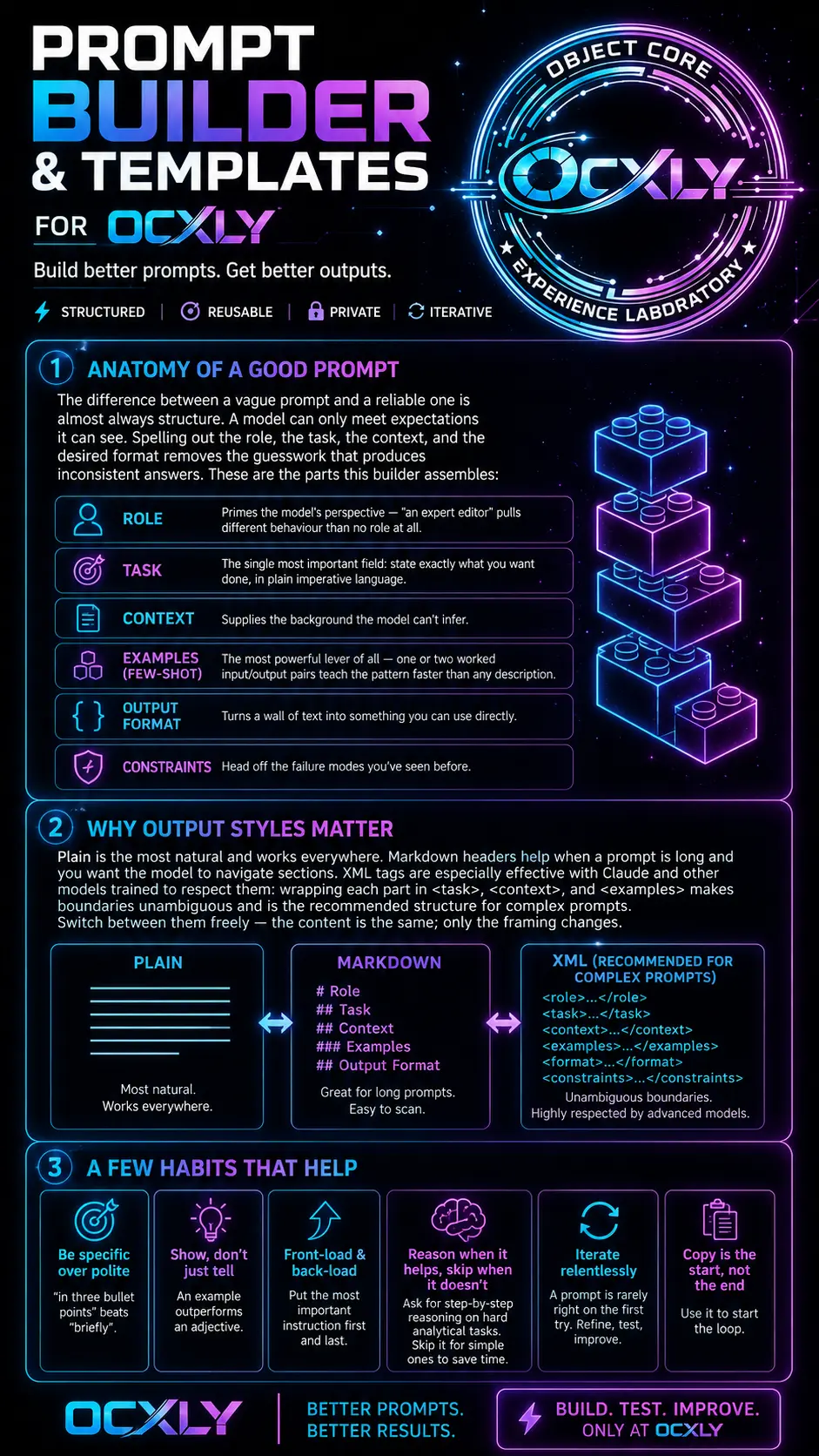
Role primes the model's perspective — "an expert editor" pulls different behaviour than no role at all. Task is the single most important field: state exactly what you want done, in plain imperative language. Context supplies the background the model can't infer. Examples (few-shot) are the most powerful lever of all — one or two worked input/output pairs teach the pattern faster than any description. Output format turns a wall of text into something you can use directly. Constraints head off the failure modes you've seen before.
Why the output styles matter
Plain is the most natural and works everywhere. Markdown headers help when a prompt is long and you want the model to navigate sections. XML tags are especially effective with Claude and other models trained to respect them: wrapping each part in <task>, <context>, and <examples> makes boundaries unambiguous and is the recommended structure for complex prompts. Switch between them freely — the content is the same; only the framing changes.
A few habits that help
Be specific over polite — "in three bullet points" beats "briefly". Show, don't just tell: an example outperforms an adjective. Put the most important instruction first and, for long context, last as well. Ask for step-by-step reasoning on hard analytical tasks, but skip it for simple ones where it just adds latency. And iterate — a prompt is rarely right on the first try; treat the copy button as the start of a loop, not the end.
Privacy
Everything is assembled in your browser. Nothing you type is sent anywhere, stored, or logged.