Serverless computing in 2026: faster apps, infinite scale, and a backend you never patch
"Serverless" does not mean there are no servers. It means there are no servers you manage — no machines to provision, patch, or scale. You ship a function; the platform runs it, bills you per request, and scales it from zero to a flood and back without you touching a thing.
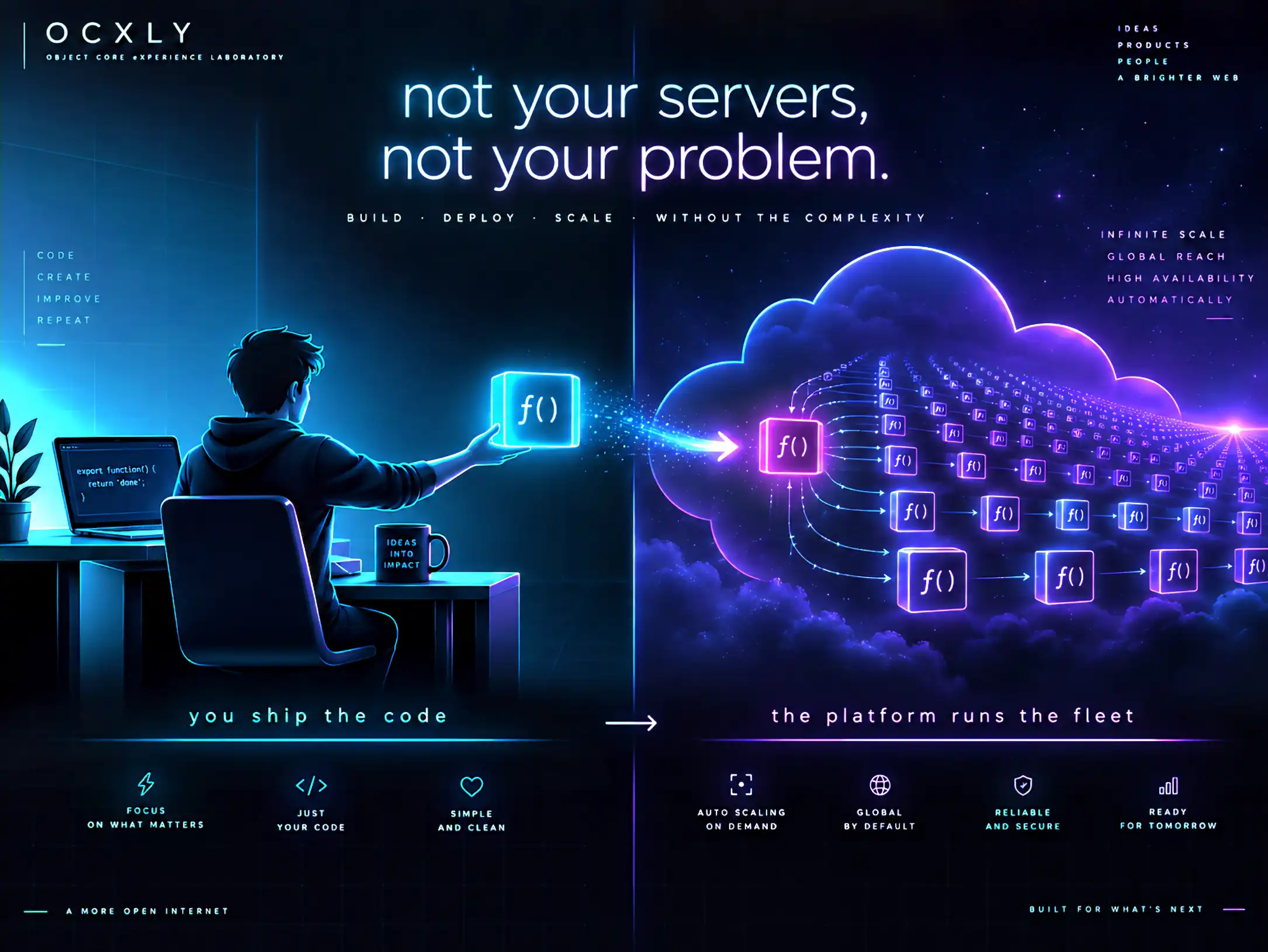
For most of the web's history, running an application meant renting a server and babysitting it: choosing its size, keeping it patched, watching it fall over at 3 a.m. when traffic spiked, and paying for it around the clock even while it sat idle. Serverless computing deletes that job. You upload code; the cloud provider supplies the machines, the operating system, the scaling, and the availability, and charges you only for the moments your code is actually running. In 2026 this is no longer a fringe pattern — the serverless market is estimated at roughly $33 billion and growing north of 20% a year — but the details of how it works are exactly what decide whether it is the right tool for your app.9
01What "serverless" actually means
The name is a marketing simplification that causes endless confusion, so start with the precise version. A widely cited Berkeley analysis defines serverless computing as the combination of two things: Functions-as-a-Service (FaaS) — you provide code as short-lived functions triggered by events — and Backend-as-a-Service (BaaS) — managed building blocks like databases, authentication, storage, and queues that you consume as APIs rather than run yourself.1 The defining shift is operational: the provider, not you, is responsible for provisioning, scaling, patching, and keeping the servers alive.2
Three properties fall out of that arrangement and together form the actual definition:
- No server management. There is no machine for you to size, secure, or keep patched — that is the provider's job.2
- Scale-to-zero, and scale-to-flood. With no requests, nothing runs and you pay nothing; under load, the platform spins up as many parallel copies of your function as it takes, automatically.2
- Pay-per-use. Billing is tied to actual execution — number of requests and the compute time each one consumes — not to a server reserved by the hour.2
02The old way versus the new way
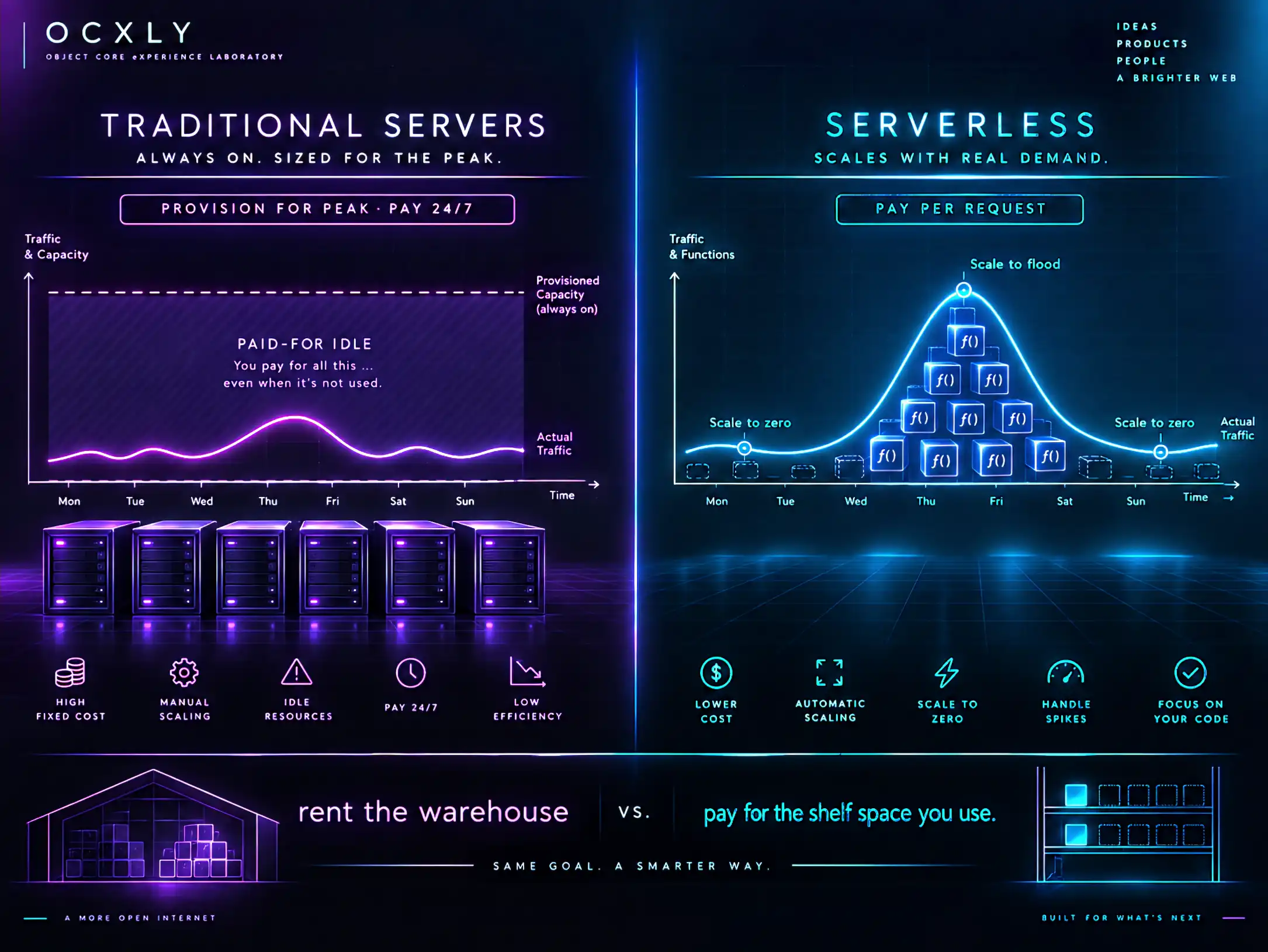
Under the traditional model, you provision for the peak you hope to hit and pay for it continuously. A server sized for Black Friday sits 95% idle the rest of the year, and if you guessed too small, it topples under the load you did get. Scaling is a project: add machines, configure a load balancer, keep every instance patched and consistent.
Serverless inverts that. Capacity is provisioned per request, in milliseconds, by the platform. Ten users or ten million, you deploy the same function and the provider fans it out to match demand — a property AWS describes as automatic scaling with no capacity planning on your part.2 When the traffic ebbs, the copies evaporate and the bill drops with them. For spiky, unpredictable, or brand-new workloads, that is the difference between paying for a warehouse and paying for the shelf space you actually use.
The old question was "how big a server should I rent?" The serverless question is "what should happen when this event fires?" — and the capacity takes care of itself.
03How your code actually runs — and why cold starts happen
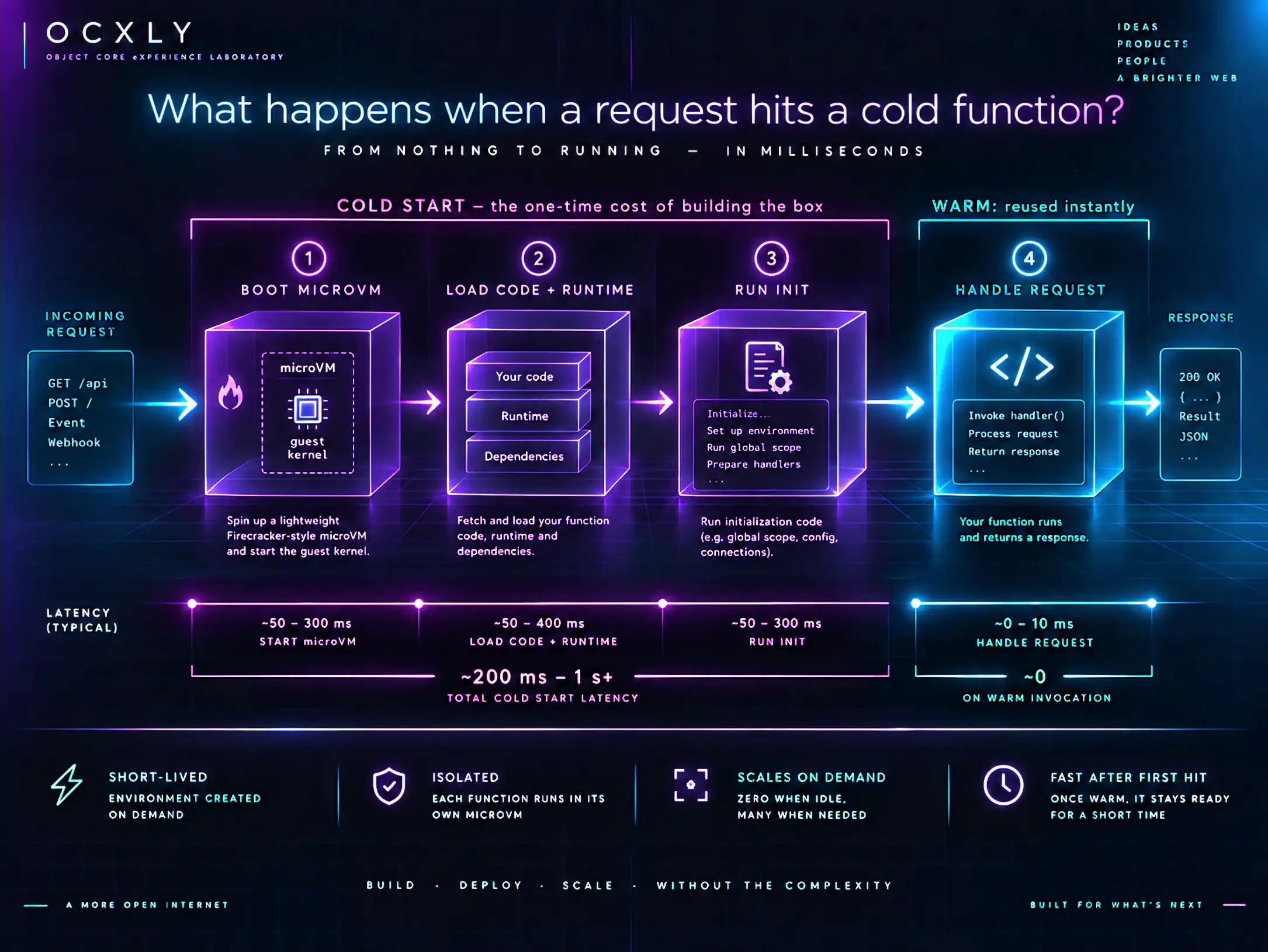
Behind the abstraction, your function still has to execute on a real machine, and the way the platform prepares that machine is the source of serverless's most famous quirk: the cold start. When a request arrives and no ready instance exists, the provider must create an isolated environment, load your code and its runtime, run any initialisation, and only then handle the request. That setup is the cold start; once warm, the same instance can serve subsequent requests immediately.
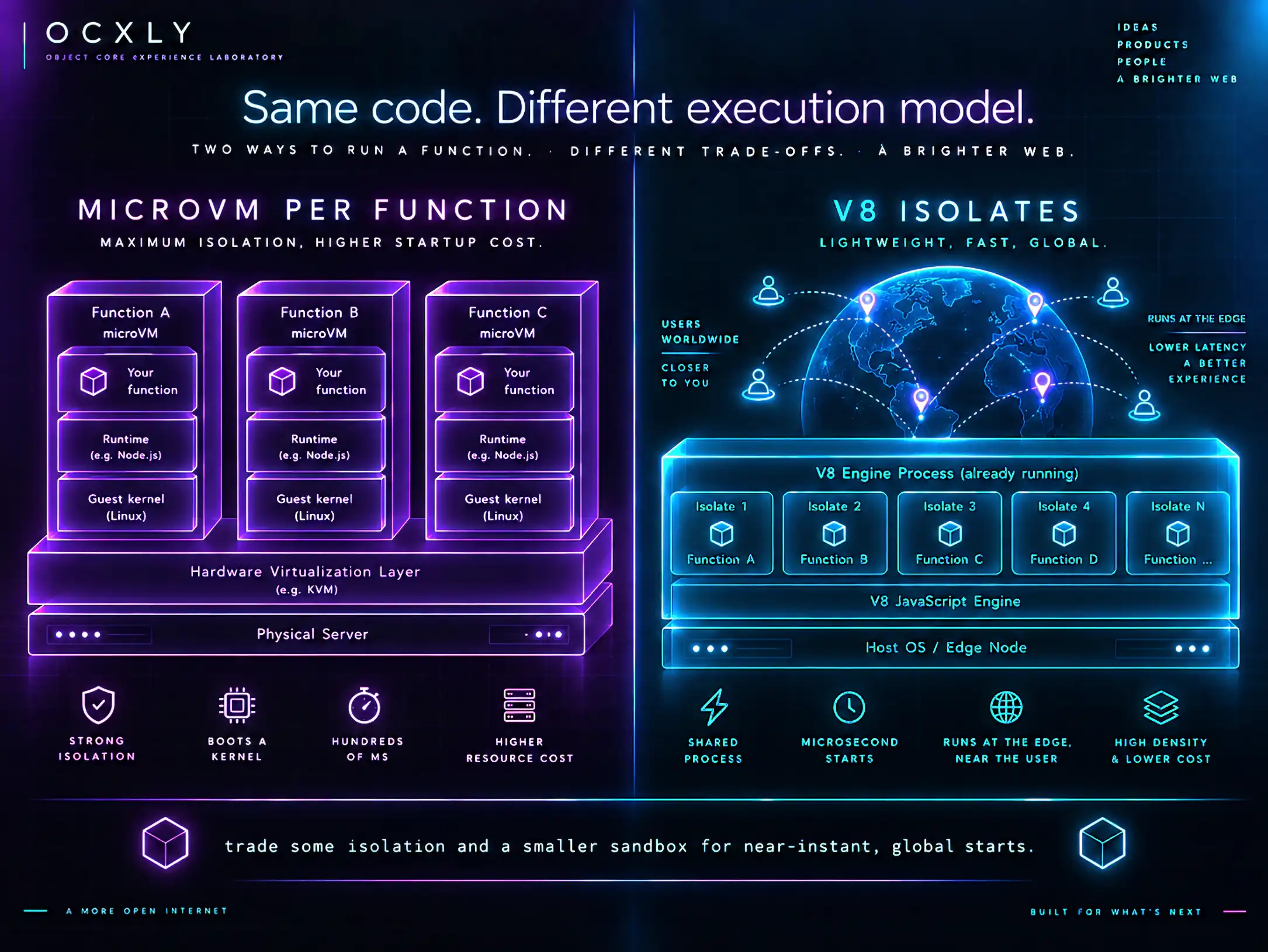
On AWS Lambda, that isolation is provided by Firecracker, a lightweight virtualisation technology that boots a minimal "microVM" with its own guest kernel, confined by hardware virtualization.3 Firecracker microVMs start in a fraction of a second and give each tenant strong VM-grade isolation — but booting a kernel and initialising a language runtime is not free, which is why container- and VM-based platforms typically see cold starts ranging from a couple hundred milliseconds to a second or more.5 For a nightly batch job this is invisible; for a user-facing API endpoint that is hit sporadically, it is a real latency tax.
Providers attack the problem from several directions. AWS offers provisioned concurrency, which keeps a pool of environments initialised and ready so latency-sensitive functions respond without the cold-start penalty — at the cost of paying to keep them warm.4 Keeping functions small, trimming dependencies, and moving heavy work out of the initialisation path all shrink the window too.
04The edge answer: isolates instead of microVMs
A different architecture sidesteps the cold-start problem almost entirely. Instead of giving each function its own microVM, edge platforms such as Cloudflare Workers run your code inside a V8 isolate — the same lightweight sandboxing mechanism a browser uses to keep tabs apart — many of which share a single, already-running process.6 There is no kernel to boot and no VM to spin up; creating a new isolate takes on the order of microseconds, so Workers effectively eliminate the cold start, with startup measured in single-digit milliseconds rather than hundreds.7
The second twist is where the code runs. Edge functions execute in data centres physically close to the user rather than in one central region, cutting the network round-trip on top of the startup win. The trade-off is a more constrained runtime — isolates share an OS process and impose tighter limits than a full microVM — and a weaker isolation boundary than per-tenant virtualization. It is a deliberate exchange: less isolation and a smaller sandbox in return for near-instant starts and global proximity. Unsurprisingly, edge is the fastest-growing corner of the serverless market.10
05The real promises: zero maintenance and (near-)infinite scale
Strip away the hype and two promises are genuinely delivered. The first is zero backend maintenance. Because the provider owns the machine, they also own OS patches, security updates, kernel upgrades, and capacity — the unglamorous operational toil that consumes so much engineering time evaporates from your plate.2 You are still responsible for your code and its dependencies, but not for the fleet it runs on.
The second is elastic scale you did not build. Auto-scaling from zero to very high concurrency is a property of the platform, not something you architect, configure, and test. That collapses time-to-launch: a small team can ship an app that survives a traffic spike on day one without ever standing up a load balancer or an auto-scaling group.2 Paired with pay-per-use, it means an idea can go live for cents and only start costing real money once real users show up — the economics that make serverless so attractive for startups, prototypes, and event-driven glue.
06The catch: where serverless bites
Serverless is a set of trade-offs, not a free lunch. The honest engineering view names the costs plainly:
- Cold-start latency. Covered above — real for sporadically-hit, user-facing endpoints on microVM platforms, and mitigable but not always free.5
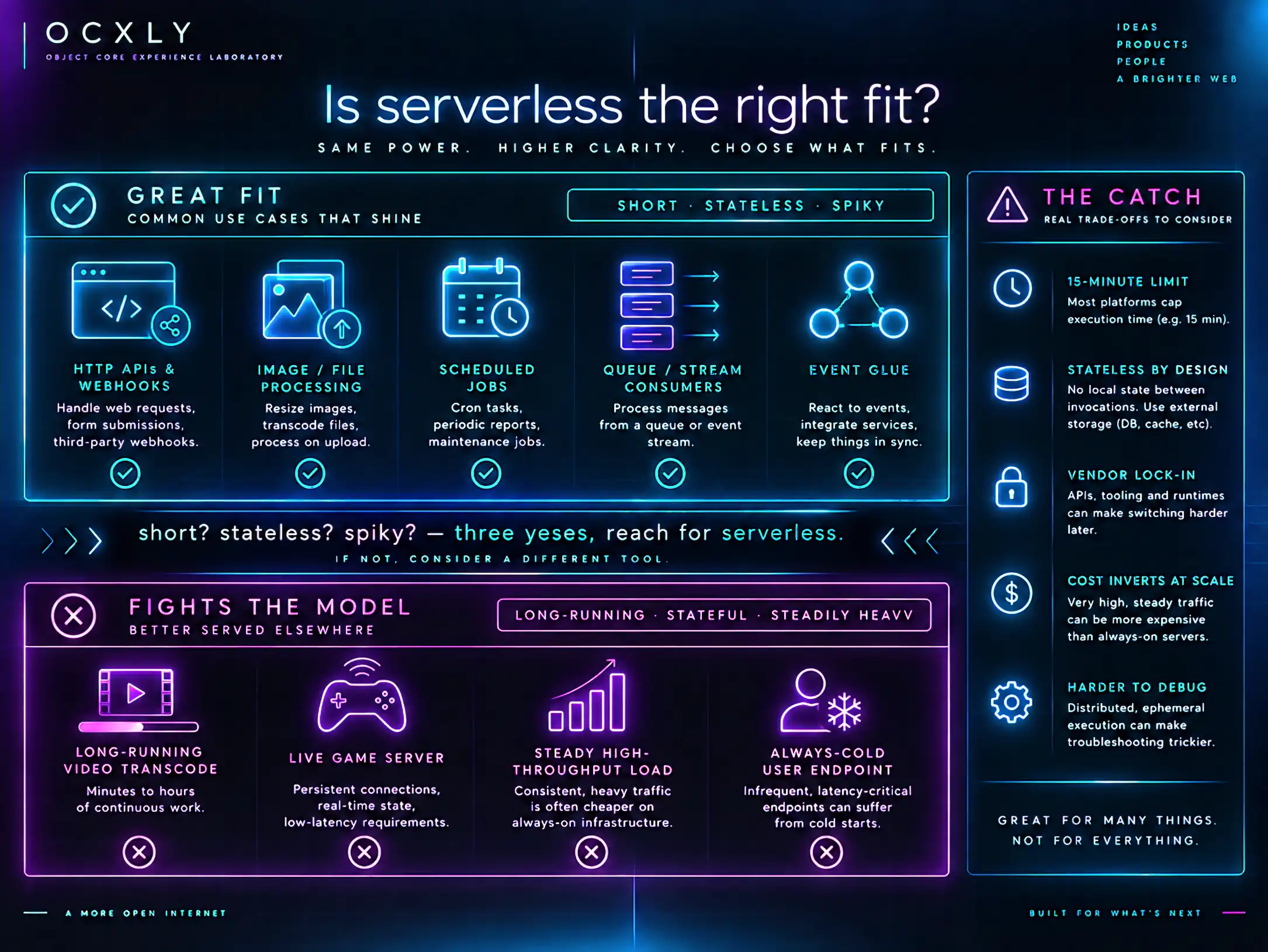
- Hard execution limits. AWS Lambda caps a single invocation at 15 minutes and gives each function a slice of temporary disk (512 MB by default, configurable up to 10 GB).8 Anything longer-running or disk-heavy has to be re-shaped into steps, queues, or a different service.
- Statelessness. Functions are ephemeral and share nothing between invocations, so any state — sessions, counters, workflow progress — must live in an external store or a managed orchestrator. Stateful sequences take deliberate design.
- Vendor lock-in. Functions tend to bind tightly to one provider's triggers, IAM model, and BaaS APIs; moving off can mean rewriting handlers, event wiring, and deployment.5 Portability frameworks help (see below), but the risk is real.
- Cost can invert at scale. Pay-per-use is a bargain at low or spiky volume and can become more expensive than a reserved server once you run a steady, high, round-the-clock load — the very case a plain server handles cheaply.5
- Harder to observe and debug. You cannot attach a debugger to a live function; reproducing issues leans on logs, traces, and redeploys across a distributed set of short-lived executions.5
On lock-in specifically, the open-source ecosystem has an answer: platforms like Knative bring the serverless model — scale-to-zero, event-driven functions — to Kubernetes, so you can run a portable serverless layer across clouds or on your own infrastructure rather than on a single vendor's proprietary runtime.11
07What serverless is great for — and what it is not
The trade-offs draw a fairly clean boundary. Serverless shines when work is event-driven, bursty, or independent: HTTP APIs and webhooks, image and file processing on upload, scheduled jobs, stream and queue consumers, chat and notification handlers, and the connective "glue" between managed services. These are short, stateless, spiky, and embarrassingly parallel — exactly the shape FaaS was built for, and where scale-to-zero and pay-per-use pay off most.
It fits poorly when work is long-running, stateful, latency-critical at all times, or steadily heavy: a video transcode that runs for an hour, a low-latency game server holding live connections, a workload pinned at high constant throughput where a reserved machine is simply cheaper, or an app whose every request is user-facing and cannot tolerate an occasional cold start. None of these are impossible on serverless, but you end up fighting the model — bolting on orchestrators, warm pools, and workarounds — rather than riding it.
08The 2026 state of play
Serverless in 2026 is mainstream infrastructure, not an experiment. The market sits around $33 billion and is projected to compound at roughly 20% annually through the mid-2030s, with FaaS the dominant slice.9 Two shifts define the current moment. First, the edge — isolate-based, globally distributed functions with negligible cold starts — is the fastest-growing deployment model, pulling latency-sensitive work closer to users.10 Second, portability is maturing: open frameworks like Knative and OpenFaaS let teams adopt the serverless model without betting the whole architecture on one vendor's runtime, taking the sharpest edge off the lock-in objection.11
09Where OcxlyDev lands
Serverless is not the end of servers, and it is not the right answer for every workload — the "infinitely scalable, zero maintenance" headline is true only inside the boundary the trade-offs draw. But inside that boundary it is transformative: it lets a small team ship a fast, resilient app that scales itself and costs nothing at idle, without ever provisioning a machine. For event-driven APIs, background jobs, and the glue between managed services, it is very often the correct default in 2026.
Our take: reach for serverless first for anything short, stateless, and spiky; keep a container or a reserved server for the long-running, stateful, or steadily-heavy jobs; and if lock-in worries you, build on a portable layer like Knative from the start. Match the tool to the shape of the work, and "serverless" stops being a buzzword and becomes what it actually is — a way to delete a whole category of operational toil.