Vector databases explained: the hidden infrastructure behind modern LLMs
A language model's built-in knowledge is frozen at training time and impossible to cite. The fix that powers almost every serious LLM app — chatbots over your docs, copilots, search — is a specialized database that stores meaning as coordinates and finds the nearest ones in milliseconds.
Ask a large language model about your company's internal handbook and it will either admit it does not know or, worse, invent a confident answer. Its knowledge is parametric — baked into billions of weights at training time — so it is frozen at a cutoff date, cannot cite a source, and has never seen your private data. The dominant fix is Retrieval-Augmented Generation (RAG): before the model answers, fetch the most relevant passages from an external knowledge store and hand them to the model as context.1 But that raises a hard question — how do you search a pile of documents by meaning rather than exact keywords, fast enough to sit in front of every query? The answer is the vector database, the quiet piece of infrastructure underneath the current generation of AI applications.
01The problem: a keyword search can't find meaning
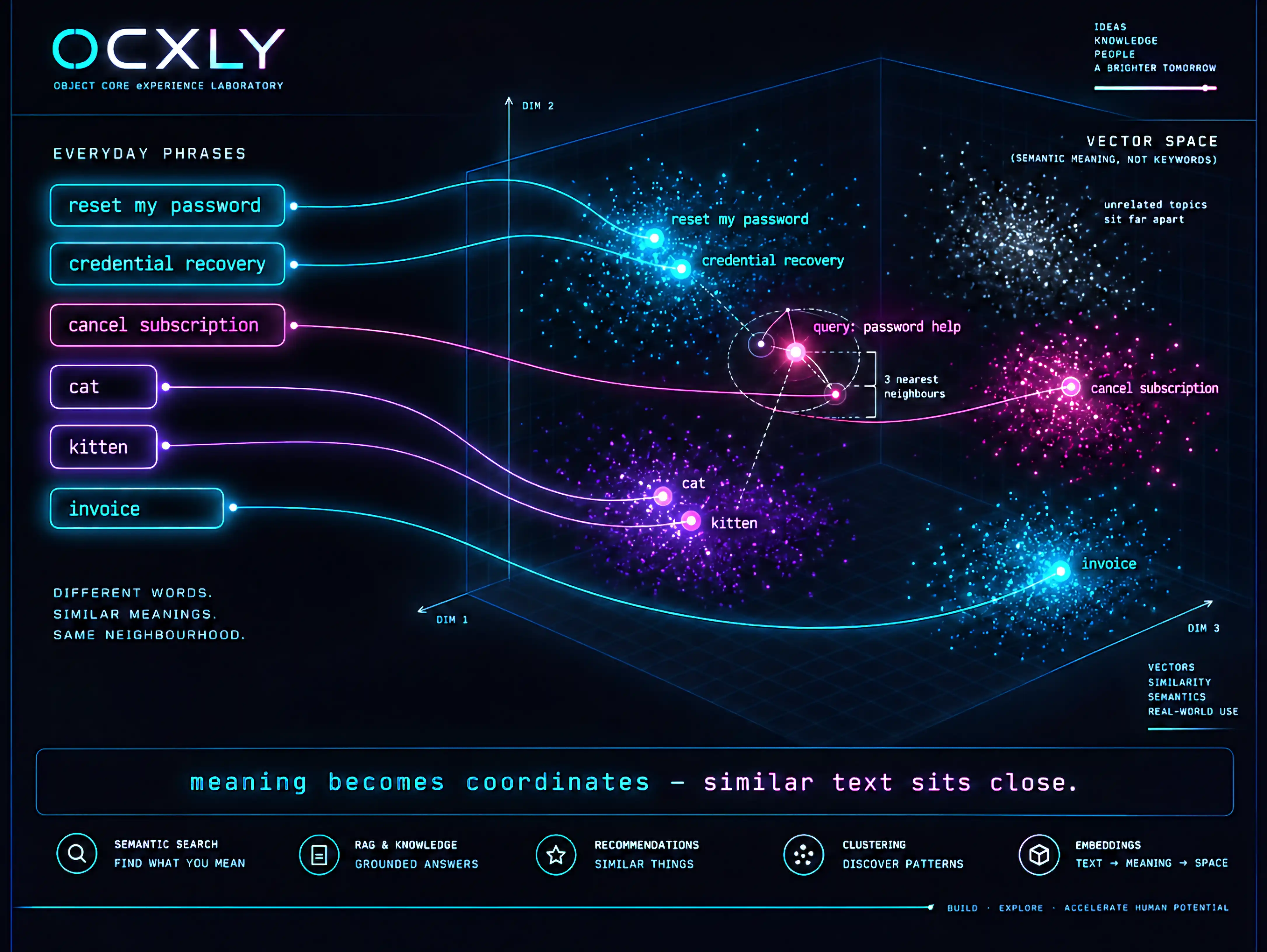
Traditional databases are built for exact matches and ranges: find the row where id = 42, or every order after a date. Full-text search goes a step further and matches words, but it is still fundamentally lexical — search for "car" and it will not return a document that only says "automobile," because the letters differ. For an LLM assistant that needs to pull the relevant passage regardless of exact wording, lexical matching is not enough. You need to retrieve by semantic similarity: "how do I reset my password" should find a paragraph titled "credential recovery," even with no words in common.
That requires a way to represent meaning that a computer can compare mathematically. That representation is the embedding, and everything else in a vector database is built to store and search embeddings at scale.
02Embeddings: turning meaning into coordinates
An embedding is a list of numbers — a vector — that a neural network assigns to a piece of content so that its position encodes its meaning. The idea traces to word-embedding models like word2vec, which showed that training a network to predict words from context produces vectors with startling geometric structure: related words cluster, and directions carry meaning.2 Modern sentence embeddings extend this to whole passages, so that semantically similar sentences map to nearby vectors — the technique introduced by Sentence-BERT and now standard in every embedding model.3
These vectors are high-dimensional — typically hundreds to a couple thousand numbers each (a common OpenAI embedding is 1,536 dimensions). You cannot picture 1,536-dimensional space, but the intuition from three dimensions holds: each document is a point, and "similar meaning" becomes "short distance." The embedding model is the translator that turns messy human language into these coordinates; the vector database is what stores millions of them and answers "which points are closest to this one?"
An embedding is a coordinate for meaning. Once text is a point in space, "find something similar" becomes "find the nearest points" — a geometry problem, not a spelling problem.
![How an embedding is made: a passage of natural-language text feeds into an embedding model (a small neural network), which outputs a high-dimensional vector — a row of numbers like [0.12, -0.94, 0.37, …] with 1,536 dimensions. In vector space each text becomes a point; 'reset my password' and 'how to recover my account password' land as nearby points (similar meaning), while 'cancel subscription' sits far away. The model translates language into a point in space.](/assets/images/blog/vector-databases-explained-01-embeddings.webp)
03Similarity is just distance
With text reduced to vectors, comparing meaning becomes measuring geometric closeness. The most common measure is cosine similarity: the cosine of the angle between two vectors, which is large when they point in the same direction regardless of length. To answer a query, you embed the query with the same model, then look for the stored vectors with the highest cosine similarity to it — the semantic nearest neighbors.4
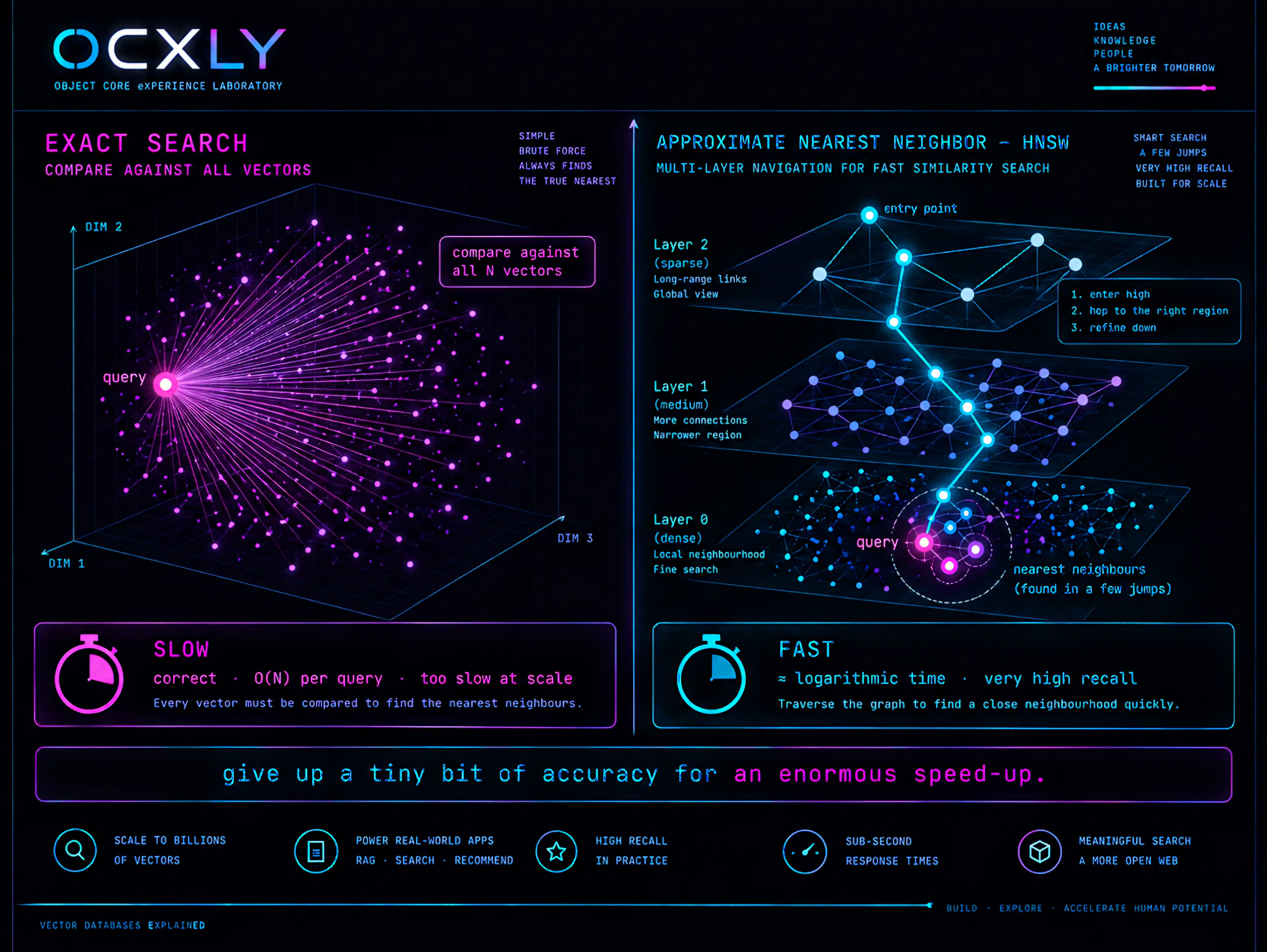
Done naively, this is simple but brutal: to find the closest vectors you compare the query against every stored vector, an exhaustive scan. With a few thousand items that is fine. With tens of millions of high-dimensional vectors — the scale of a real document corpus — computing an exact nearest neighbor for every query is far too slow to sit in a live request path. This is the wall that a plain database, even one with a vector column, hits first.
04Why exact search doesn't scale — and the ANN trick
Exhaustive ("brute-force") nearest-neighbor search costs time proportional to the number of vectors times their dimensionality, for every single query. High-dimensional geometry also works against you: as dimensions grow, distances between points become less distinctive and the clever indexing tricks that make one-dimensional databases fast stop helping — the so-called curse of dimensionality. The practical consequence is that exact similarity search does not scale to production corpora.
The breakthrough that makes vector search practical is to give up a little accuracy for an enormous speed-up: approximate nearest neighbor (ANN) search. Instead of guaranteeing the single closest vector, ANN returns vectors that are almost certainly among the closest, by searching only a smart subset of the space. In practice the recall is very high and the speed-up is orders of magnitude — the trade every vector database makes.5
05The engine room: HNSW and the index
The most widely used ANN index is HNSW — Hierarchical Navigable Small World graphs, introduced by Malkov and Yashunin.5 The intuition is a multi-layer map. The top layer is a sparse graph of a few "landmark" vectors with long-range links; each layer below is denser, with shorter links. A search enters at the top, greedily hops toward the query through the sparse long-range links to get into the right neighborhood fast, then drops down layer by layer to refine — much like zooming from a country map to a street map. This gives roughly logarithmic search time instead of linear, which is why HNSW is the default in-memory index in FAISS, hnswlib, Qdrant, Weaviate, and pgvector.5
An older family, IVF (inverted file) indexes, take a different route: cluster the vectors into buckets in advance, then at query time only search the few buckets nearest the query. Both approaches — and quantization schemes that compress vectors to save memory — are the kind of specialized machinery a general-purpose database simply does not have. FAISS, Meta's open-source similarity-search library, popularized many of these index types and remains a common engine underneath higher-level databases.6
06How it all fits together: RAG end to end
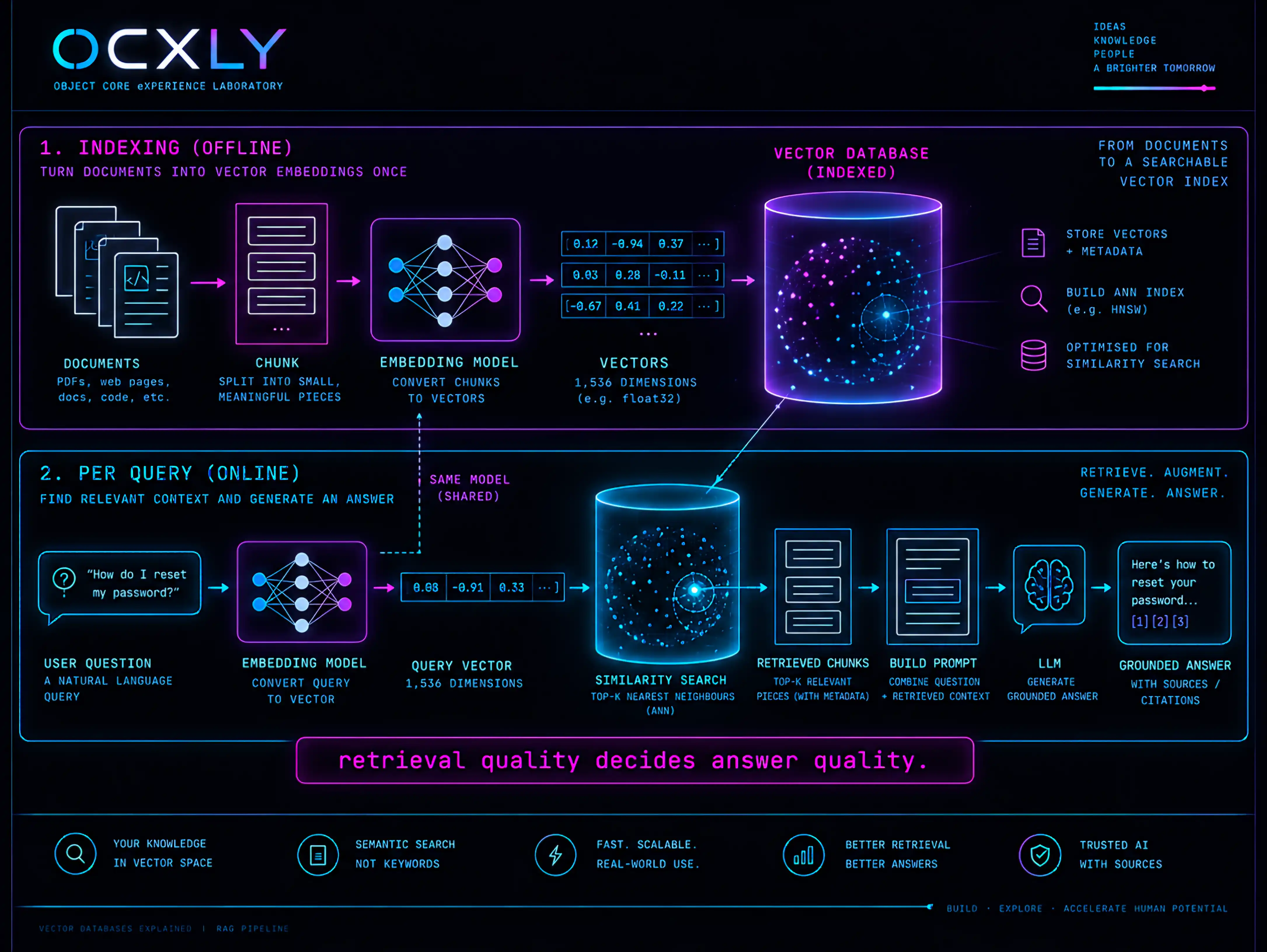
Retrieval-Augmented Generation, introduced by Lewis and colleagues at NeurIPS 2020, is the pattern that ties embeddings, the index, and the LLM into one pipeline.1 The original paper paired a sequence-to-sequence generator with a retriever over a FAISS index of 21 million Wikipedia passages — the template nearly every document-grounded assistant still follows.1 In production it runs in two phases:
- Indexing (offline). Split your documents into chunks, run each chunk through an embedding model, and store the resulting vectors — plus the original text and metadata — in the vector database, which builds its ANN index over them.
- Retrieval + generation (per query). Embed the user's question with the same model, ask the vector database for the top-k most similar chunks (an ANN search), and paste those chunks into the LLM's prompt as context. The model then answers grounded in the retrieved text — and can cite it.
This is why the vector database is "hidden infrastructure": the user sees a chatbot, but the quality of its answers is largely decided by whether the retrieval step surfaced the right passages. Good retrieval turns a plausible-sounding guesser into a grounded, citeable assistant; bad retrieval is the root of a large share of RAG failures and hallucinations.
07What a vector database adds beyond the index
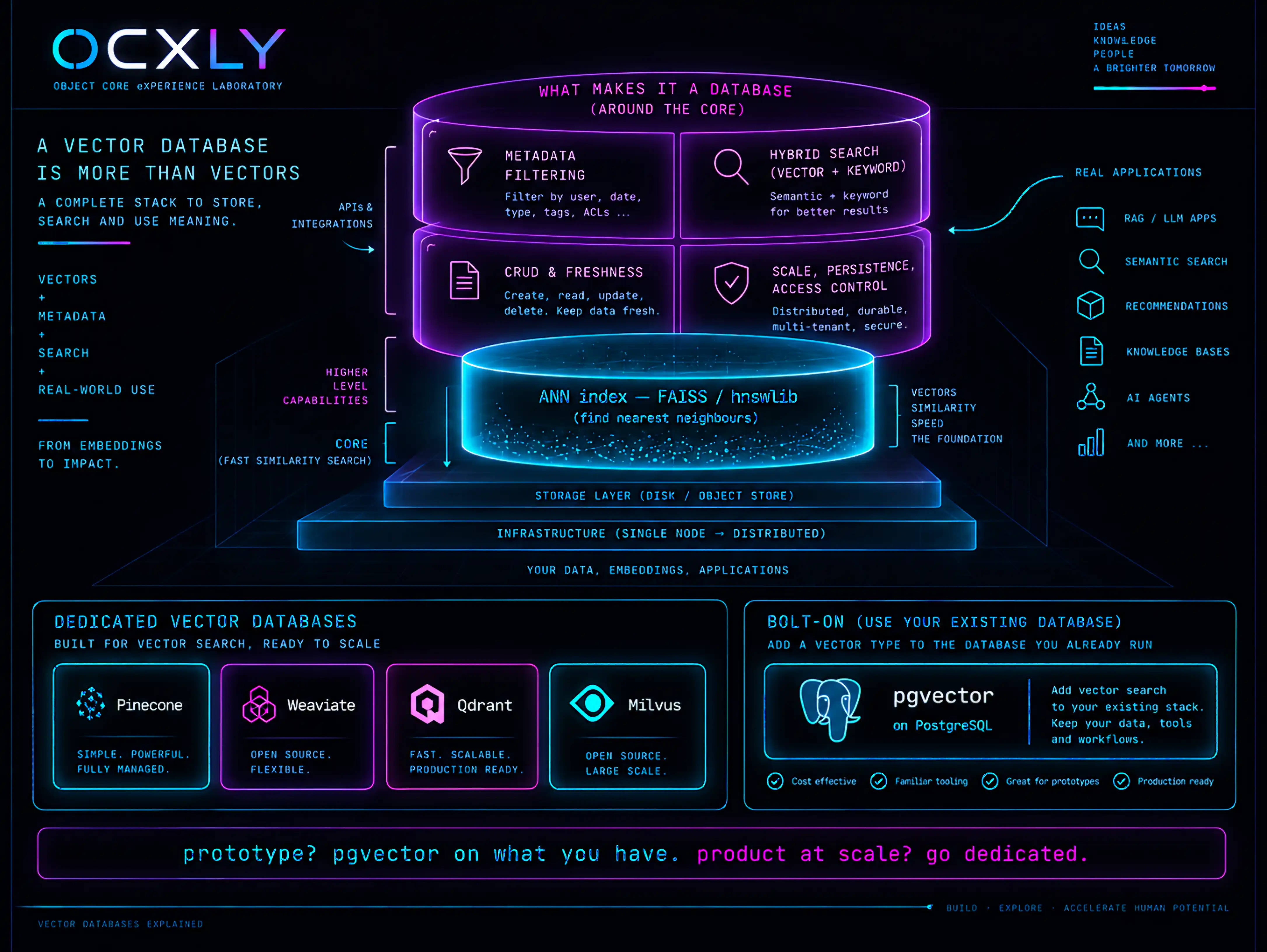
An ANN library finds nearest neighbors; a vector database wraps that in the things production systems actually need:
- Metadata filtering. "Find the most similar chunks, but only from documents this user is allowed to see, in English, updated this year." Combining a similarity search with structured filters is a first-class feature, not an afterthought.
- Hybrid search. Blending semantic (vector) similarity with classic keyword scoring, so exact terms like product codes or names still rank when pure semantics would miss them.
- CRUD and freshness. Inserting, updating, and deleting vectors as your documents change, without rebuilding the whole index — so the assistant's knowledge stays current.
- Scale and operations. Sharding across machines, replication, persistence, and access control for billions of vectors — the unglamorous database work that turns an algorithm into a service.
08The landscape: dedicated vs bolt-on
By 2026 the options cluster into two camps. Dedicated vector databases — Pinecone, Weaviate, Qdrant, Milvus — are built from the ground up for similarity search, with the filtering, hybrid, and scaling features above as core concerns. Bolt-on options add vector search to a database you already run: pgvector brings HNSW and IVF indexes to PostgreSQL, and most major databases and search engines have added a vector type.7 The bolt-on route keeps your data in one system and is often enough for moderate scale; the dedicated route tends to win on very large corpora, latency, and vector-specific features.
The common thread is that they all solve the same core problem — store embeddings, build an ANN index, and answer nearest-neighbor queries with filters — and they all exist because the naive alternative, exact search in a general-purpose database, falls over at the scale LLM applications demand.
09Where OcxlyDev lands
The vector database is easy to overlook because it is never the part of the product a user sees. But it is the component that decides whether an LLM app is grounded and trustworthy or a confident fabricator. Embeddings turn meaning into geometry; ANN indexes like HNSW make searching that geometry fast enough to sit in a live request; RAG stitches the retrieved context into the model's prompt. Remove the vector database and the whole retrieval story collapses back to a frozen, un-citeable model.
Our take: treat retrieval as a first-class part of any LLM feature, not a bolt-on. Start simple — pgvector on the database you already run will carry a surprising amount of load — and move to a dedicated vector database when scale, latency, or filtering demand it. And remember that retrieval quality, not model size, is often the highest-leverage knob: the best embedding model and a well-tuned index do more for answer quality than a bigger LLM sitting on top of bad context.