Beyond the chatbot: bounded tasks your local LLM can actually handle
A local model is easy to judge unfairly. Give it a wide-open reasoning problem and compare it with the best cloud model, and the local one will usually lose. Give it a small, well-defined job with a clear answer, and the picture changes quite a bit.
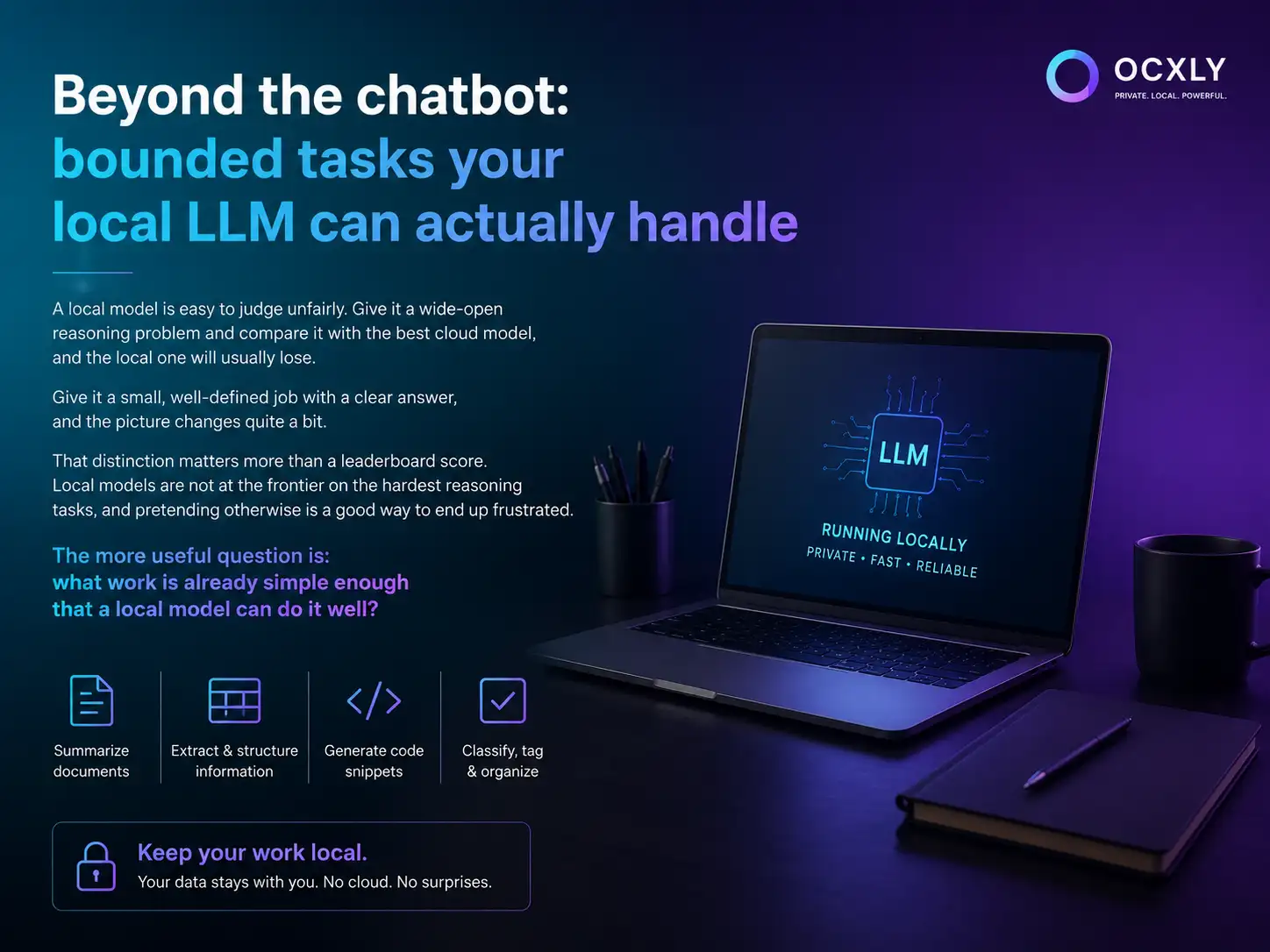
That distinction matters more than a leaderboard score. Local models are not at the frontier on the hardest reasoning tasks, and pretending otherwise is a good way to end up frustrated. The more useful question is: what work is already simple enough that a local model can do it well?
01The capability gap, stated honestly
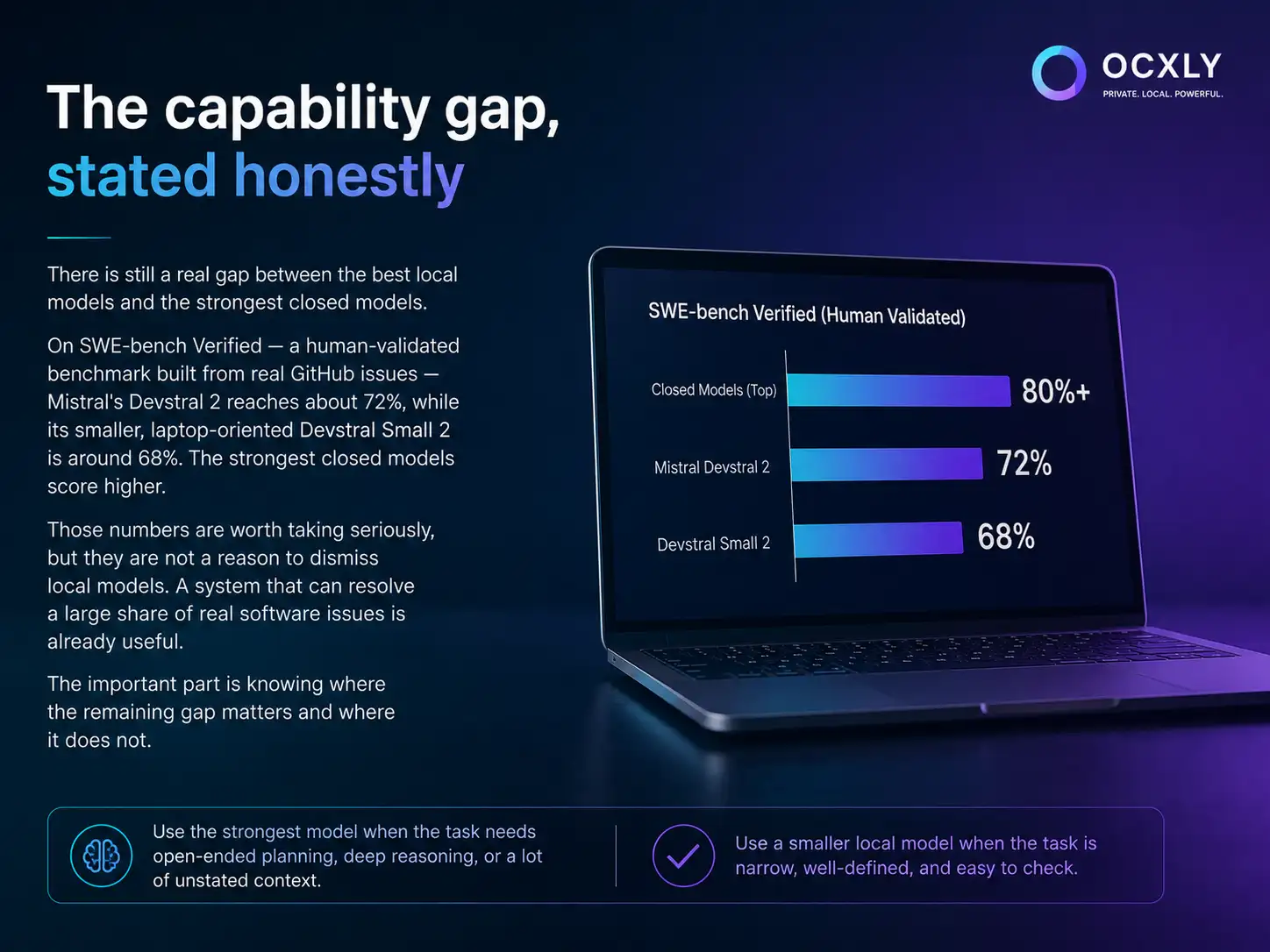
There is still a real gap between the best local models and the strongest closed models. On SWE-bench Verified — a human-validated benchmark built from real GitHub issues — Mistral's Devstral 2 reaches about 72%, while its smaller, laptop-oriented Devstral Small 2 is around 68%.12 The strongest closed models score higher.3
Those numbers are worth taking seriously, but they are not a reason to dismiss local models. A system that can resolve a large share of real software issues is already useful. The important part is knowing where the remaining gap matters and where it does not.
If the task needs open-ended planning, deep reasoning, or a lot of unstated context, use the stronger model. If the task is narrow and easy to check, a smaller local model may be all you need.
02Where local models work well
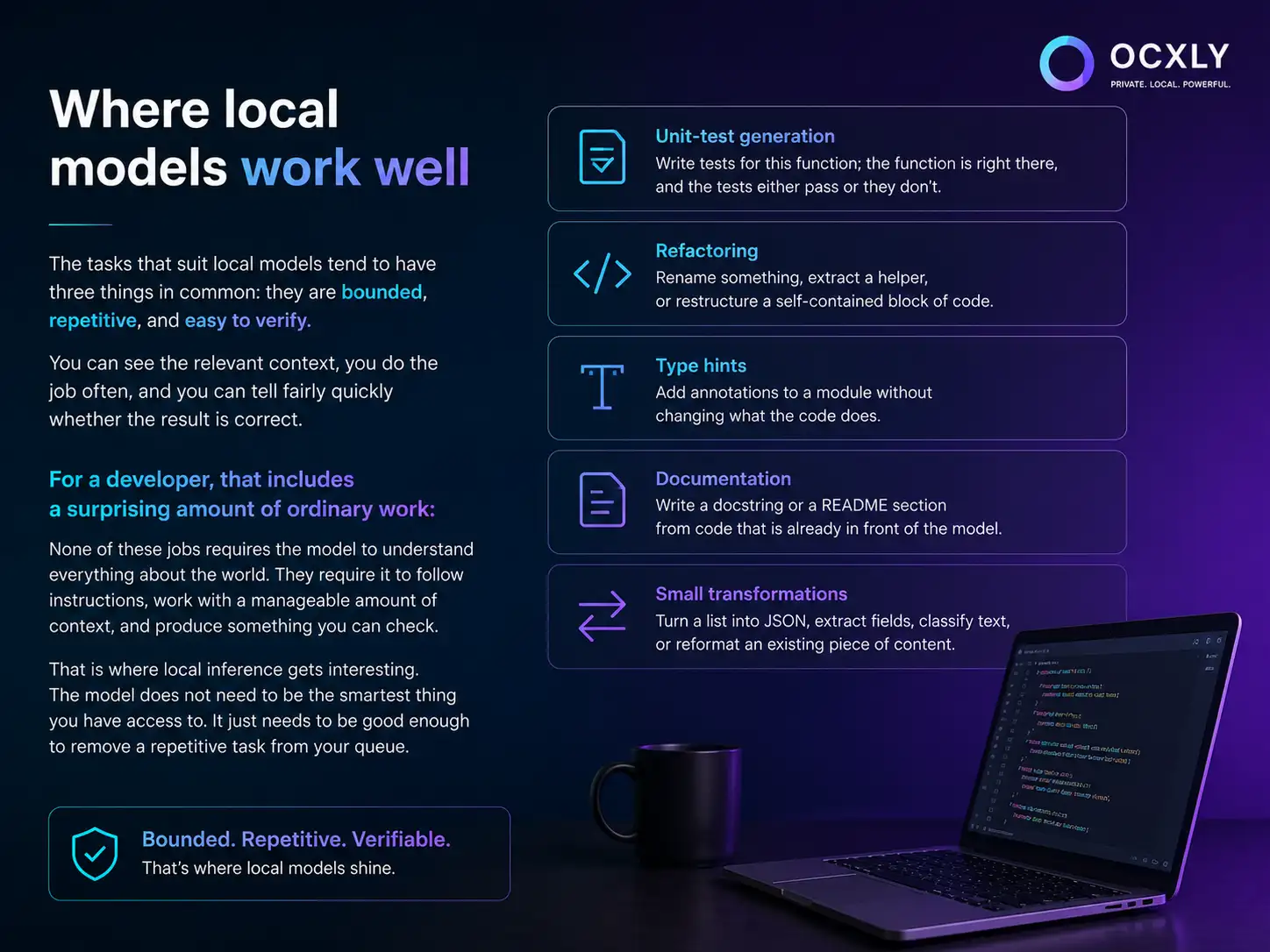
The tasks that suit local models tend to have three things in common: they are bounded, repetitive, and easy to verify. You can see the relevant context, you do the job often, and you can tell fairly quickly whether the result is correct.
For a developer, that includes a surprising amount of ordinary work:
- Unit-test generation — write tests for this function; the function is right there, and the tests either pass or they don't.
- Refactoring — rename something, extract a helper, or restructure a self-contained block of code.
- Type hints — add annotations to a module without changing what the code does.
- Documentation — write a docstring or a README section from code that is already in front of the model.
- Small transformations — turn a list into JSON, extract fields, classify text, or reformat an existing piece of content.
None of these jobs requires the model to understand everything about the world. They require it to follow instructions, work with a manageable amount of context, and produce something you can check.
That is where local inference gets interesting. The model does not need to be the smartest thing you have access to. It just needs to be good enough to remove a repetitive task from your queue.
03Agentic coding in your IDE, offline
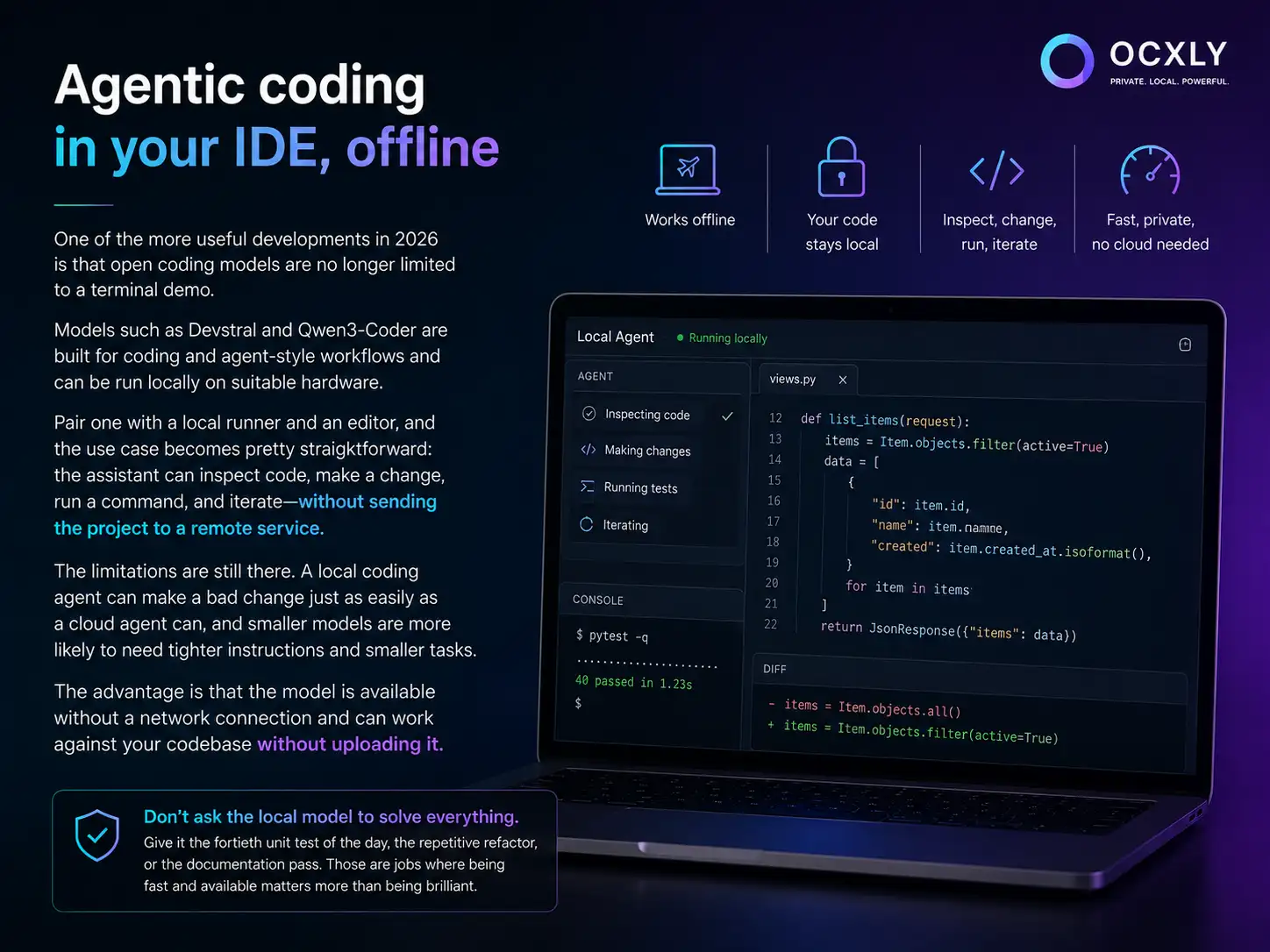
One of the more useful developments in 2026 is that open coding models are no longer limited to a terminal demo. Models such as Devstral and Qwen3-Coder are built for coding and agent-style workflows and can be run locally on suitable hardware.14
Pair one with a local runner and an editor, and the use case becomes pretty straightforward: the assistant can inspect code, make a change, run a command, and iterate without sending the project to a remote service. That is useful on a plane, on a disconnected machine, or simply when the code should stay on the computer.
The limitations are still there. A local coding agent can make a bad change just as easily as a cloud agent can, and smaller models are more likely to need tighter instructions and smaller tasks. The advantage is that the model is available without a network connection and can work against your codebase without uploading it.
Don't ask the local model to solve everything. Give it the fortieth unit test of the day, the repetitive refactor, or the documentation pass. Those are jobs where being fast and available matters more than being brilliant.
04The useful pattern: route by difficulty
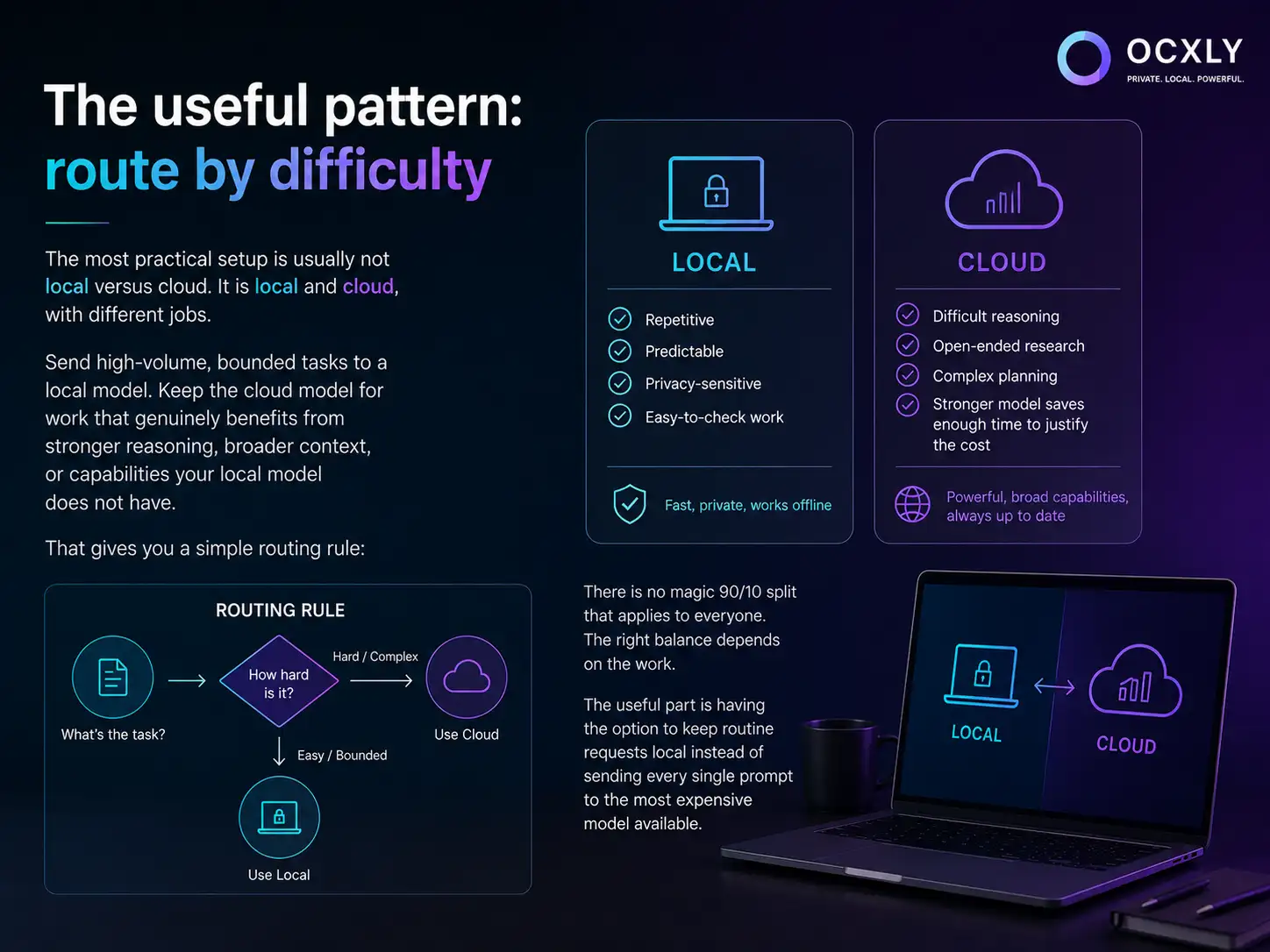
The most practical setup is usually not local versus cloud. It is local and cloud, with different jobs.
Send high-volume, bounded tasks to a local model. Keep the cloud model for work that genuinely benefits from stronger reasoning, broader context, or capabilities your local model does not have.
That gives you a simple routing rule:
- Local: repetitive, predictable, privacy-sensitive, or easy-to-check work.
- Cloud: difficult reasoning, open-ended research, complex planning, or tasks where the stronger model saves enough time to justify the cost.
There is no magic 90/10 split that applies to everyone. The right balance depends on the work. The useful part is having the option to keep routine requests local instead of sending every single prompt to the most expensive model available.
05Where OcxlyDev lands
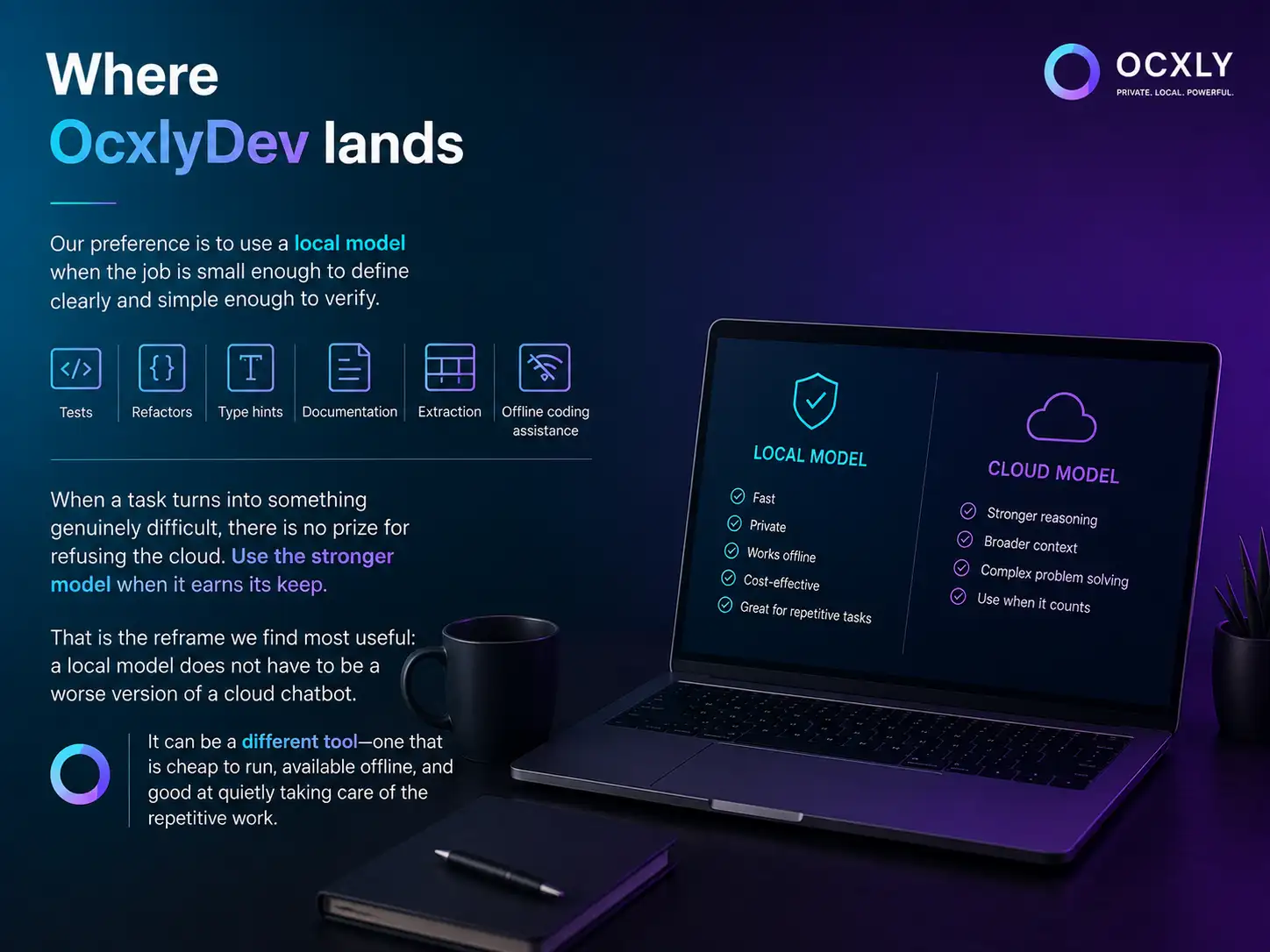
Our preference is to use a local model when the job is small enough to define clearly and simple enough to verify. Tests, refactors, type hints, documentation, extraction, and offline coding assistance are good examples.
When a task turns into something genuinely difficult, there is no prize for refusing the cloud. Use the stronger model when it earns its keep.
That is the reframe we find most useful: a local model does not have to be a worse version of a cloud chatbot. It can be a different tool — one that is cheap to run, available offline, and good at quietly taking care of the repetitive work.