Small is the new big: the rise of high-performance sub-10B models
For a long time, the easy way to compare language models was to look at the parameter count. Bigger usually meant more capable, so the number of billions became a kind of shorthand for intelligence.
That shortcut is getting less useful. In 2026, several models below 10 billion parameters are good enough to be genuinely useful on ordinary hardware. They are not replacements for the biggest frontier models, and they do not need to be. The interesting part is that a model you can run locally can now handle a surprising amount of everyday work without sending every request to a remote server.
01The sub-10B class is now genuinely useful
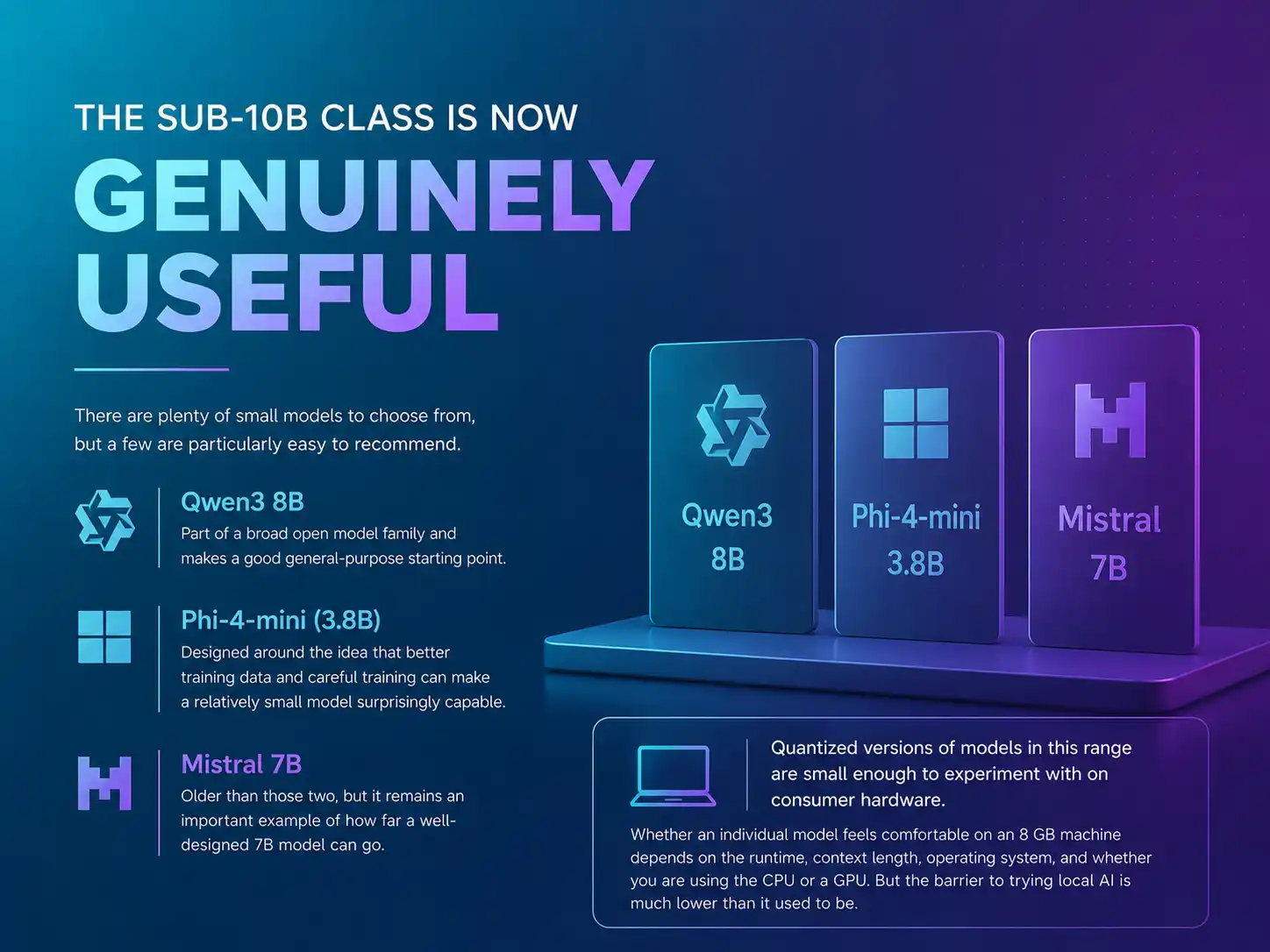
There are plenty of small models to choose from, but a few are particularly easy to recommend. Qwen3 8B is part of a broad open model family and makes a good general-purpose starting point.1 Microsoft's Phi-4-mini has 3.8 billion parameters and was designed around the idea that better training data and careful training can make a relatively small model surprisingly capable.2 Mistral 7B is older than those two, but it remains an important example of how far a well-designed 7B model can go.3
The practical advantage is obvious: quantized versions of models in this range are small enough to experiment with on consumer hardware. Whether an individual model feels comfortable on an 8 GB machine depends on the runtime, context length, operating system, and whether you are using the CPU or a GPU. But the barrier to trying local AI is much lower than it used to be.
02Mixture of Experts changes the equation
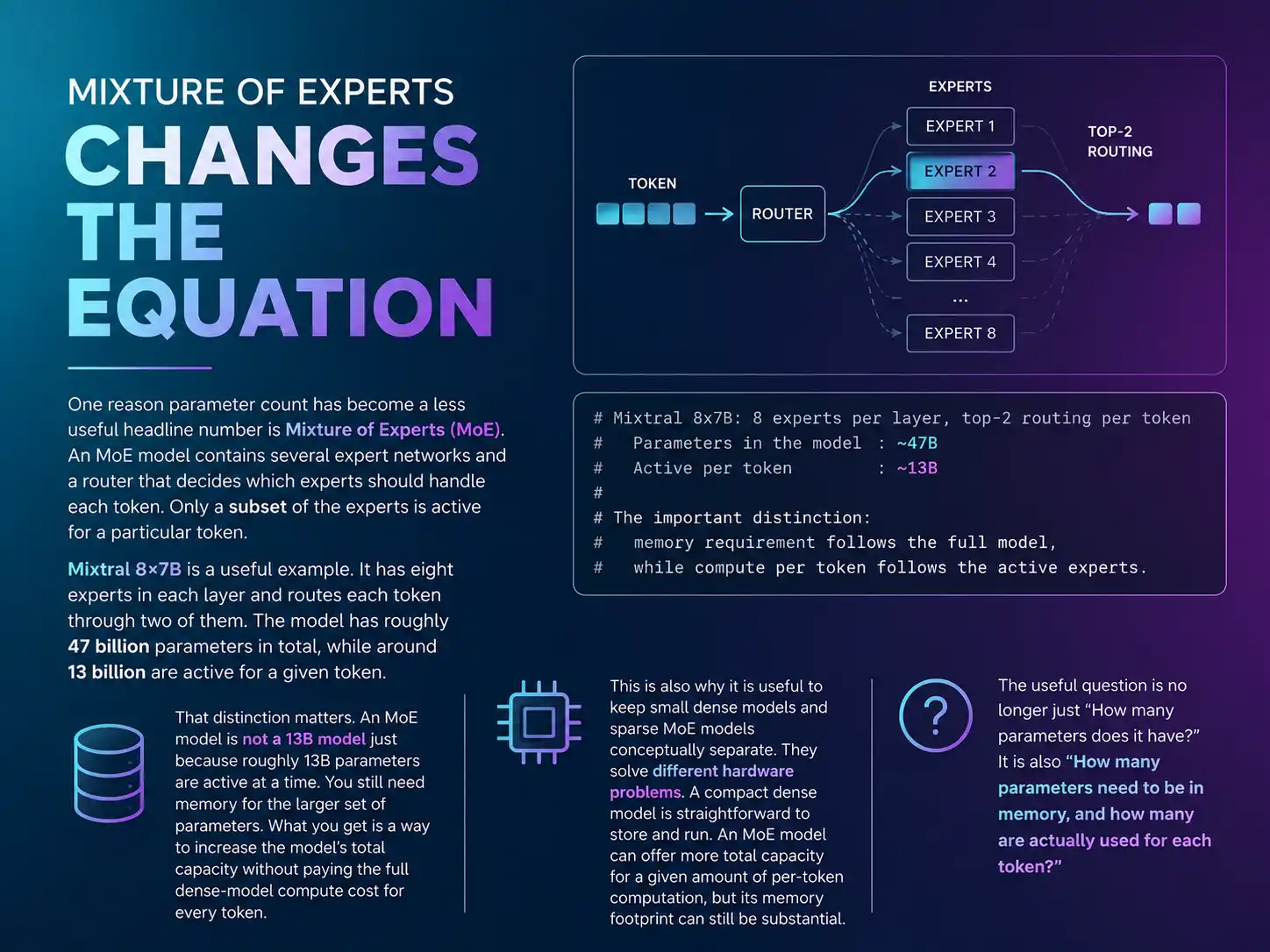
One reason parameter count has become a less useful headline number is Mixture of Experts (MoE). An MoE model contains several expert networks and a router that decides which experts should handle each token. Only a subset of the experts is active for a particular token.4
Mixtral 8×7B is a useful example. It has eight experts in each layer and routes each token through two of them. The model has roughly 47 billion parameters in total, while around 13 billion are active for a given token.45
# Mixtral 8x7B: 8 experts per layer, top-2 routing per token
#   Parameters in the model : ~47B
#   Active per token         : ~13B
#
# The important distinction:
#   memory requirement follows the full model,
#   while compute per token follows the active experts.
That distinction matters. An MoE model is not a 13B model just because roughly 13B parameters are active at a time. You still need memory for the larger set of parameters. What you get is a way to increase the model's total capacity without paying the full dense-model compute cost for every token.
This is also why it is useful to keep small dense models and sparse MoE models conceptually separate. They solve different hardware problems. A compact dense model is straightforward to store and run. An MoE model can offer more total capacity for a given amount of per-token computation, but its memory footprint can still be substantial.16
The useful question is no longer just “How many parameters does it have?” It is also “How many parameters need to be in memory, and how many are actually used for each token?”
03What a small model is actually good for
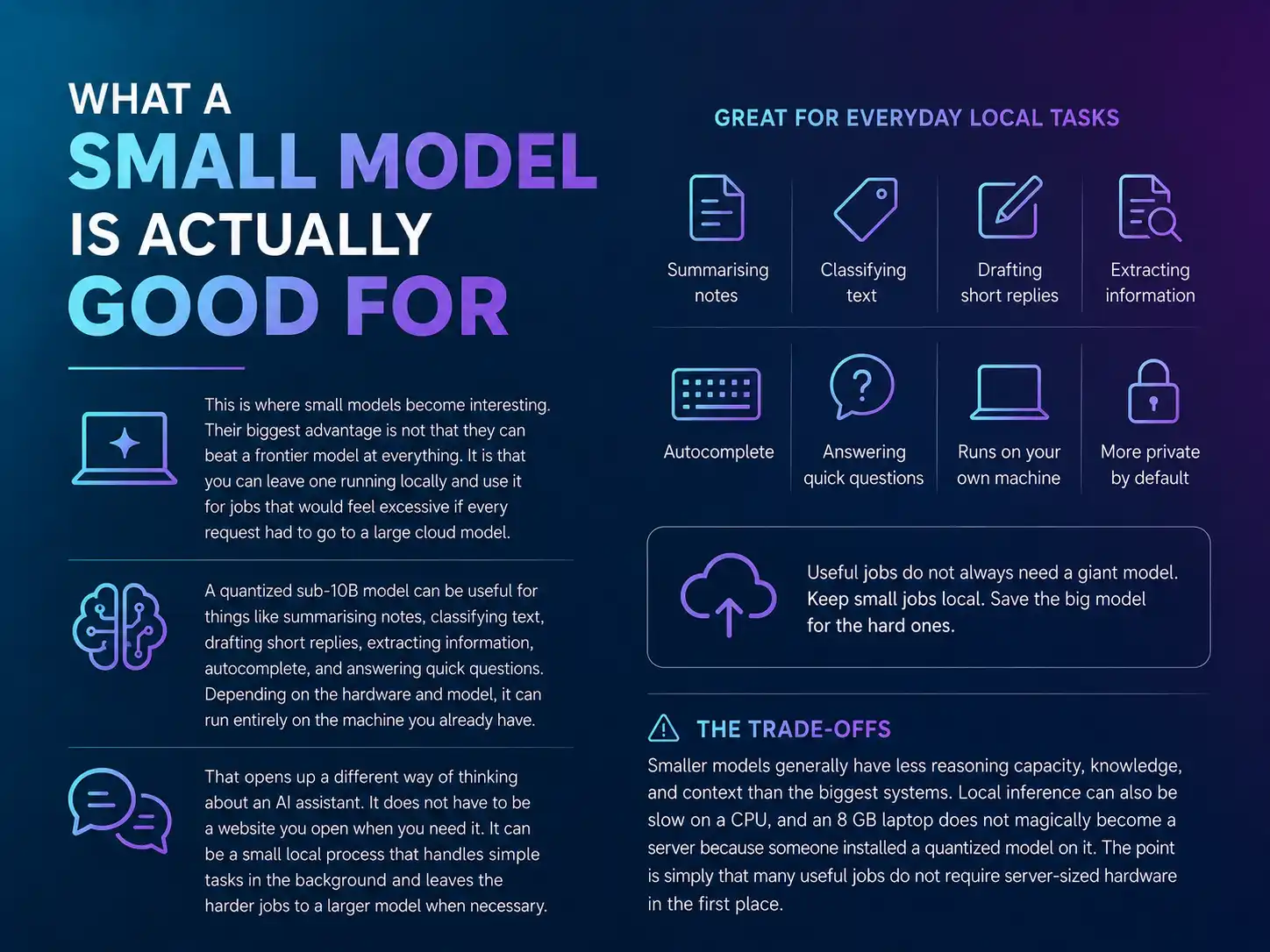
This is where small models become interesting. Their biggest advantage is not that they can beat a frontier model at everything. It is that you can leave one running locally and use it for jobs that would feel excessive if every request had to go to a large cloud model.
A quantized sub-10B model can be useful for things like summarising notes, classifying text, drafting short replies, extracting information, autocomplete, and answering quick questions. Depending on the hardware and model, it can run entirely on the machine you already have.
That opens up a different way of thinking about an AI assistant. It does not have to be a website you open when you need it. It can be a small local process that handles simple tasks in the background and leaves the harder jobs to a larger model when necessary.
There are trade-offs, of course. Smaller models generally have less reasoning capacity, knowledge, and context than the biggest systems. Local inference can also be slow on a CPU, and an 8 GB laptop does not magically become a server because someone installed a quantized model on it. The point is simply that many useful jobs do not require server-sized hardware in the first place.
04Choosing one
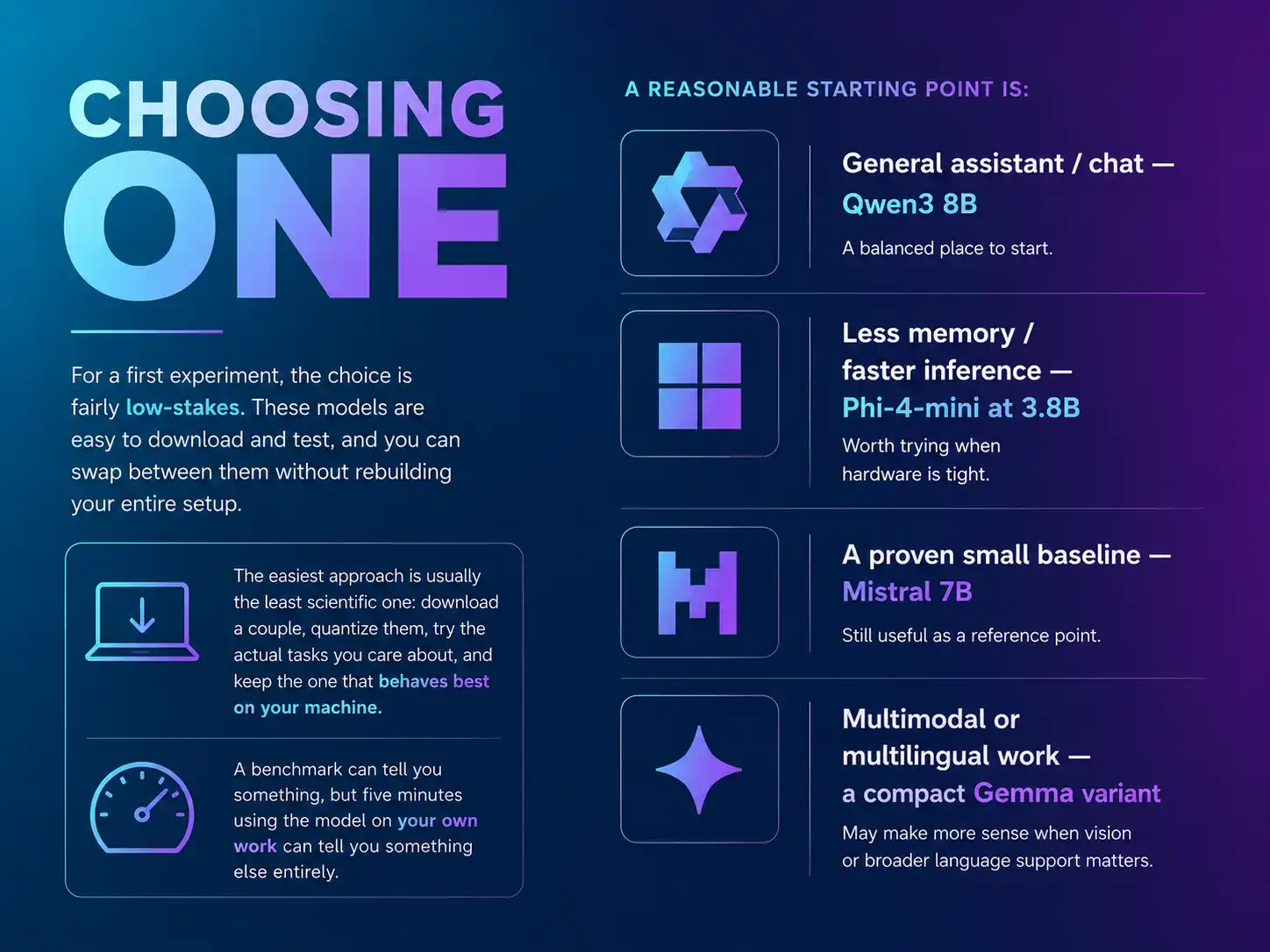
For a first experiment, the choice is fairly low-stakes. These models are easy to download and test, and you can swap between them without rebuilding your entire setup.
A reasonable starting point is:
- General assistant / chat — Qwen3 8B: a balanced place to start.1
- Less memory / faster inference — Phi-4-mini at 3.8B: worth trying when hardware is tight.2
- A proven small baseline — Mistral 7B: still useful as a reference point.3
- Multimodal or multilingual work — a compact Gemma variant may make more sense when vision or broader language support matters.6
The easiest approach is usually the least scientific one: download a couple, quantize them, try the actual tasks you care about, and keep the one that behaves best on your machine. A benchmark can tell you something, but five minutes using the model on your own work can tell you something else entirely.
05Where OcxlyDev lands
Our preference is pretty simple: use the smallest model that does the job well enough.
That does not mean refusing to use larger models. If a task needs a larger model, use one. But a lot of everyday AI work is less demanding than the demos make it look. A small local model can be fast enough, private by default, cheap to run, and available even when there is no network connection.
That is the part of the small-model story we find most interesting. The goal is not to squeeze a frontier model into a laptop just to prove that it can be done. The goal is to find useful jobs where a small model is already enough.
For those jobs, small is not a compromise. It can simply be the more practical choice.